
Trader’s League
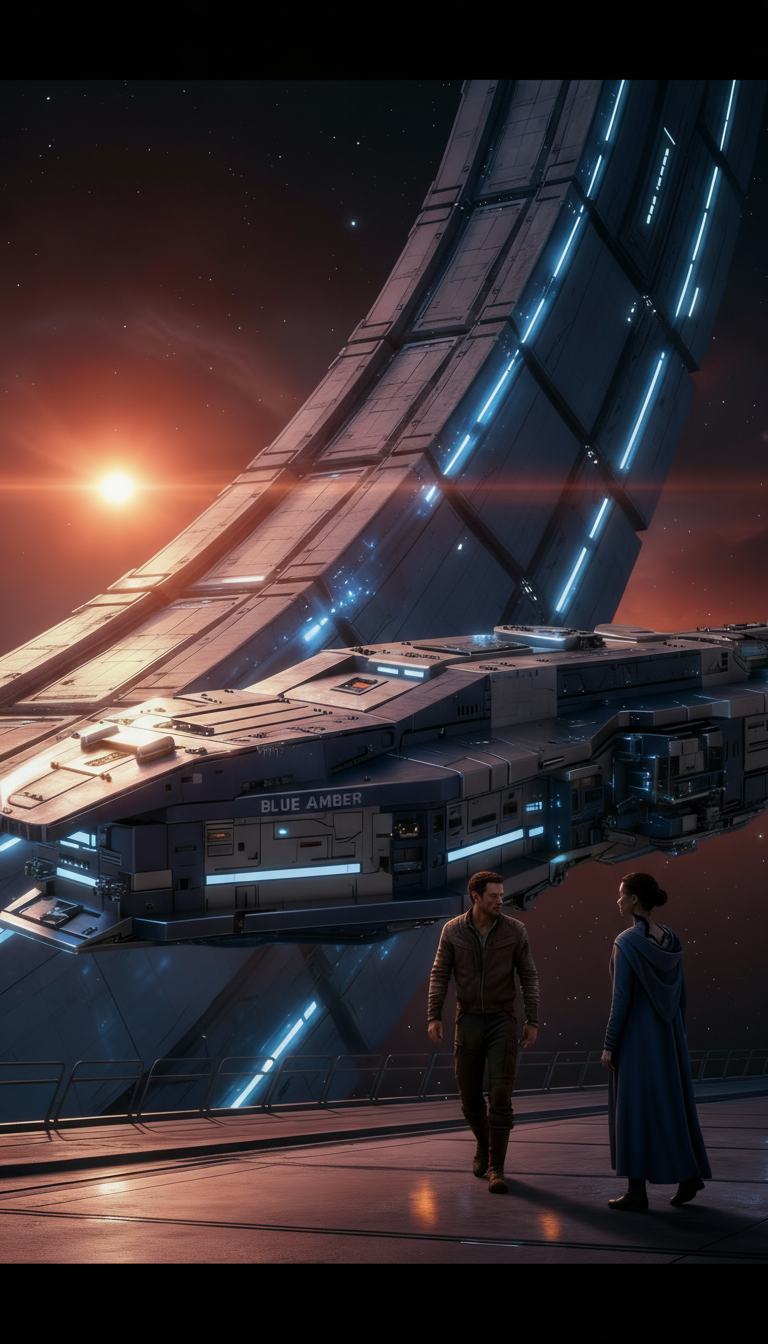
Day 1: The Directive
Dockside air always smells the same: ozone, grease, and desperation.
Cestisus adds polish to it—clean lines, pale stone, and port officials who move like clockwork—but beneath the ash-white tile and votive lamps, the same old hunger keeps time. People want what they cannot afford, to go where they should not, to live one month farther than their credit will allow. Ports are factories that stamp those wants into cargo. You strap them under your keel and pray your drives do not cough mid-jump.
I brought the Blue Lantern in on a high, careful arc, bow thrusters tapping the station’s guidance grid like a blind man’s cane. The Consortium customs drones drifted close enough that my floodlights painted them in milk-blue halos. Their lens clusters clicked like insects tasting the air.
“Hold her steady,” I told Kez from the pilot’s couch.
He is built like a loading crate and twice as stubborn, with a scar across his scalp that makes strangers uneasy until he grins. He kept us centered in the docking spine’s swallow, and then came the familiar blessing: clamp, shudder, seal. Home, for as long as our berth lease held and no one decided we were worth more as an impound.
The berth supervisor met us with a procession of symbols projected above his wrist—my manifest, our Guild registration, and a legal paragraph I pretended to read while he pretended not to notice me pretending. Cetians can smile without moving their mouths. It is all in the eyes. This one’s slid over the scar on my cheek and did not blink.
“Captain Rourke,” he said. “Your entry is lawful. Your inspection window is ninety minutes. Detainments will be assessed at triple rate. Law is Consortium.”
“Bless the law,” I said. “May it always weigh more than a drunk with a gun.”
“We have very few drunks,” he replied. “Guns, however, are carried by those with permission.”
His assistants flowed around us like water: seal checks, hull sniffers, residual-radiation swabs. I signed the alerts and nodded through their small, deliberate talk. When they were finished, they thanked the ship, not me. That struck me as funny and right at the same time. Ships work harder than their captains.
Kez and I were halfway to the freight lift when a woman in a slate cloak stepped into our path. Cetian. Middle years. Razor posture. A thin tattoo like a bar of night across her throat. Her badge marked her as Militia Liaison, and authority clung to her like cold smoke.
“Captain Rourke,” she said. No question in it. “A moment of respect.”
“Always happy to respect a moment,” I said. “Especially if it respects me back.”
“You unloaded Secundus grain and Terra-smelted alloy on your last visit,” she said, watching the dock’s orchestrated chaos instead of me. “You departed with crystalware and ceramic superconductors. Your records say you keep your papers proper. We appreciate order.”
Kez shifted his weight, which meant he smelled trouble. I smiled like a man with no sense of smell at all.
“Order’s easier to carry than fines,” I said.
“Then carry a message.” She offered a sliver of data film between two fingers. “You will receive a private request to transport special cargo. Decline it.”
“From who?”
“If you need to ask, you do not intend to decline.” The smallest curve touched her mouth. “Law is Consortium.”
She left as if she had risen from the deck plating itself. The data film warmed in my palm through the glove. I slipped it into the pocket I reserve for talismans and future mistakes.
“Friendly,” Kez grunted.
“Like a storm that hasn’t decided which coast to drown,” I said.
We got the freight moving: six containers of alloy, three of grain. The stevedores were so efficient you could have filmed them and sold it as meditation. A pair of Cetian children watched from behind a transparent safety barrier that warped their faces with refraction. One waved. I wiggled my fingers and made a coin appear from behind his ear through the glass. He laughed like bells.
Ports are all the same in the end: people, hunger, and the occasional laugh that sounds like forgiveness.
I burned through the logistics with half my head and walked the station with the other half. The D-ring concourse opens onto a view of Pi Eridani’s crowded light, a cool, indifferent sun spilling itself across the planet’s cloud seams. The Consortium builds its stations in curves and hush—every edge softened, every corridor ending in a breath of open space. Even the armed patrols look ceremonial until you watch how they set their feet. The liaison had it right: guns where the permission lives.
The bar I favor on Cestisus has no sign, only a pane of etched glass marked with three circles. It smells of citrus, disinfectant, and old metal, which is how places that hide trouble usually smell. The bartender is a Terran woman with copper braids and one eye more mirror than flesh. She calls herself Rhea. Between us, there exists the ancient religion of trading favors at reasonable interest.
“You look like a man who stepped in a puddle and discovered it was a well,” she said, sliding me a drink without asking what I wanted.
“Some militia liaison slipped me a sermon about law,” I said. “It made me thirsty.”
“Law is a ladder where I’m from. People climb up and kick others down.” Her mirror eye watched the room’s reflection, as if the present was only honest from the other side. “You here to sell me something?”
“Information. You too.”
“Always,” she said. “You first.”
“Someone’s going to ask me to carry special cargo. I’ve been advised to say no.”
“Everyone advises no right up until they sell yes.” Rhea tapped two fingers on the bar, then left her hand there, palm down. Old spacer signal: danger on the floor. “You remember Vok? Tall, Cetian, laughs like he’s strangling a bird?”
“That description narrows the species less than you think, but yes.”
“He’s been sniffing for outbound hulls. The kind with good jump lattices and captains who believe nothing builds a reputation like surviving their first bad decision.”
“Vok’s a broker,” I said. “Brokers don’t care about morals, only margins.”
“Vok’s a broker the way I’m a priest,” she said. “He’s wearing militia perfume.”
“Meaning?”
“Meaning the people who say law is Consortium want to see who breaks it. Or who they can break with it.”
I finished the drink and counted coins into her palm. They looked like small suns against her skin.
“What do you want for the rest of this sermon?” I asked.
“For you not to die on my shift,” she said. “And for you to buy the next bottle directly.”
I left the bar with a pleasant dread humming under my skin. Dockside air: ozone, grease, desperation, and the smell of a trap whose bait tastes like money.
Vok came to me before I could go looking for him. That is the other thing about ports: if trouble wants you, it already knows your berth number.
He arrived with two aides who made no noise and carried themselves as though they would never need to. He wore a cloak the color of wet stone and a chain of narrow metallic leaves. His smile was a neat crescent. He did not offer a hand. Cetians rarely do unless they are buying you or selling themselves.
“Captain Rourke,” he said. “We admire your ship’s punctuality. We admire punctual things.”
“Thank you,” I said. “We admire buyers with money that spends.”
“Your candor is refreshing.” His eyes moved over the hull markings as if they might reveal the ship’s memories. “A question before we discuss numbers. Are you fond of the star Vega?”
“I’m fond of not burning,” I said.
He nodded as if I had quoted a proverb. “Imagine, then, the cost of flame. We have materials that stabilize drives under stress. Components that keep tunnels aligned near gravitational gradients. You understand me?”
He meant jump-lattice parts, the rings that coax space into folding in the shape you need. The war near Vega had been chewing drives into slag. Repairs out there were triage and prayer.
“Those are pricey and regulation-heavy,” I said.
“Regulations are a kind of poetry,” Vok said, and his aides smiled the thin professional smile of men who think poetry sounds better under guard. “Beautiful on the wall, often ignored when men are bleeding in the field.”
“Whose field?” I asked.
“The one where your credits grow tallest,” he said. “There’s a route that avoids the worst of the blockades. Risky, but worth the risk. You’ll carry sealed cargo. Inspection waivers are arranged on both ends. Payment is sixty percent upfront, forty on delivery. The numbers will make you blush.”
“What happens if someone decides poetry matters?”
“Then the law is a lesson,” he said. “For someone. Not us.”
When we parted, he sent details to my comm: times, codes, a bay number tucked into the E-ring where the lighting always feels like the moment before a storm.
Kez was waiting against a cargo strut, chewing on nothing, the habit he picked up when he quit cigarettes.
“I don’t like his shoes,” he said.
“You don’t like shoes?”
“I don’t like men who wear shoes you can’t scuff.”
“This thing smells like sixty percent,” I said.
“And forty percent and prison,” he said. “Rhea?”
“Rhea says his cologne is militia. Our liaison says decline politely. Which makes me wonder who’s the hunter and who’s the hound.”
“What about who’s the rabbit?” Kez asked.
We went to inspect the bay anyway, because men like me are drawn to lines we should not cross the way moths go to lamps. Warmth and warning look the same until you are too close to fly straight.
E-ring bay 47 sat behind a door that pretended it would not open. The glass was dark as sleep until we came within a meter, then bloomed awake and reflected us in pale light. Inside, twenty crates sat in two neat stacks with military precision. Every one of them wore the sort of seal that reads: do not think too hard.
A militia man stood watch, not the liaison but one of her kind: shaved skull, dead gaze, holding a clipboard the way some men hold knives.
“You’ll take these,” he said. “You’ll deliver them to a coordinate near Vega. You won’t ask what’s inside. You’ll sign and go.”
“And if I say no?” I asked.
He considered the question as though the answer might have evolved since morning.
“Then someone else says yes.”
“Law is Consortium,” Kez said, and made it sound unkind.
The man’s mouth tightened. “Law keeps ships like yours from becoming salvage,” he said. “You don’t want salvage.”
I asked for the manifest. He looked at me as though I had asked for his name at a funeral. I asked again, warmer this time, the way you ask a tired cook for a little extra. He handed it over like he was certain I could not read.
Some entries soothed me: drive stabilization beads, coolant lattices, emergency capacitors. Others made my skin go cold: field modulators that could be weaponized, micro-coils tuned for jamming. And then there were eight crates marked with a medical sigil so deeply processed through bureaucratic translation layers that it looked intentionally dull.
I signed anyway. Sixty percent buys a lot of conscience. If you cannot clean your soul, you can at least rent a room inside it and keep the lights on.
They loaded us at shift change, when the dock’s rhythm stutters. The last crate on the pallet hummed so faintly you could have mistaken it for a feeling. I asked what powered it. The handler told me the crate was sleeping and I should let it dream.
By the time we sealed the cargo deck, the station clocks were telling second shift to dream as well. I sent Kez for two hours of rack time and sat by the forward viewport with the data film, wrapped in the ship’s dim light like a blanket. When I slid the film into the reader, the militia liaison’s voice emerged from the speakers like the half-remembered line of a song.
“Captain Rourke. Decline the cargo. If you cannot decline, open crate 18A once you are clear of our jurisdiction. There are lives inside. Yours among them.”
I played it twice. Then again. The Blue Lantern’s ventilation whispered overhead.
Kez came back without sleeping. He sat on the ladder in the passageway, chin in his hands.
“What’s your face doing?” he asked.
“Trying on decisions,” I said. “None fit.”
He looked at the manifest thumbnail on my display, a block of numbers singing if you squinted.
“You’re going to open a crate on a militia job.”
“I’m going to open crate 18A,” I said, “because the woman who told me to decline also told me how to disobey correctly. There’s a pattern in that, and I don’t like patterns I didn’t choose.”
“What if it’s a decoy?” he asked. “What if they’re testing you to see if you peek?”
“Then I fail an exam I was never told I was taking,” I said. “I’ve failed worse.”
We undocked on a clearance that came too fast. The guidance tug gave us a push like a polite hand between the shoulder blades. As the station fell away, Cestisus daylight smeared itself across the Blue’s flank. The silence after the clamp release always feels like standing up too fast; your blood drops a deck before it remembers how to climb again.
Once we were a few ship-lengths clear, the Blue’s personality took over. She is a stubborn craft and hates being told what she cannot do. Tunnel spines warmed, the lattice rang out a scale only the hull could hear. The stars bulged, sighed, flattened.
“Give me a vector that looks shy,” I told Kez. “Not the path Vok sent. Something with a stutter in it.”
“Stutter it is,” he said.
Space became a tight throat and we slid down it, the ship singing to calm herself.
I went below with a crowbar and the sort of prayer you offer to machines. Kez followed because if I was about to make a bad decision, he wanted to shoulder it beside me. We found 18A in the second stack, third from the floor. When I popped the seals, the crate exhaled like it had been holding its breath for a long time.
Inside were cylinders. Six of them. Medical gray, labeled in a way that pretended to be shy and turned aggressive the longer you read. The nearest cylinder’s readout showed a pulse.
Kez swore very softly.
I brushed frost from the viewport. A child looked back. Pale skin. Freckles. Hair the color of winter straw. Eyes closed, lashes tangled. Induced hypothermia. Slow heart. Lungs taking one careful paragraph to finish each breath.
The others were the same: five more small human lives, folded into cold sleep like treasure no decent person should ever have to inventory.
There are many kinds of smuggling. Guns are heavy in the hand. Drugs make people louder or quieter in ways that feel like cheating. People, children, that is a different ledger. That is not cargo. That is indictment.
“Vok,” Kez said, and managed to spit without using spit.
“Or the liaison,” I said. “Or both. Or neither. Someone wanted us to carry this without looking.”
There is a moment every captain knows, the one where the math drops through the floor. Air. Power. Range. Risk. And then the larger arithmetic: what kind of person you want to be once the counting stops.
“We change course,” I said.
“Where?”
“The manifest gives a rendezvous near Vega. That’s a killing field. We are not taking infants into that. There’s a neutral clinic in the shadow of Vega’s third world. I’ve run charity freight past them before. They can manage cryo, and if these children were meant to cross the war line at all, it was for treatment, not leverage.”
Kez let out a breath that could have been a laugh or grief.
“So we save them and become criminals to someone.”
“Someone already decided what we were,” I said. “We can decide too.”
We were fifty minutes into a long tunnel when the Blue shuddered the way a dog shudders in bad sleep. Sometimes that means you’ve brushed a gravity seam. Sometimes it means you have acquired a tail.
“Company,” Kez said, voice calm because he saves his shouting for actual fires. “Two contacts. Cold-chasing. Lattice shadow says light hulls with overclocked spines.”
“Vok sent a retrieval team,” I said. “Or a funeral committee.”
“They’re pinging like salvage crews.”
“Which means militia,” I said. “Or pirates with a sponsor.”
We did not carry weapons that mattered against war hulls, but we did carry stubbornness and tricks. The Blue has an old miner’s toy hidden in her gut, a field caster meant to confuse magnetic sensors. It makes us ring like a ship one corridor over. Kez woke it up and sang us two doors sideways in the tunnel.
We bled velocity and staggered into a gap that wasn’t there until we insisted upon it. The contacts ghosted past like wolves snapping at air.
“Nice,” I said. “Again?”
“Again.”
We danced with our own shadow for an hour, long enough for me to feel the ship’s nerves inside my own. The Blue is older than she looks. She has survived things because she was always allowed to want survival. I spoke to her like a partner and she answered in shudders I understood.
When we came out of tunnel, we were in the cold empty between Pi Eridani and the long burn toward Vega. The courier route there is a braid of sanctioned vectors and the footpaths smugglers cut between them. The sanctioned path glows with patrol beacons. The footpaths glow with the absence of mercy.
Our tail emerged behind us: two needle-shaped ships with paint like old teeth. Not militia colors. Too mean for that. Privateers with permission. They settled into our wake like barnacles trying to become sharks.
“Broadcast,” I told Kez.
He opened the channel.
“This is Blue Lantern to pursuing vessels. You are crowding my field and my patience. State your business in words or leave me to chart my own.”
The reply was laughter, then a man’s voice with an accent from nowhere and everywhere.
“Blue Lantern, you picked up packages by mistake. We’ll relieve you of them, and you will receive a stipend for your inconvenience. Cut drive, power down your spines, and submit to tow.”
“Not today,” I said.
“Today is the only day there is,” he said, and killed the line.
I told Kez to lock down the cylinders on the secondary mag and told the Blue we were about to do something she would hate. We burned for a grit field, a wide belt of ice and rock orbiting a dead dwarf. Grit fields are where captains find out whether they actually know their ships. You slalom or you bleed.
The privateers followed because of course they did. Money is a string. Greed is the hand that pulls it.
We skimmed the first ice boulder close enough to smell frost through the vents. The second wore a tail like a wedding veil. The Blue cut through it and came out glittering. The first privateer followed bravely and lost a fin; he spun, corrected, cursed on an open band. The second had the better pilot. He stayed on us like regret.
“Time for the caster again,” Kez said.
“Time for something stupider,” I said.
We had one thing left: a tunnel twitch. A very small, very ugly fold, the sort you do not disclose to insurance. It is like stepping off a curb you did not see. Your stomach invents a new word for hate, and your ship forgives you only because she loves living too much to stay angry.
I opened the fold beneath us and the Blue dropped through it like a trapdoor. The grit we’d stirred up rained in after us and came out in the privateer’s face as a spray of furious gravel. He swallowed it and spat fire. We emerged crooked, bruised, and alive.
“His drive’s coughing,” Kez said. He sounded the way people sound after outrunning a dog they were sure would catch them. “The other one’s limping.”
“Then we limp toward the clinic,” I said.
The clinic sits in the shadow of Vega-III’s shepherd moon, where the star’s spite is filtered into something the human eye can forgive. It is a place the war pretends not to see and the warlords pretend to respect because one day they may need it not to become rubble. I sent our tight-beam ahead and got a reply in fast, clean code, which comforted me by proving adults still existed somewhere.
We slid in under a noon that looked like midnight. The clinic docking arms took hold of us like nurses’ hands: gentle, relentless. The airlock opened into corridors painted in the colors of safety. People in soft suits took the cylinders from us like crowns.
A doctor with silver hair and a mouth trained equally in sternness and kindness laid two fingers on the frost of one viewport, then looked at me.
“You opened them,” she said. Not praise. Not rebuke. Just fact.
“Who are they?” I asked.
“Collateral,” she said. “From a deal gone wrong. They were being traded for passage permits. Someone’s bright idea of leverage and loyalty. They were always meant to reach us, but we were supposed to sign a paper that would sign us later. Your signature will do.”
“I didn’t sign.”
“You will,” she said. “In gratitude, if not to us then to the universe.”
We moved the last cylinder together, Kez and I and two med-techs with hands like birds. The remaining crates sat in my hold, heavy with the sort of uncertainty that always arrives after you make the only good decision available.
“What about the rest?” I asked.
The doctor read my face the way doctors are trained to.
“Some of what you carry will save ships,” she said. “Some of it will help break them. We’ll take only the former. Return the latter to Cestisus. Hand it to the same liaison who told you to open 18A. She’s trying to keep her port from becoming an armory.”
“Returning it paints a target on my keel.”
“You already painted one,” she said. “At least choose the color.”
We stayed just long enough to drink water so clean it tasted new. Then I came back aboard to find Rhea waiting on the comm, patched through with a signature the liaison must have blessed. Ports are webs before they are places.
“You’re alive,” Rhea said.
“Against common sense.”
“Common sense is a map people draw after they arrive.” She leaned in close enough that her mirror eye caught me twice. “Listen. Your friend Vok is telling everyone you bolted with his charity boxes. He’s trying to make you an example.”
“Charity,” I said, and the word rotted in my mouth.
“Words are costumes,” she said. “Vok’s wearing a nice one. He’ll be waiting when you come home.”
“Home,” I said, meaning Cestisus. Meaning any place willing to sell me fuel and pretend my sins fit under my coat.
Kez stood beside me, arms folded, jaw locked into stubborn.
“We could run to Secundus,” he said. “Disappear into grain routes.”
“We could,” I said. “But men like Vok treat distance like a dare. And there’s something in that liaison. She warned us. I’d like to think warning means more than theater.”
“This belief thing,” Kez said, “it’s why I don’t gamble.”
I burned a return path that stayed mostly on sanctioned lanes and only occasionally stepped onto the footpath long enough to let me pretend I was still clever. The privateers did not follow. Maybe they’d swallowed too much grit. Maybe Vok whistled them back. Maybe the universe decided we had finally sized our trouble correctly.
Cestisus received us with the same immaculate manners, the same glass and hush. The berth supervisor thanked the ship instead of me. I handed over the crates I had promised, minus the ones that could do more harm than good. The militia liaison watched in a stillness sharper than motion.
“You opened 18A,” she said after her people rolled the last dangerous crate off my deck.
“You told me to.”
“I told you to decline.”
“You also told me how to disobey correctly.”
A small tilt of her head. “Vok’s circle needed to learn which captains value instruction more than profit.”
“Instruction,” I said. “Law.”
“Leverage,” she replied, as if correcting a child’s pronunciation. “We are not naive. But we prefer our leverage to keep children out of firing lines. Do you?”
“Today,” I said. “Ask again when my accounts run dry.”
“Then we’ll try to keep them wet long enough for you to say today again.”
“What about Vok?”
“He will be reprimanded,” she said, and the slight curve of her mouth suggested that reprimanded might contain multitudes.
“I don’t need him dead,” I said, surprising myself by meaning it. “I need him not to try children again.”
“I’ll note that in my report.” She paused. “Your sixty percent?”
“Feels heavier now.”
She sent a payment anyway. Not the full amount Vok had promised, not a fine either. Something calibrated to say: we see you.
Rhea found me later in the bar with three circles and poured me another sermon.
“You look less alive than last time,” she said, “but more certain.”
“Certainty is a kind of hangover.”
She laughed. “People will talk. Let them. You boarding tonight?”
“In the morning. Give me a few hours to remember why I didn’t run.”
“Because you’re a captain,” she said simply. “And because you like to pretend you’re not a good man.”
“I like to pretend I’m just one who keeps the lights on.”
She shrugged. “Sometimes that’s the same thing.”
I slept aboard, because I always do. The Blue is my church, my confessional, and occasionally my sentence. Kez grumbled about my decisions and then slept like a man who trusts his own bad ideas more than other men’s good ones. I sat at the forward port and watched Cestisus turn its quiet face. Ports become constellations if you stare at them long enough. Eventually you start to see the lines between the lights.
In the morning we took on legal cargo: wound sealants, memory cloth, bacterial cultures that turn poison water into something close to mercy. The liaison’s people stamped our papers loud enough for me to hear it through the hull. If Vok came by to sneer, he did it at a distance. The only wet-stone cloak I saw hung empty on a peg, like the skin of someone who had decided not to come back for it.
We departed on a vector designed not to raise suspicion and made jumps so clean the Blue purred through them. Somewhere behind us, a child woke to a white ceiling and someone saying their name. Somewhere ahead, another port’s air was already perfuming itself with greed. The universe is large enough that you can run forever and still never leave yourself behind.
I logged it like this:
— Took on regulated stabilizers, returned unregulated modulators to authority at origin.
— Discovered six cryo cylinders misdeclared as inert medical freight.
— Diverted to neutral clinic in Vega shadow. Lives preserved.
— Survived encounter with two privateers via grit-field evasion and tunnel twitch.
— Established that sixty percent can weigh less than six beating hearts.
— Suspect: Vok acting as proxy for militia elements. Ally: unnamed liaison with throat tattoo like night.
— Conclusion: Law is Consortium. Mercy is optional. Today we carried both.
End log.