
Not So Simple Start
New Liberty, Terra Secundus, July 4, 2122
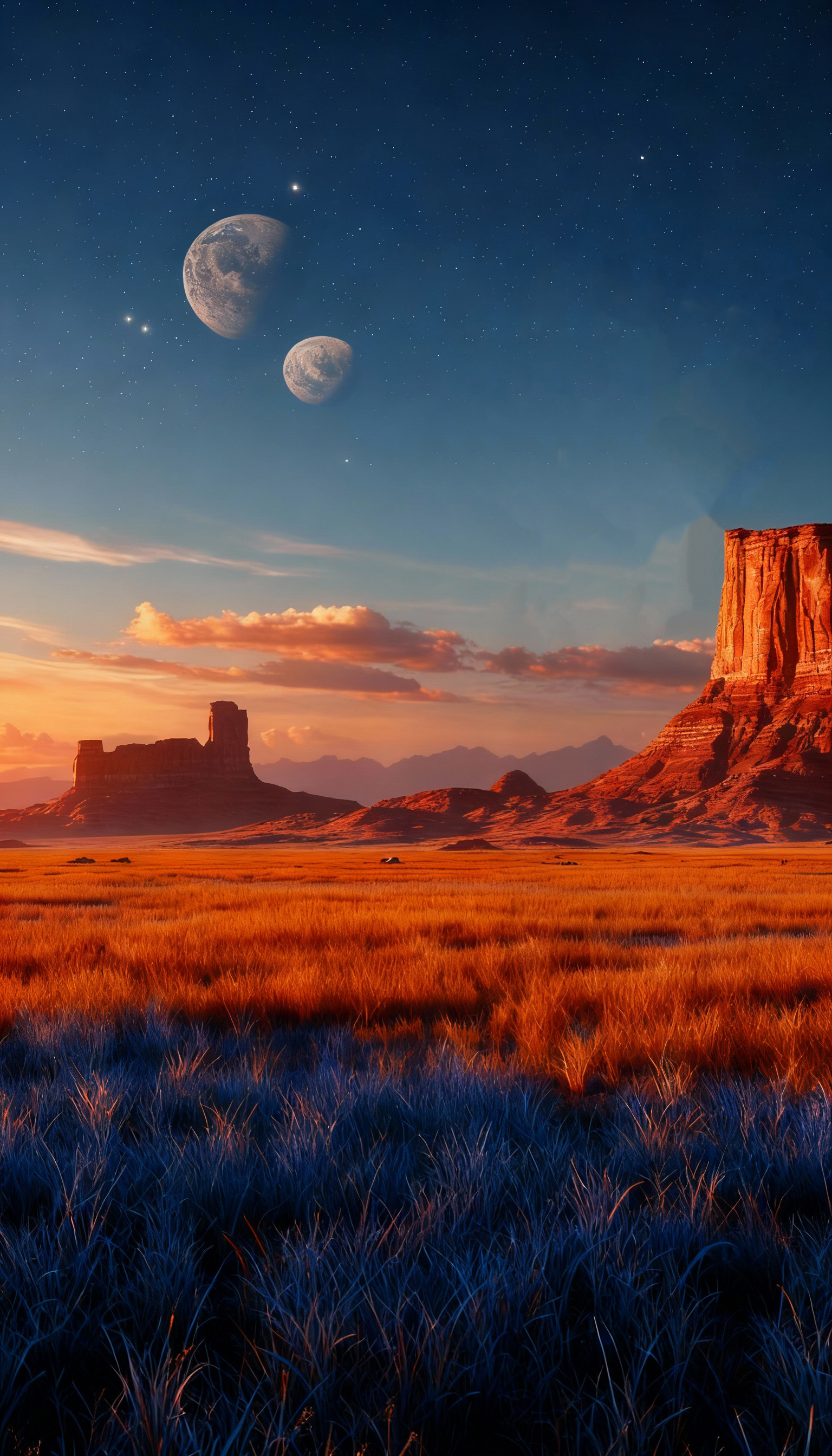
We arrived on Terra Secundus six months ago, though it feels at once like yesterday and a lifetime past. When my family—the Carters—volunteered for this mission, we carried hope in one hand and excitement in the other. We were among the first wave of American settlers, part of the effort to establish a foothold on this new world. I still remember the descent. Endless plains of orange and blue grass stretched toward the horizon, towering cliffs glimmered beneath the light of twin moons, and the sky burned with colors no Earth sunset had ever taught me to expect. It looked like paradise.
But paradise, we discovered, comes with its own conditions.
Month One: Arrival and Uncertainty
The first weeks were chaos disguised as progress. We landed in what would later become New Liberty, a selected settlement zone chosen for its access to water and nearby mineral reserves. Our family of five—my husband Tom, our three children, and I—had prepared for years. We brought rations, tools, medical kits, spare clothing, filtration units, and even a compact hydroponic system. We thought we had planned for everything. We had not.
The weather became our first real enemy. Terra Secundus changes without warning. One moment the plains lie still beneath calm air, and the next roaring winds come down hard across the settlement, carrying sharp mineral dust that strips paint, scars metal, and works its way into every seam and hinge. Our prefab shelters were engineered for endurance, yet by the end of the first month nearly every family had suffered structural damage of some kind.
The ecosystem brought dangers of its own. Earth crops struggled in the alien soil, and the native flora proved as treacherous as it was beautiful. Some plants were toxic, others corrosive, and all of them reminded us how little the world cared for our expectations. Our youngest, Ben, fell violently ill after brushing against a vine that triggered an acute allergic reaction. The medical team saved him, but that moment stayed with me. It was the first time I truly understood that we were not settlers in command of a frontier. We were newcomers in a place that had not decided whether it wanted us at all.
Month Two: Settling In
By the second month, adaptation had replaced excitement. Our days began before dawn to avoid the worst of the midday heat and often stretched deep into the evening. Tom joined one of the resource teams mapping mineral deposits and scouting for metals that could sustain long-term construction. He came home each night exhausted, coated in dust, his voice worn thin by wind and grit.
I stayed closer to camp, tending the hydroponic garden and learning how much patience it takes to coax Earth life into surviving beneath alien skies. Lettuce and tomatoes began to grow well enough in nutrient baths, but everyone knew the truth: imported seeds would not carry us forever. The science teams had already begun discussing ways to adapt Terran crops genetically for native conditions.
Food remained a constant concern. Most meals still came from ration packs, supplemented by whatever our hydroponics could produce. Some colonists talked about hunting native fauna, but the creatures that moved across the plains were elusive and deeply unnerving. At dusk, immense shapes drifted through the mist with slow, deliberate confidence. They never approached too closely, yet their presence was enough. At night, strange calls echoed through the valley—low, resonant sounds that seemed almost musical if not for the unease they carried. Few people slept well.
Month Three: The First Crisis
Our first true disaster came with the water.
What we believed to be safe turned against us almost overnight. After a routine supply run, several colonists fell sick within hours. Then more followed—fever, muscle spasms, disorientation, even hallucinations. Panic moved through the settlement faster than the illness itself. The filtration systems had failed to identify microscopic organisms in the water, harmless to native life but toxic to human biology.
The medical team worked without pause. Samples were isolated, filters recalibrated, and emergency protocols rewritten in real time while families waited to see who would worsen and who would recover. The outbreak was contained within days, but those days felt much longer. We had taken water for granted in ways we no longer could. Afterward, something shifted in the colony. Families who had barely known one another volunteered side by side, helping reinforce the filtration network and support the medical staff. For the first time, New Liberty began to feel less like a collection of frightened households and more like a community learning, the hard way, how to endure together.
Month Four: Building Community
By the fourth month, the settlement had changed. New Liberty no longer looked like a temporary camp thrown down in haste. The shelters were stronger. Common areas had taken shape. Walkways connected family blocks, and people had begun to decorate the interiors of their units with whatever small comforts they could spare. The children ran through the open fields between work shifts, laughing as they chased one another through the strange colored grasses. Ben had fully recovered, though I still kept a close eye on him whenever he wandered too near unfamiliar plants.
We marked the midpoint of our first year with a colony festival. Someone found a guitar. Others contributed preserved food, fresh hydroponic greens, or whatever else they could manage. Beneath the twin moons, laughter carried across the settlement in a way I had not heard since leaving Earth. For a single evening, the homesickness loosened its grip. We felt pride—not only in what we had built, but in what we had survived.
And something else was changing too. We were no longer thinking of ourselves only as Americans or as representatives of distant nations. Out here, those divisions meant less than they once had. On Terra Secundus, we were becoming one colony, one people, bound more by necessity than ideology and perhaps stronger for it.
Month Five: Unexpected Discoveries
During an expedition north of New Liberty, Tom’s team made a discovery that would alter the colony’s future. Roughly fifty kilometers from the settlement, they found a field of metallic formations rising from the ground like the exposed bones of the planet itself—vast remnants of ancient geological upheaval. Running through and beneath those formations were veins of rare minerals unlike anything yet cataloged in Terran records.
The significance of the find was obvious almost immediately. Specialists from across the colony were sent to survey the site, and before long a second expedition had been organized to expand the analysis. The excitement it generated was undeniable. For the first time, people spoke not only of survival, but of prosperity.
Yet even that hope carried an undercurrent of caution. Every major discovery on this world had come with a reminder of how little we understood the larger system around us. Terra Secundus offered opportunity, yes—but never without mystery, and never without a price.
Month Six: Hope and Determination
Now, at the six-month mark, I can finally say that hope feels less like wishful thinking and more like something earned. We have survived the storms, the sickness, and the long silence of alien nights. Our hydroponic bays are producing more food than they were a month ago. Tom’s mining team continues to uncover resources that may secure the colony’s future. The settlement is growing, and so is our confidence.
There are still countless unknowns ahead. Terra Secundus remains a world of mystery, and I suspect it will test the people who live here for generations to come. But we have endured the hardest stage of all: the beginning. We have learned that survival on this world is not simply a matter of persistence. It is adaptation—patient, painful, and necessary.
As I look out across the plains of New Liberty now, with the two moons rising over the horizon, I no longer feel like a guest. None of us are. We are settlers of a new world, and whatever this place becomes, some part of that future has already begun with us.
Our story is only starting.
— Emily Carter, New Liberty Colony