
Second Earth
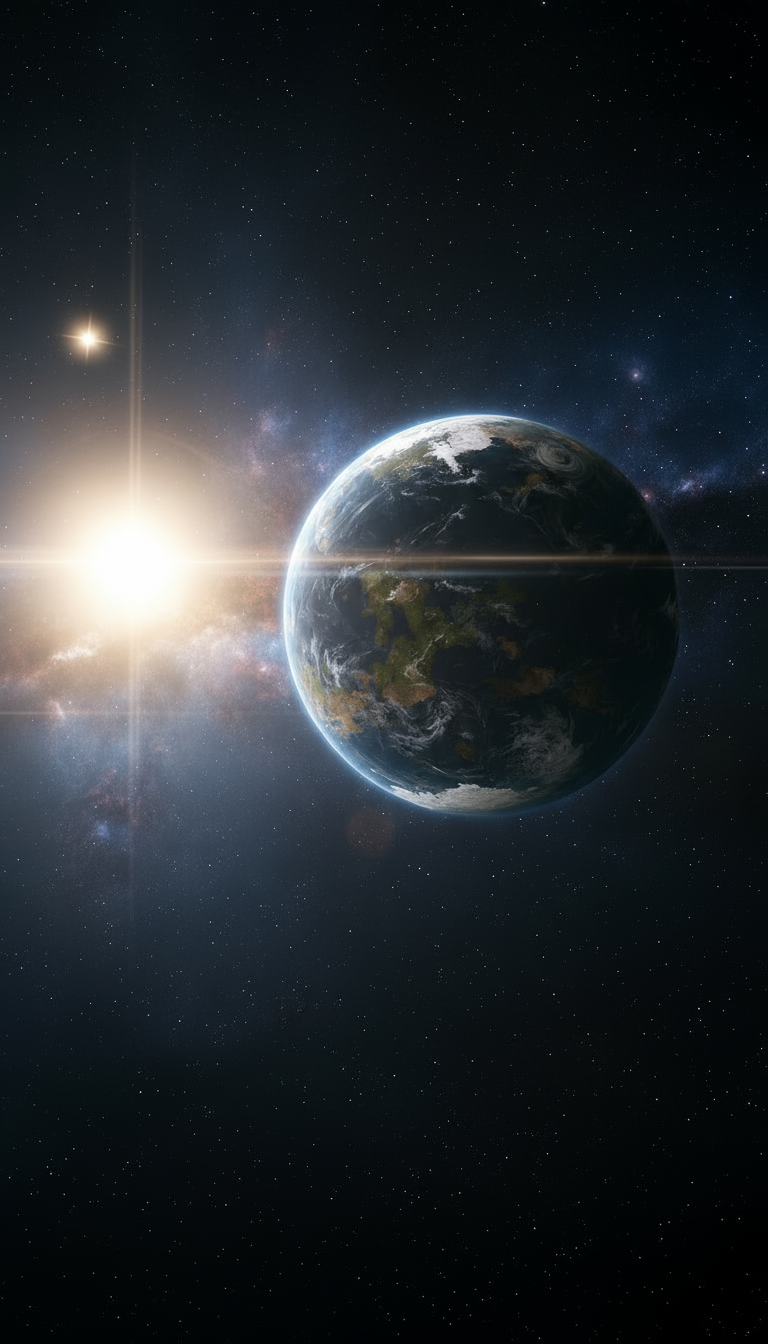
Day 1: Arrival in Alpha Centauri A
Today, we entered the Alpha Centauri system, the destination generations of humanity once spoke of with equal parts hope and disbelief. When we emerged from transit, the view beyond the viewport silenced the ship. Alpha Centauri A burned before us in warm gold, so familiar in color and radiance that for a moment it felt like looking at our own Sun through some strange distortion of memory. Yet nothing about it was truly familiar. It was home, and not home. A reflection of everything we had known, placed impossibly far beyond it.
The crew stood in quiet awe, suspended between disbelief and the dawning realization that we had actually arrived. For years I had worked beside scientists, engineers, navigators, and explorers from across the United States, all of us imagining what this first true crossing would feel like. None of us imagined it correctly. The reality was larger, quieter, and far more emotional than any simulation ever prepared us for.
Our mission parameters were simple enough on paper: scan, survey, and identify viable worlds. Initial sweeps revealed several planetary bodies, but one quickly separated itself from the others—an Earth-sized world orbiting at an ideal distance from the star. Atmospheric readings suggested a breathable balance of gases, a stable climate band, and, most astonishing of all, the clear spectral signature of surface water. In that instant, the mission changed. We had not merely found an interesting candidate. We had found the world we came for.
Day 3: First Approach to Planet AC-04
The ship carried a different kind of energy today, something sharper and more alive than routine anticipation. The crew had designated the planet AC-04, but the name already felt inadequate, too clinical for a world that seemed to pulse with promise. As we closed the distance, the planet filled the viewport in brilliant color—vast blue oceans, emerald and violet continental masses, and broad cloud systems that caught the light in luminous bands. It was unlike Earth and yet impossible not to compare to it.
Watching the world grow larger, I felt the weight of history settle across the bridge. We were not simply observing another planet. We were standing at the threshold of a new chapter in human existence.
Captain Alvarez supervised descent preparations while I handled atmospheric verification. The numbers remained astonishingly stable: nitrogen, oxygen, and trace gases in ratios close enough to Earth standard that several of us had to rerun the models simply to believe them. When we finally descended, the landing was smooth and controlled. Surface stability checks came back clean. Then, for a brief moment after touchdown, everything became still. There was no ceremony in that silence, no applause, only the awareness that for the first time in human history, we had landed safely on a living world beneath another star.
Day 5: Stepping onto the Surface
I will carry the memory of that first step for the rest of my life. The soil beneath my boots was soft, dark, and rich with mineral life, yielding just enough to remind me that this was not barren ground but the skin of a living planet. Around us stretched a landscape almost impossibly vivid—towering trees crowned in violet leaves that trembled in the wind, broad swaths of brilliant orange and blue flowering growth along the valley floor, and a light unlike any I had seen before, bright yet gentler than Earth’s daylight.
The air was cool and astonishingly clean. Every breath carried a faint sweetness of vegetation and moisture, and somewhere beyond the tree line there were sounds—soft, melodic, irregular, the first whispers of an ecosystem not our own. It was the kind of sound that makes you stop moving without realizing you have stopped.
When I looked up, I saw two distant moons suspended in the pale sky, their presence lending the whole landscape a dreamlike grandeur. Even in daylight, a scattering of stars remained visible, quiet points of light reminding us just how far we had come. Dr. Erikson stood beside me, his voice nearly unsteady as he whispered, “This is our new world.” In that moment, none of us disagreed. Humanity had found not just a destination, but a second beginning.
Day 10: The Naming of Terra Secundus
As our exploration range widened, the conversation turned inevitably toward naming. AC-04 had served its purpose, but it no longer belonged to the reality of what we were walking through each day. This world demanded something more fitting, something worthy of its beauty and of what it might one day mean to humanity.
After a long discussion, Captain Alvarez made the final declaration official: Terra Secundus—Second Earth.
The name carried exactly the right balance of humility and ambition. It acknowledged our point of origin without diminishing the uniqueness of the world before us. It was not Earth reborn, nor a replacement for home. It was the next world in humanity’s long story.
We raised the American flag beside the landing module that afternoon, its colors bright against an alien sky. I have studied the great milestones of exploration all my life—lunar landings, Martian settlements, the first deep-orbit stations—but this felt larger than any of them. Around us flowed clear rivers, forests alive with unseen movement, and mountain ranges in the distance crowned with permanent snow. Terra Secundus was not merely habitable. It was abundant, dynamic, and breathtakingly alive.
Day 14: The First Signs of Native Life
Today altered everything we thought we understood about this world.
While surveying a dense section of forest beyond the eastern ridge, we encountered the first unmistakable signs of native fauna. Small, furred creatures moved between the trees with quick, graceful motions, their bright eyes fixed on us with more curiosity than fear. Their coats shimmered with iridescent tones that shifted as they turned through the light, and they communicated in soft harmonic calls that echoed through the canopy like fragments of music.
Later in the afternoon, we observed larger grazing animals crossing the open plains to the south. They moved in loose herds with a calm, deliberate caution, their long, sinewed frames built for endurance rather than speed. Their hides were thick, patterned in muted bands that blended naturally with the tall grasses and low violet brush.
With every hour on this planet, another layer of mystery gave way to something even more profound. Terra Secundus was no longer simply a habitable world. It was a thriving biosphere with its own rhythms, its own evolutionary history, and its own claim to existence entirely independent of us.
Day 20: Leaving Terra Secundus
Departure came sooner than any of us wanted. Terra Secundus had become more than a survey target or mission objective. In just a few short weeks, it had become a place we carried in us, a landscape already beginning to feel like memory before we had even left it behind.
Before final ascent, I took one last walk along the river near our base camp. I let my hand pass through the water, cool and clear against my fingers, and watched the red ferns along the bank bend with the current. Farther off, those iridescent creatures moved through the undergrowth, their distant calls rising and falling in haunting, beautiful patterns. I found myself wanting to remain—not for duty, but simply to witness what this world might become in the years ahead.
We have stored our samples, our imagery, our atmospheric records, and every other form of data the mission required. But none of it will ever fully capture what it meant to stand here. Numbers can record composition. Images can record form. Neither can preserve wonder.
Others will come after us. Explorers, scientists, settlers—perhaps in time, entire cities. For now, Terra Secundus remains untouched, untamed, and extraordinary.
As we rose through the upper atmosphere, I looked back one final time. The planet shone beneath us in blue, green, and silver, alive in a way no report could ever truly express. I whispered a promise I did not realize I was making until the words had already left me: I will return.
Terra Secundus belongs to humanity’s future now—our second chance, our new beginning among the stars.
— Journal of Dr. Elise Fontaine