
Doom Patrol on Pittman
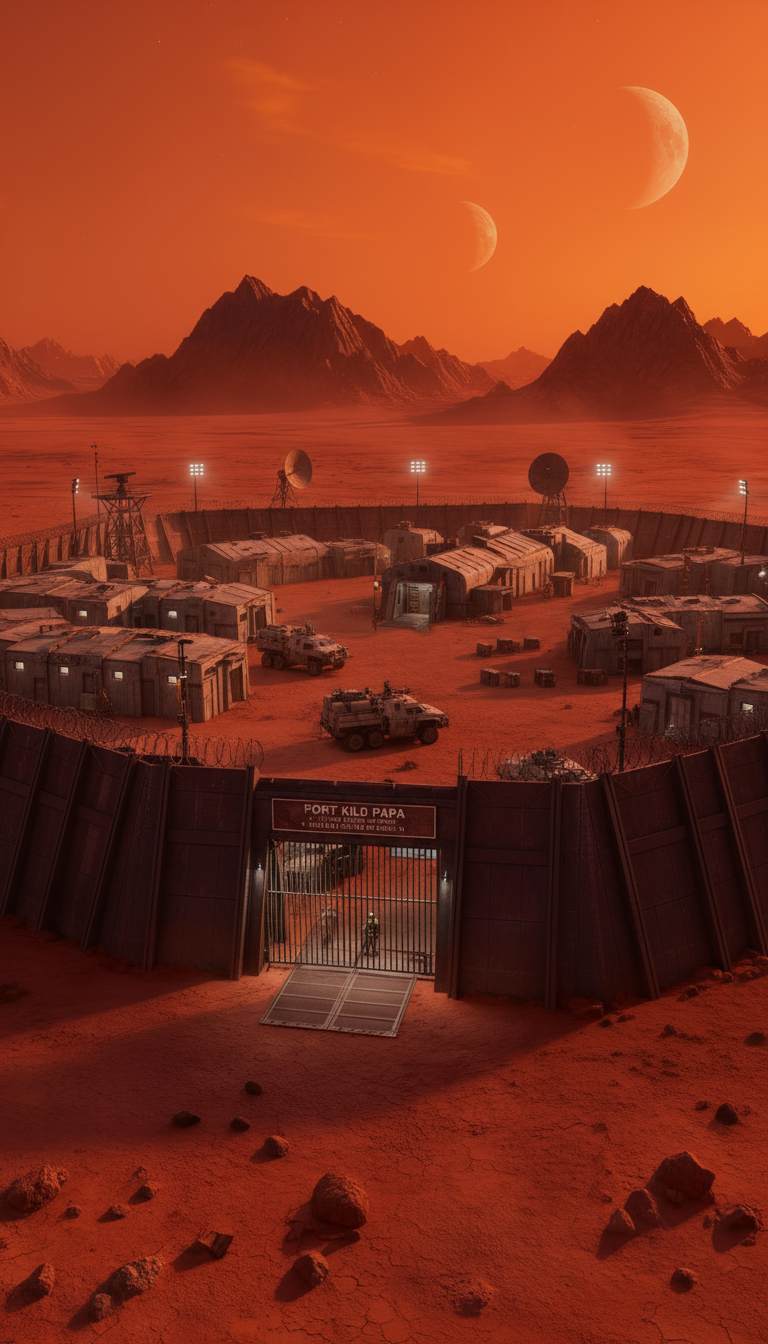
Day 1: Arrival on Pittman
I arrived on Pittman today. Nothing about this world resembles Earth except gravity and the false assumption that land should feel habitable once your boots touch it. Pittman is barren, hostile, and brutally exposed, a place of red deserts, jagged mountain chains, and winds sharp enough to feel like they are trying to skin the planet one layer at a time. The outpost where I have been assigned—Fort Kilo Papa—is little more than a fortified camp of armored bunkers, sensor towers, and prefabricated shelters housing just over a hundred soldiers.
There is tension here that no one quite names aloud. You feel it in the way conversations cut short when officers pass through, in the long looks cast toward the mountains, in how even routine maintenance carries an edge of urgency. Officially, my orders are simple: reconnaissance and defense of the extraction zones. Pittman’s mineral reserves are too important to both the United States and MDF supply chains to leave exposed. We have heard the usual whispers of sabotage in the mines, but what unsettles me more are the unconfirmed reports of something not human moving beyond the ridgelines.
For now, I am focusing on the immediate. Settle in. Learn the layout. Memorize procedures. Tomorrow brings my first full briefing—and my first patrol.
Day 2: First Briefing
Today’s briefing made one thing clear: the danger here is not isolated. It is structural.
Captain Duvall, the outpost commander, laid out our operational area in cold, practical terms. We are expected to patrol a perimeter covering nearly fifty square kilometers of unstable ground, broken ridges, mining spurs, and exposed access routes. The extraction sites are scattered, lightly shielded, and vulnerable to both environmental failure and hostile action. Pittman’s weather adds its own form of warfare. A clear sky can become a wall of dust, lightning, and atmospheric static in minutes. We were ordered never to leave the outpost without emergency kits, signal beacons, and terrain-fall contingencies.
What stayed with me most was not the map or the warnings. It was the isolation. Reinforcements are days away at best. On Pittman, help is not a thing you wait for. It is a thing you survive long enough to deserve.
Day 4: First Combat Patrol
Our first patrol took us through Razorback Ridge, a jagged rise of black and red stone that looks like the exposed spine of something ancient and half-buried. I was paired with Sergeant Kiera, a veteran six months into her Pittman rotation and already carrying the hard, economical manner of someone who has learned there is no value in wasting words out here.
The sky was a muted orange, and the wind carried sulfur from the nearby mine vents. Every step seemed amplified by the silence around us. I had trained for this kind of assignment. I had rehearsed movement, observation, contact protocols, emergency extraction procedures. None of that training prepared me for the stillness of a dead world or for the way that stillness makes your body anticipate danger even when nothing is moving.
We returned to Fort Kilo Papa at dusk without incident. But the entire time we were out there, I had the persistent feeling that the landscape was not empty at all—that something beyond our sightline was aware of us and choosing, for now, not to make itself known.
Day 7: Dust Storm Delay
A storm rolled in overnight, the worst I have seen since landing. The wind hit the outpost like a sustained bombardment, rattling plating, shaking support braces, and reducing visibility outside the walls to absolute zero. We spent the day sealed indoors, waiting for the storm to exhaust itself.
During the worst of it, a few of us gathered in the mess to pass the hours. Stories always surface in places like this when people are forced to sit still. Most were the usual patrol exaggerations and half-serious complaints. Then Corporal Diaz mentioned seeing strange blue lights in the mountains during his last run. A few people laughed it off, but his face never changed. He believes what he saw.
I am beginning to understand what Pittman does to people. The isolation here is not passive. It works on the mind. It sharpens doubt until every rumor starts to feel like a warning you missed the first time.
Day 10: Signs of Sabotage
Patrols had stayed quiet until today.
We reached one of the smaller mining outposts and found equipment damaged across multiple systems. The sabotage was crude in execution but deliberate in intent. Whoever did it understood enough about the machinery to create maximum disruption without needing to dismantle the entire site. Sergeant Kiera suspects local dissidents or black-market scavengers trying to force shutdowns and steal components later. I am less convinced.
The site felt wrong in ways I cannot fully explain. No tracks. No bodies. No sign of forced approach or withdrawal. Just damaged infrastructure and a silence that felt heavier than it should have. We reported everything to Captain Duvall, and engineering teams were sent to stabilize the outpost. On paper, the incident is minor. In my gut, it feels like a beginning.
Day 13: Midnight Patrol
I drew midnight patrol duty tonight. Pittman after dark is a world stripped down to fear and instrumentation. The only illumination came from the faint glow of our visors and the cold scatter of stars reflecting against dust moving low across the ground.
Halfway through the patrol, our scanners picked up a faint signal—irregular, mechanical, almost rhythmic. Each time we tried to close on it, the source shifted or vanished before we could fix a reliable triangulation. We marked the coordinates and withdrew with the data intact. Captain Duvall says he will send a drone to investigate.
The signal did not feel random. It felt measured. Not like a damaged relay or loose hardware bouncing noise through the terrain. It felt as though something was probing us, testing our response time, learning how closely we would pursue.
Day 16: Ambush at Razorback Ridge
We walked into an ambush today.
Razorback Ridge again. The explosion came first, then the gunfire—sharp, controlled, and placed with enough discipline to tell us immediately we were not dealing with panicked raiders or opportunistic saboteurs. The rocks around us erupted under impact. I barely made it to cover before a round caught me high in the shoulder. Not enough to take me out, but enough to send a shock through me that had nothing to do with pain alone.
Sergeant Kiera dragged me behind a boulder while the rest of the squad returned fire into smoke, stone, and muzzle flash. The engagement lasted minutes, though in memory it stretches longer. That happens when the body cannot decide whether it is fighting or surviving. When it ended, the attackers were gone. No bodies. No recoverable equipment. No trace of where they had staged or how they had moved out so quickly.
The medics patched the wound. The deeper damage is harder to close. Whoever attacked us knows the terrain intimately. They are studying our routes, our timing, and our habits. They are not improvising. They are preparing.
Day 19: Reconnaissance Drone Report
The drone sent to investigate the midnight signal returned with data none of us were ready to dismiss. It captured multiple heat signatures moving through the mountain sectors—too large and too structured to be explained away as animal motion, too irregular and brief to fit any known human patrol profile. They appeared, shifted position, and vanished in patterns that suggest intent.
Captain Duvall tried to downplay the result as geological interference, but I saw the feed myself. The signatures were too clean, too coordinated, too deliberate to be random distortion.
Tomorrow, Sergeant Kiera and I are leading a recon team to the source coordinates.
I can feel something building out there. Pittman has the atmosphere of a battlefield moments before the first artillery round lands—everything holding still, not from peace, but from anticipation.
Day 21: The Encounter
We reached the coordinates after hours of climbing through blistering heat and razor-edged stone. The zone was silent when we arrived. No tracks. No debris. No signs of habitation or recent passage. Just heat, rock, and the oppressive stillness of a place that seemed to know we did not belong there.
Then I saw movement.
A shadow crossed the ridge line—too fast, too deliberate, too controlled to be dismissed as heat distortion or drifting dust. I brought the scope up and caught it clearly for one brief, unforgettable instant.
Humanoid, but not human.
Taller. Leaner. Encased in armor that looked less manufactured than grown, as though it were alive or responsive to the body inside it. It carried an energy weapon unlike anything I have ever seen in service. Its motion had none of the clumsiness of a creature surprised. It moved like a hunter that had already decided how much of itself it wanted us to witness.
And then it was gone.
We reported everything immediately. Captain Duvall remains skeptical in his official posture, but Sergeant Kiera and I know what we saw. This is no longer sabotage. It is contact, and whatever has made contact with us is hostile.
Day 23: The Calm Before the Storm
Two days since the sighting, and Fort Kilo Papa no longer feels like the same outpost. Conversations cut short when someone enters a room. Every noise outside the walls pulls eyes toward the perimeter. No one wants to say it too plainly, but the truth has already settled over the camp.
We are not alone on Pittman.
Whatever is out there is not acting blindly. It is observing us, learning our patterns, identifying our weak points, and choosing its moment. In response, we have doubled patrol frequency, reinforced the barricades, armed the perimeter drones, and begun rotating command responsibilities more aggressively. I have been given control of a small patrol unit. The weight of that sits heavily on me, but there is no room left for private fear. Not now.
Day 25: The Alien Assault
It happened tonight.
The sky lit first—streaks of blue fire cutting through the cloud cover like blades. For a moment some of us thought it was a meteor event or a chain reaction at one of the mining sites. Then the hum began. Low. Resonant. So deep it could be felt in the chest before the mind fully understood it. The ground itself seemed to answer.
Then they came.
The alien assault hit with terrifying precision. Their weapons were nearly silent, but their effect was absolute. Energy beams tore through barricades, steel plating, and armor with an efficiency that made our defenses feel ceremonial. We returned fire, but the engagement dissolved into immediate chaos. Half my squad went down within the opening minutes. Through smoke, glare, and running comm traffic, I saw flashes of them moving—armor alive with pulsing energy, bodies too fast to track cleanly, discipline too exact to mistake for anything but military purpose.
These were not scavengers. Not dissidents. Not wildlife made strange by Pittman.
These were soldiers.
We fell back to Fort Kilo Papa under sustained fire, fighting yard by yard just to keep the perimeter from collapsing all at once. Reinforcements have been requested, but I do not know whether they can reach us in time. The frontier phase of Pittman is over. Whatever this world was before, it is something else now.
Pittman is a battlefield.
And the enemy is only just beginning.
— Corporal Kamau Nyaga, MDF Forward Recon, Fort Kilo Papa, Pittman