
Diplomat’s Mission Log
Day 1: Arrival and Observation
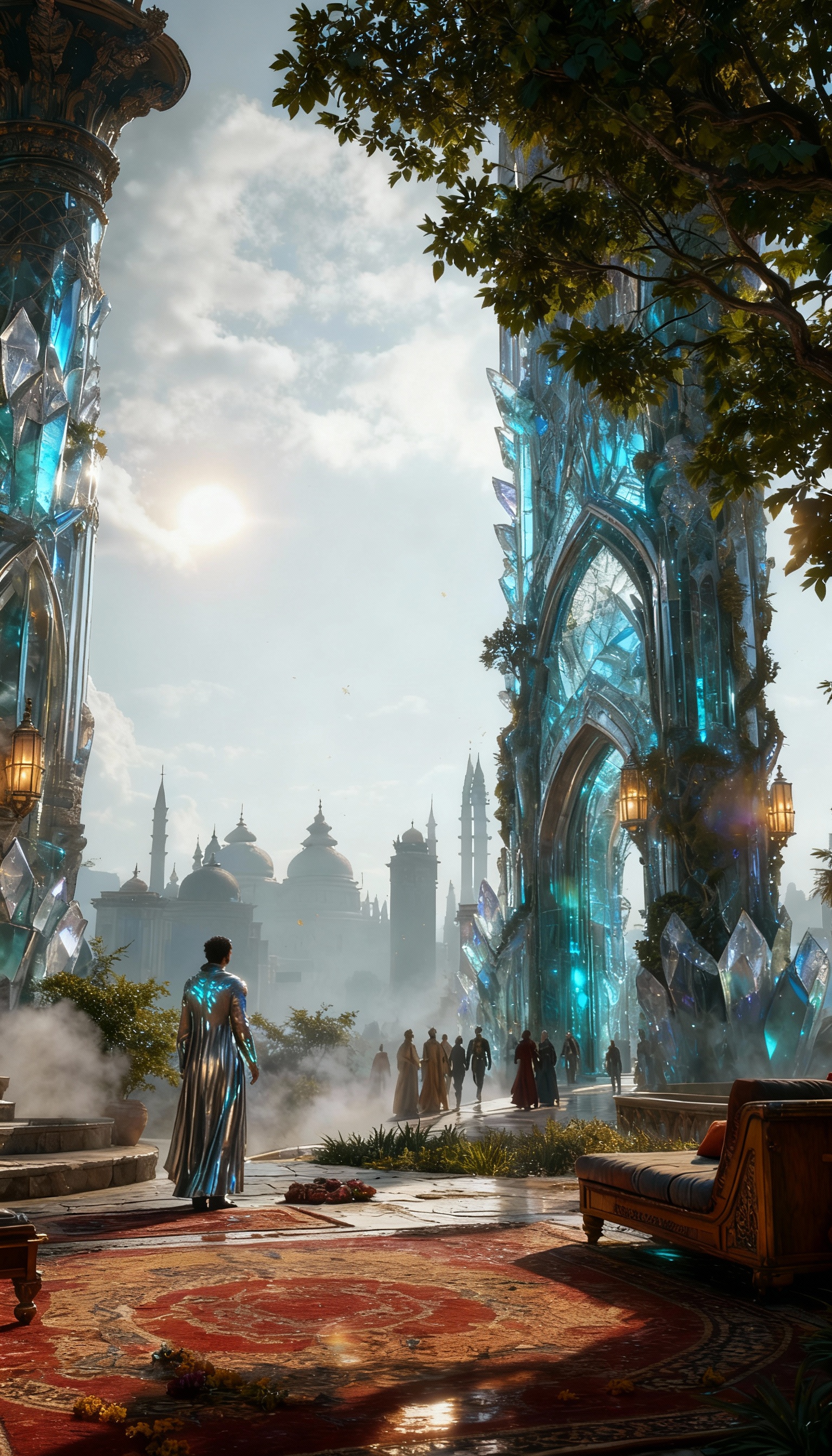
Chandigarh received me beneath the light of its twin suns, their radiance casting shifting bands of color across the capital. The Diplomatic Enclave within Harmony Spire is an extraordinary place—an elegant fusion of Terran design and Chandari craftsmanship. Towering crystalline structures shimmer beneath the dual light, while silent hovercraft move between elevated platforms in smooth, graceful arcs.
My assignment is as delicate as it is important. The Chandari Coalition, an alliance of three cautious sects, has long resisted outside interference, preferring balance, ceremony, and internal consensus to foreign entanglement. The Zhevar Syndicate stands in sharp contrast: bold, practical, and often confrontational, with little patience for ritual if profit or strategic gain is at stake. My task is to bridge these opposing forces and secure trade and resource-sharing agreements that will serve both them and the Indian colonies.
The Chandari emissaries received me with formal poise, though little warmth. Their voices were measured, deliberate, and carefully restrained. I am told their bioluminescent markings reveal emotional states; during our first meeting, those markings flickered only faintly, as though even curiosity was being held in check. The Zhevar delegation arrived late and unapologetic, led by Commander Graav, whose confidence bordered on theatrical and whose impatience was visible before he ever spoke. From the first hour, it was clear this mission would demand more than procedure. It would demand endurance.
Day 3: First Negotiation Session
The negotiation chamber was chosen for its symbolism: neutral ground, set within an oval hall of translucent walls overlooking Chandigarh’s crystal forests. It should have felt calming. Instead, it sharpened every contrast in the room.
The Chandari favored quiet diplomacy, speaking in soft, rhythmic cadences that carried the quality of song more than argument. The Zhevar interrupted often, dismissing extended formalities in favor of direct outcomes. It did not take long for the central dispute to surface. Chandigarh’s crystalline ores are of immense value to Indian propulsion research, but to the Chandari they are more than material resources. Many deposits are regarded as sacred, and extraction without ritual recognition is seen as desecration. The Zhevar, by contrast, mine and trade such resources as a matter of practical necessity, with little interest in sanctity when weighed against utility.
I proposed an early compromise: limited mining zones, jointly governed by a Chandari–Zhevar council, with profit sharing, oversight, and restrictions designed to prevent intrusion into sacred sites. The Zhevar showed cautious interest. The Chandari withdrew into a hushed internal consultation, their markings dimming toward gray—a visible sign, I had learned, of disapproval and concern. The session ended without resolution. Even so, the fact that neither side rejected the framework outright was reason enough to keep moving.
Day 5: Cultural Exchange and Tensions
In the hope of easing the atmosphere, I arranged a cultural exchange within the enclave. What followed was as revealing as any formal negotiation.
The Chandari opened the evening with a luminous performance of synchronized movement and controlled biolight, their bodies tracing intricate patterns through the air in displays of extraordinary grace. The Zhevar responded with a demonstration of powered exosuits and close-order weapons drills, emphasizing discipline, force, and technical mastery. The contrast was absolute—beauty and balance on one side, strength and precision on the other.
The event might have ended as a useful exchange of values, but tension rose quickly. Chandari emissary Va’ren accused the Zhevar of reducing sacred culture to spectacle. Commander Graav dismissed the Chandari as idealists trapped in ritual and unwilling to confront practical realities. I intervened before the argument could harden into something irreversible, urging both parties to recognize that grace and strength are not opposites unless pride insists on making them so.
My appeal quieted the room, though not the resentment beneath it. Still, the evening did not collapse. The conversation continued, strained but unbroken. In diplomacy, that often counts as a victory greater than it appears.
Day 6: The Incident
Today nearly ended the mission.
A Chandari diplomat accused a Zhevar guard of tampering with one of the sacred crystals housed within the enclave. The guard denied the charge, but the accusation alone was enough to ignite the chamber. Chandari markings blazed crimson, their anger impossible to misread. Zhevar security closed ranks immediately, hands hovering just near enough to their weapons to make every breath in the room feel dangerous.
For one tense hour, I believed the mission was on the verge of total collapse.
I proposed an independent inquiry overseen by a neutral observer acceptable to both delegations. Neither side trusted the other, but both recognized the alternative. Reluctantly, they agreed. The matter remains unresolved, yet open confrontation has been avoided. That is no small thing. Each day makes the fragility of this peace more apparent.
Day 8: Breakthrough in Private Discussions
The breakthrough did not come in the council chamber. It came in private.
I met first with Va’ren, away from the formal halls and away from the gaze of her fellow emissaries. In that quieter setting, she admitted that the Chandari might accept limited mining if their customs were meaningfully honored. She proposed ceremonial blessings at each approved site before excavation began—a symbolic acknowledgment that the land was not merely being used, but approached with respect.
Later, I met with Commander Graav. His position was as direct as ever, but for the first time it carried flexibility. He indicated that the Zhevar could accept Chandari oversight if Terran investment were directed toward Zhevar industrial infrastructure and technical upgrades. In other words, he was willing to trade freedom of action for legitimacy, stability, and material benefit.
By evening, I had drafted the first real framework for an accord. For the first time since arriving on Chandigarh, cooperation no longer felt abstract. It felt possible.
Day 9: The Draft Proposal
The draft accord took shape around four central provisions:
- Regulated Mining Zones: Extraction limited to non-sacred regions under strict environmental and territorial safeguards.
- Joint Oversight Council: Equal representation from Chandari, Zhevar, and Indian delegates to supervise implementation, disputes, and compliance.
- Cultural Integration: Chandari blessing rites conducted at each newly opened site as a formal sign of respect and shared legitimacy.
- Terran Investment: Directed support for Zhevar infrastructure and technological development in exchange for stable and fair trade access.
The Chandari reviewed the proposal with visible caution, yet their markings glowed a pale blue—what I had come to understand as tentative approval. The Zhevar requested only minor revisions related to transport rights and industrial scheduling. Most significant of all, the two delegations began addressing one another directly without slipping into open hostility. The dialogue remained fragile, but for the first time it was genuinely mutual.
Day 10: Agreement Reached
Success came only after twelve relentless hours of negotiation, revision, pause, and renewed argument. Yet by the close of the day, both sides signed the Harmony Accord beneath the light of Chandigarh.
The Chandari accepted it as a necessary step toward balance. The Zhevar accepted it as an opportunity worth seizing. For the Indian colonies, it marks a strategic and diplomatic success. For all three parties, it is something rarer: proof that cooperation is possible even where values sharply conflict.
The signing ceremony was broadcast from Harmony Spire’s central platform. As I stood between Va’ren and Graav, the weight of the moment became impossible to ignore. Chandari biolight shimmered through the air in soft bands of color, while the low strains of the Zhevar anthem echoed through the hall. For the first time since my arrival, I allowed myself a quiet moment of pride—not in triumph, but in endurance.
Reflection: The Weight of Diplomacy
Chandigarh has taught me that diplomacy is rarely about victory. More often, it is about patience, restraint, and the ability to remain standing in the space between incompatible truths. The Chandari and the Zhevar will never see the galaxy through the same eyes. But they now share the same horizon, and that matters more than agreement born of convenience ever could.
This accord is more than a trade pact. For humanity, it is a foothold in a wider and increasingly complex dialogue among the stars. For me, it is a reminder written in equal parts humility and persistence: in a galaxy defined by distance, memory, and difference, bridges matter far more than borders.
End Log
Location: Harmony Spire, Capital Enclave, Chandigarh
Mission Officer: Envoy Daniel Rourke, Indian Diplomatic Corps
Objective: Establish cooperative trade and cultural agreements between the Chandari Coalition, Zhevar Syndicate, and Indian representatives