
Hidden Jewel
Day 1: Landing on Pace
Today we touched down on Pace, the hidden jewel of the Gliese 144 system. The landscape opened before us in a vast sweep of sand and stone, broken by jagged ridges and distant mountains shimmering beneath a pale, washed sky. The air was thin but breathable, carrying a metallic taste that lingered at the back of the throat. What struck me most, however, was the silence. It felt immense, almost unnatural, as though the planet itself were holding its breath and waiting to see what we would do.
Our team—geologists, chemists, and environmental scientists—established our first base beside a towering natural rock formation we named The Gateway. It rose above the desert like some ancient monument, its surface carved by uncounted centuries of wind and abrasion. As I stepped down onto the sand and watched dust swirl around my boots, I found myself thinking of Earth and the extraordinary distance between that world and this one. Tonight, we rest. Tomorrow, the real work begins—the work that may define this mission and perhaps our understanding of Pace itself.
Day 2: First Survey of the Eastern Flats
The morning began with calibration checks, instrument diagnostics, and the kind of quiet routine that always comes before first field movement. By midday, we divided into survey teams and headed east across the open flats, scanning the surface for mineral content and subsurface variation. The sand here is unlike anything I have seen before—soft, almost powder-fine, clinging to fabric, seals, and instrumentation with stubborn persistence. Our footprints vanished almost as quickly as we made them, erased by the steady movement of the wind.
By late afternoon, we uncovered a dark mineral seam embedded in exposed rock. Yves believes it may possess unusual magnetic properties, though we will need proper analysis to confirm it. Collecting samples proved difficult. The wind carried fine abrasive grains that struck our suits and equipment like needles, and even through layered gloves the dust seemed to bite. Back at base, exhaustion gave way to something closer to awe. We were the first people to touch these stones, to breathe this air, to pull answers from a world that had waited in silence for ages. There are some moments science cannot fully describe, only witness.
Day 3: Discovering the Fumarole Fields
Today we followed faint orbital thermal readings west across broken, unstable terrain. After several hours of slow travel, we reached a field of fumaroles venting thin clouds of gas into the wind. The ground beneath our boots was cracked and irregular, as though the planet had split and cooled without ever fully settling again. Even through the filters, the smell of sulfur carried through in sharp, bitter traces. At measured intervals, narrow columns of steam burst upward and dissolved almost immediately into the air.
Our sensors recorded xenon traces and an uncommon helium variant rising from the vents. Martin, our lead chemist, could barely contain himself once the readings stabilized. He believes we may be standing over an undiscovered reserve of rare elements—something that could transform how this planet is understood and, inevitably, how it is valued.
As night fell, the escaping gases began to glow faintly, washing the fumarole field in muted blue and amber light. None of us spoke for a long time. The place felt ancient in a way that had nothing to do with ruin and everything to do with endurance. For a few quiet minutes, it felt less like fieldwork and more like trespassing inside something sacred.
Day 4: The Sandstorm
We saw the storm at dawn: a wall of dust and shifting light spanning the horizon so completely that it seemed to erase the distance itself. By midday it reached us with a violence none of us had truly prepared for. The wind screamed across the desert and drove sand into the habitat shell with such force it sounded like metal striking metal. Inside, the entire structure hummed with vibration, and static crawled through the air until even the lights seemed uneasy.
Beyond the reinforced viewport, there was nothing to see but a swirling red haze. The roar was so constant and overwhelming that conversation became pointless. We waited in a silence made heavier by the noise outside, listening to the planet batter the walls around us. Hours later, when the wind finally weakened enough for us to venture out, the world had changed. Familiar landmarks were buried. New ridges had appeared where none had been before. The ground looked freshly made, as though Pace had rearranged its own face while we hid from it in the dark.
Day 5: The Ridge Walk
Today we climbed toward a northern ridge we had mapped from orbit. The ascent was slow, steep, and punishing, every step sinking into unstable sand before we could fully commit our weight. By the time we reached the crest, the effort had left all of us breathless. Then we looked out.
The plains of Euclides stretched all the way to the horizon, vast and shimmering under the pale light, broken by isolated rock spires that seemed to rise from the desert like the remains of forgotten towers. We spent the day surveying the exposed strata and collecting samples from the ridge face. The rock layers told a story too orderly to ignore—sediment laid down over ages, shaped by water and time, evidence of rivers and perhaps oceans that no longer exist.
Then Yves found something neither of us expected: a fossil embedded in a weathered stone face, its surface marked by delicate spirals and ridges. No one said much at first. We simply stared. The implication was too great to rush into words. Pace is not an empty world. It has a biological history written into its own bones, buried beneath wind and dust, waiting for patient hands to uncover it.
Day 6: The Abandoned Outpost
Our final day brought the most unsettling discovery of the expedition.
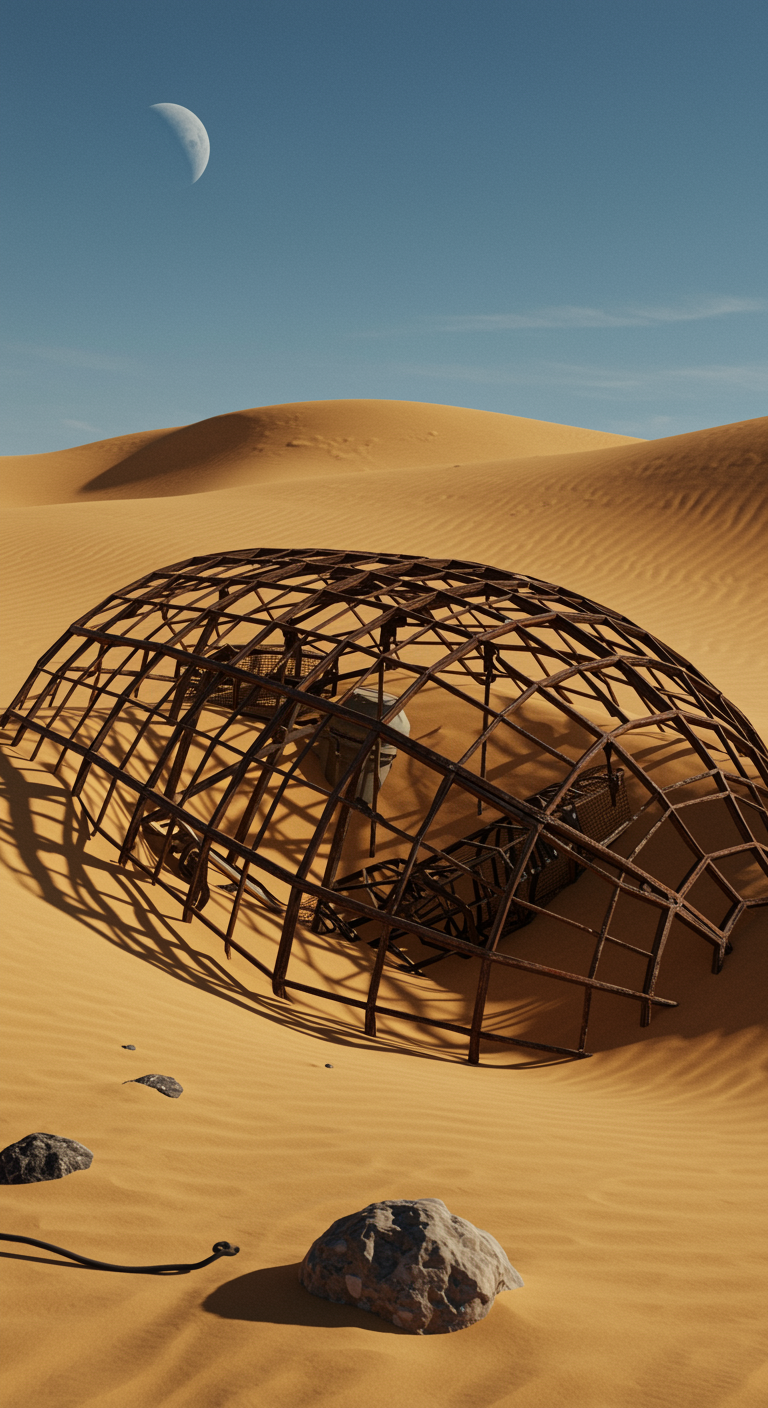
West of base, half-swallowed by dunes, we found the remains of an old human structure. Its metal frame was corroded, bowed, and nearly consumed by sand, but there was no mistaking the design. Someone had been here before us. No mission record we brought with us mentions an outpost on Pace.
Inside, we found fragments of ruined equipment, shattered displays, and several personal logs too badly damaged to recover in the field. There were no bodies, no clear indication of departure, and nothing that explained why the site had been abandoned to the desert. The silence inside that structure felt different from the silence outside. Heavier. More personal. Standing in the half-buried ruin, I felt an unexpected kinship with those forgotten explorers. They had stood on this same world, looked out at this same horizon, and wondered what kind of future could be built here—or what danger had found them first.
Tonight, as the twin moons cast their pale glow across the sands, I understand the name we gave this world better than I did on the day we arrived. Pace is not a jewel because it shines. It is a jewel because it endures—beautiful, dangerous, and full of secrets that yield only to patience and respect. We have only begun to understand it. Long after we are gone, others will return, drawn back by the same mystery that has already taken hold of us.
Journal of Dr. Lucia Moretti, European Exploration Team on Pace