
Alien Combat Unit Encounter Debrief
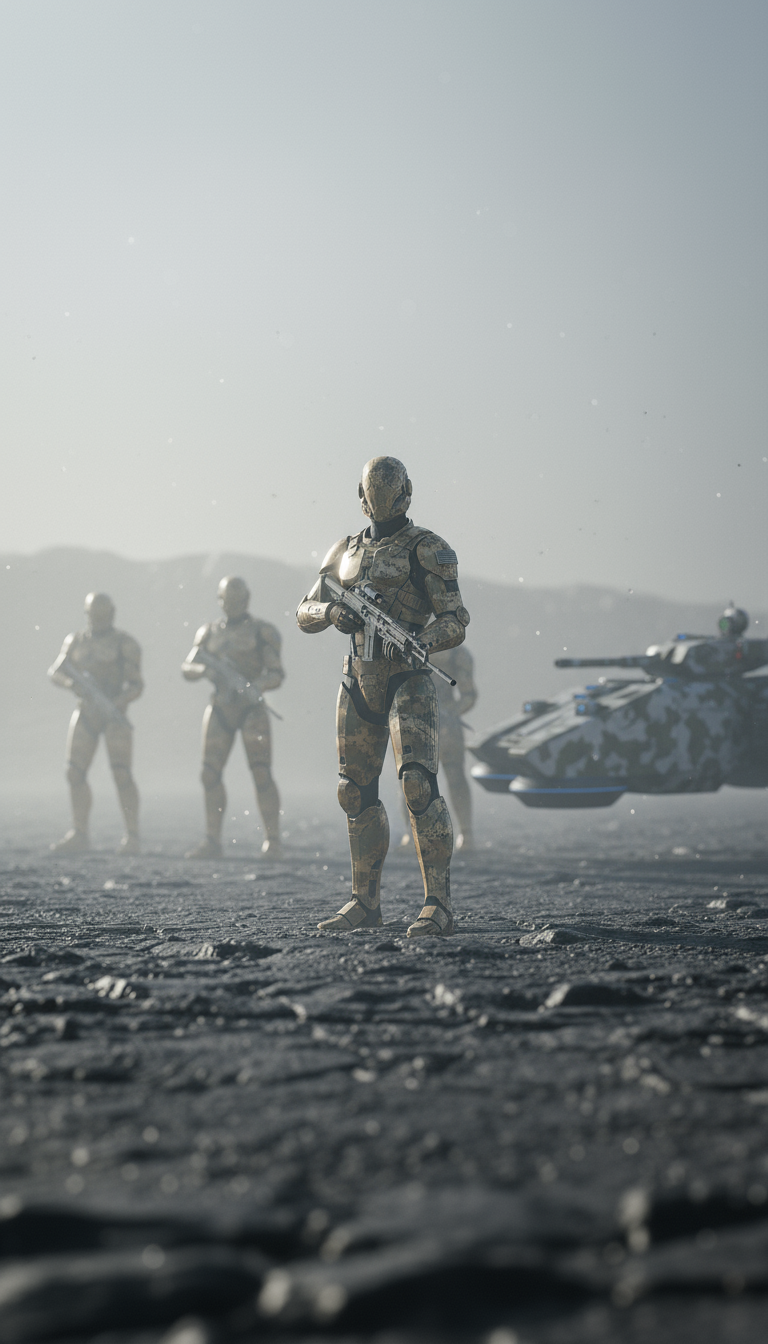
Entry 1: Briefing and Deployment
We were dispatched at first light to investigate abnormal energy signatures in Sector 12B. Command believed they might be residual traces from the alien combat unit reported near Hallmark the previous week, though no direct contact had been confirmed since that sighting. Our orders were simple and explicit: observe, record, and report.
Echo Squad deployed with six Marines in standard MDF combat armor, equipped with augmented-vision helmets, pulse rifles, and a Recon Sentinel drone for forward surveillance. Morale was steady. We had seen combat before, but nothing in our prior engagements matched the tone of the briefing we received that morning. Captain Myers ended the session with the line he always uses before uncertain operations: “Expect the unexpected.” On Pittman, that is not a cliché. It is doctrine.
Entry 2: Initial Encounter
We reached the coordinates by midafternoon. The terrain was a ruin of fractured stone, blackened craters, and scorched ridgelines—ground that had seen too many battles and remembered all of them. The burned-out shell of an MDF hover transport marked the edge of our search zone, half-buried in ash and dust.
The drone registered movement five hundred meters ahead. At first it appeared to be nothing more than shifting shadows moving across broken rock. Then the forms resolved.
The aliens were massive—bipedal, nearly three meters tall, with exoskeletons that shimmered like liquid metal under the ruined light. Their motion was unnervingly smooth, almost elegant, but there was nothing graceful about the threat they carried. Every movement suggested predatory control. Their weapons emitted a low, organic hum that vibrated through our armor and into the bones beneath it. Even before they fired, the air around them felt charged, almost sentient, as though the battlefield itself had begun to react to their presence.
Entry 3: The Ambush
We never got the chance to observe for long.
The first blast came without warning—a concentrated burst of energy that struck our drone and vaporized it instantly. I shouted for cover and dove behind a ridge of stone as the squad scattered across the slope. The aliens advanced immediately, their formation fluid yet perfectly coordinated, moving with the kind of synchronization that makes individual bodies look like components of a single machine.
Their fire tore through the landscape. One shot hit the rock formation Corporal Davis had chosen for cover and erased it in a burst of light and debris. Davis was gone before anyone could call out to him. We returned fire on instinct, but the effect was negligible. Pulse rounds flashed across their armor and dissipated. Explosive impacts slowed them only momentarily. I managed to stagger one of the units with concentrated fire, but I watched its plating shift and harden almost in real time, reconfiguring itself against the threat.
It was not just resisting.
It was learning.
Entry 4: Tactical Adjustment
With our position collapsing, we improvised. Private Singh deployed a portable EMP charge—an emergency field device intended to disable hostile electronics and buy time during a retreat. When it detonated, the effect was immediate. For the first time, the alien units faltered.
“Now! Focus fire!” I ordered.
The squad hit them with everything we had. Specialist Ortega landed a grenade square against one unit’s torso, and its armor ruptured in a spray of molten fragments. For a brief moment, we had the advantage. The remaining units withdrew several meters and regrouped with chilling precision.
Then they adapted again.
By the time we shifted to exploit the opening, the weakness was gone. Their movement stabilized. Their armor responses changed. Whatever vulnerability the EMP had exposed lasted only seconds. That realization hit harder than the firefight itself. We were not facing a strong enemy. We were facing one that became more dangerous the longer it survived contact.
Entry 5: The Retreat
Once it became clear we could not hold the ridge, I ordered extraction. Ammunition reserves were dropping fast, and our cover was being systematically stripped away under sustained fire. The aliens pursued us as we withdrew, their weapons sending strange ripples through the air that distorted our sensor feeds and disrupted our movement tracking.
By the time the dropship reached our position, only four of us were still mobile.
Corporal Harris volunteered to hold the line while the rest of us moved for the ramp. He did not hesitate. Over the comms, his voice was steady—calm in a way I do not think I will ever forget.
“Don’t let them win.”
He never made it aboard.
As the dropship climbed, I looked back through the viewport. The alien units stood in the clearing below, silent and motionless, watching us ascend. They made no attempt to fire on the retreating transport. That felt worse than pursuit. It felt deliberate, as though allowing survivors to escape served a purpose we did not yet understand.
Entry 6: Post-Engagement Analysis
We returned to Outpost Sentinel with four Marines instead of six. The debrief was immediate and unsparing. Morale inside Echo Squad is badly shaken, and command demanded a full reconstruction of the engagement. Unfortunately, the enemy’s interference rendered much of our telemetry unusable. Half the data feed collapsed into static before we cleared the zone.
Key Observations
- Tactics and Coordination: The alien units function with near-instantaneous collective response, suggesting either a hive-linked battlefield intelligence or a shared combat-processing network far beyond known human systems.
- Strengths: Adaptive exoskeletal armor, superior mobility across hostile terrain, and weapons capable of destabilizing local gravity and sensor reliability.
- Weaknesses: Brief but repeatable vulnerability to electromagnetic pulse disruption and concentrated explosive ordnance before adaptive compensation occurs.
Recommendations
- Accelerate development of countermeasures specifically targeting adaptive armor behavior and rapid battlefield learning.
- Issue EMP devices as standard equipment to all forward combat and reconnaissance units operating in contact zones.
- Prioritize specimen recovery, armor fragments, and intact telemetry during future encounters, even at elevated operational risk.
Entry 7: Reflection and Resolve
I have fought in more engagements than I care to remember, but this one was different from the moment it began. The enemy we encountered was not driven by rage, desperation, or even conventional strategy. It moved with an unnerving sense of purpose, as though every action had already been calculated before we arrived. They were not soldiers in any sense I understand. They were instruments of precision.
Harris’s death remains with me. He bought us the time to get word back to command, and every line of this report exists because he chose to stay when the rest of us had to run. His last words return to me every time the room goes quiet.
We cannot let this enemy dictate the future of Pittman. Not now. Not ever. Humanity has survived because we learn, because we adapt, and because we refuse to surrender the field simply because the cost is high. That will have to be true here as well.
For Harris. For Echo Squad. For every one of us still standing.
End Log
After-Action Report:
Location: Outpost Sentinel, Southern Ridge, Planet Pittman
Unit: Echo Squad, MDF Fourth Battalion
Mission: Reconnaissance Patrol, Grid Sector 12B
Log Entry Author: Sergeant Elias Kane
Date: 2157.03.18