
The Sky on New Washington
Day 1: The Sky on New Washington
They say New Washington smells like rain and stone, like the first hour after a storm when the city remembers it was built by hands instead of algorithms. That is true on good days. On bad days, it smells like hot copper and fear.
My name is Arelle Cho. My badge reads Senior Legislative Analyst, Interstellar Affairs Committee, but what I really am is a listener with a long memory and a longer inbox. I track testimony, trade data, and the kinds of rumors that arrive in plain envelopes with no return address. I live three hundred floors above a river that only pretends to be a river—desalinated, disciplined, and forced into the shape of conviction. Every morning I ride a lift to a marble corridor that pretends to be a republic and is, more often than not, a negotiation wearing ceremony.
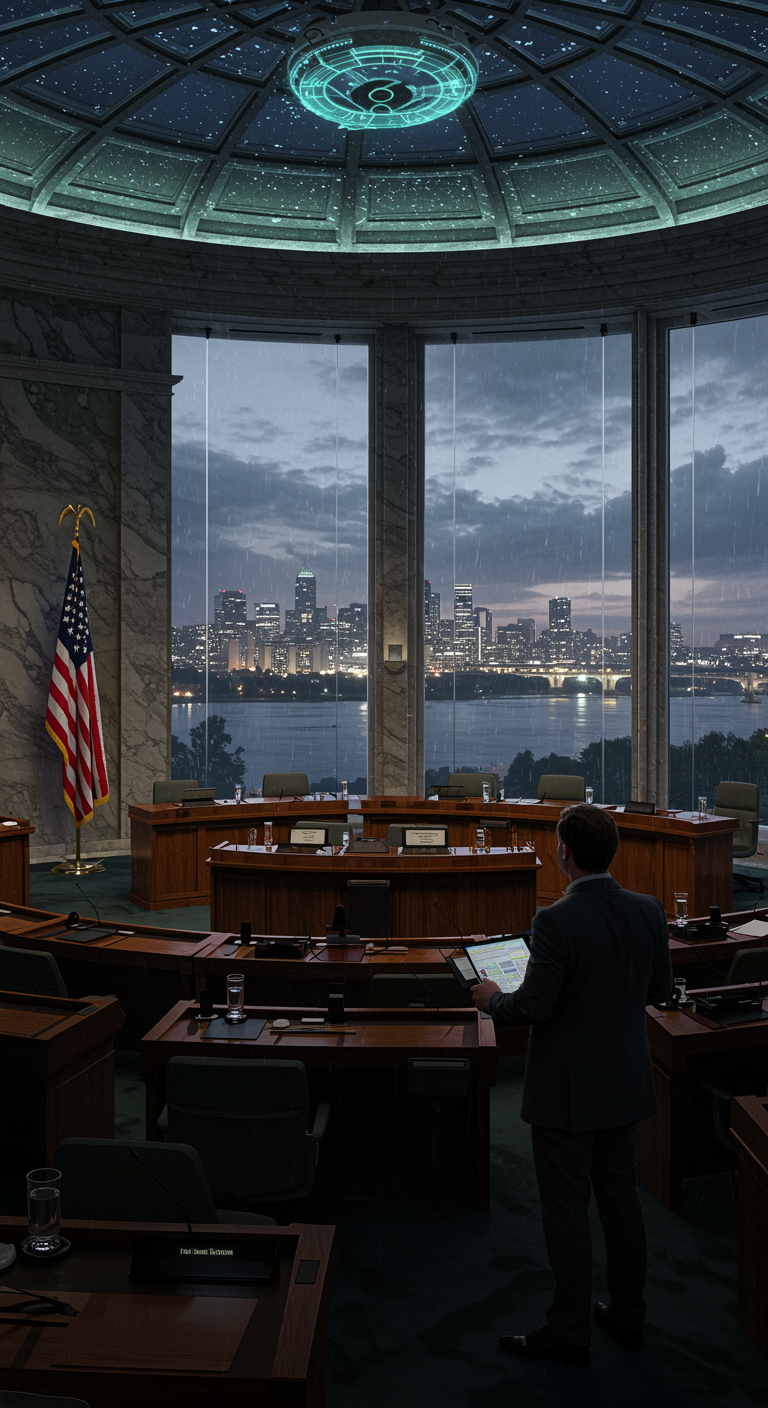
If you stand beneath the rotunda at dawn, the ceiling shows the known constellations drifting in slow procession, an old architect’s trick made from occlusion glass and a hidden ring of projectors. Tourists always look up. They applaud like they have been granted something sacred. Staffers never do. We already know how far away the stars are.
Two hearings this week will be remembered.
The first wore its title like armor: External Security and the Pittman Incidents: Status Update.
The second was quieter and more dangerous, held behind closed doors under a title no one outside the committee would bother remembering: Interpolity Coordination After Action Review: KTI Port Authority versus Colonial Transport Union (Hallmark).
You do not need to care about Hallmark to understand what follows. You only need to know that men with expensive shoes can make a dockworker disappear into an acronym.
I arrived early for the Pittman hearing because Chairwoman Dey believes empty rooms invite surprises. The chamber lights were still low, the dais a half circle shaped like a smile that had never once reached the eyes. Through the tall windows, the city was beginning to wake—transport ribbons flaring alive, towers shedding night one reflective pane at a time, the river smoothing itself into a disciplined sleeve of motion. If you stood beneath the rotunda and looked straight up, you could watch a false Vega slide slowly across the ceiling, calm as a saint. I did not look up.
Staffers appeared by degrees, as they always do, growing from the carpet like mushrooms after rain. Data aides in sober jackets. Security in soft armor designed to look less threatening than it really is. Stenographers setting old mechanical keyboards onto polished desks because the old methods still fail less loudly than the new ones. I laid out witness placards, poured water, and read the day’s brief three times, the way a person reads a diagnosis when the symptoms are still arriving faster than the language for them.
Unknowns: What is taking Pittman’s air?
Unknowns: Why do the attack traces resemble weather more than weapons?
Unknowns: Why does the Mutual Defense Force keep sending ships that return with nothing but damaged hulls and alarm logs no one admits to authoring?
When the public began filing in, the room tightened in a way only grief can manage. You can always identify the relatives. They move carefully, deliberately, as if any sudden motion might break the last thread connecting them to someone not yet formally listed among the dead. A woman in the second row wore a scarf the color of new leaves. She kept two fingers pressed to the knot at her throat, as though that was where her pulse had relocated.
The first witness was a climatologist—soft-spoken, precise, and visibly furious. He presented models that looked at first glance like thunderstorms, except these systems formed at ground level and climbed instead of falling, with pressure waves rolling outward where no natural cycle should have allowed them to. He said the pattern was not atmospheric.
He said it was motivated.
I wrote that word down and underlined it once.
The second witness, a logistics officer from the Mutual Defense Force, spoke like a ledger that had learned resentment. Relief depots were staged two jumps out. Corridor lanes were being held open under treaty obligations that no one fully trusted. Pirates were gathering at the slips, she said, because grief always attracts a certain class of entrepreneur. When one of the committee members asked whether the MDF could guarantee the safety of any evacuation attempt, she stopped sounding like a spreadsheet.
“Guarantee?” she said. “There are no guarantees. There are good days and days when we wrestle with math that hates us.”
The third witness was an environmental systems engineer from Pittman’s planetary infrastructure authority, a man whose face looked as though weather had been writing itself across it for years. He said the first time the air went wrong, it felt like an argument with a mountain. The second time, it felt like a decision.
He said he dreamed of a city where every window could stay open and every child could taste rain that belonged to them.
When the chair asked whether he believed the attacks were a weapon, he answered without hesitation.
“I believe someone found a way to push sky around like furniture.”
We recessed at noon. I walked the south colonnade and bought a bowl of noodles from a kiosk older than I am. The vendor’s sleeve had been repaired with such neat stitching it looked almost ceremonial.
“You work in there?” he asked, nodding toward the committee chamber.
“Near there,” I said.
“Then tell them to go faster,” he said. “My sister’s girl is on Pittman. She sends messages that end before the sentence does.”
He added extra broth to my bowl.
That, in a city like this, is a kind of vote.
On my way back, a man in a gray coat matched my pace so neatly he might as well have been cast from my own shadow. He was the sort of average that attracts attention by seeming designed not to—hair a forgettable color, shoes more expensive than my apartment window, eyes trained to reflect rather than reveal. He said my name without asking whether it was mine.
“Arelle Cho,” he said. “You collect testimony. You shape the questions. You might want this.”
He handed me a wafer sealed in tamper paint, the expensive kind that erases itself if questioned incorrectly.
“What is it?” I asked.
“A weather report,” he said.
He smiled because we both understood how unfunny that was. Then he was gone before the doors finished reflecting him.
Back beneath the rotunda, I took the long route to my desk, passing the relief friezes of the Founders’ Landing, the first water drawn through the city’s pipes, the night the artificial constellations were switched on and the building declared complete. New Washington believes its own mythology with real conviction. In that moment, I wanted that conviction to function like armor.
I did not open the wafer until the hearing adjourned. Chairwoman Dey is strict about contamination, even the metaphorical kind. By the time I broke the seal, the chamber was empty except for two cleaners whispering in the back row. I slid the wafer into my slate. It asked for a code phrase.
The note beneath the paint gave me one:
It rains upward.
The file opened into layered atmospheric maps over power-grid telemetry and tunnel-corridor attention profiles. It showed me exactly what the climatologist had described, only angrier. It showed what the logistics officer had implied, only closer. And at the bottom sat a photograph of equipment I recognized from trade expos, rejected procurement bids, and one ethics review I had once been told to stop reading.
A corporate prototype.
It had been designed to stabilize microclimates over open-pit mining zones—to suppress dust devils, repair torn convection cells, and keep workers breathing where a planet would have preferred them not to. It was never meant to be mounted on a truck bed beneath an open sky like a dare made by someone with shareholders behind them.
The watermark was corporate. Internal. One of the hypercorps everyone pretends not to depend on while depending on them for half the infrastructure that keeps civilization from coughing itself apart.
Let us call them LatticeSun.
You have heard of them.
I sat there for a long moment, breathing slowly, one hand against the stone beneath the marble veneer, and said aloud—because sometimes the air needs a witness—
“Do not let me be wrong.”
The second hearing, the one about Hallmark, began after dark.
No cameras. Fewer witnesses. More men with perfect hair and expressions calibrated to suggest reasonableness while preparing to destroy language from the inside. My job there was simple in theory and impossible in practice: make sure the words we used meant what they had meant last month, and that we did not invent a new truth by administrative drift.
That is how the city works, in the end. Not by speeches. Not by monuments. By the fragile maintenance of meaning under pressure.
Outside, New Washington glowed beneath its managed weather and false constellations. Inside, we discussed transport unions, port authority liability, and the vanishing class of people who do not appear in the official summaries except as losses absorbed into efficiency metrics.
But all through the meeting, Pittman sat at the edge of my thoughts like a storm front refusing to move off the map.
The sky there is being pushed around by someone.
And here, three hundred floors above a disciplined river, men in perfect collars are still deciding whether to call that weather, war, or business.