
Whispers on the Wind
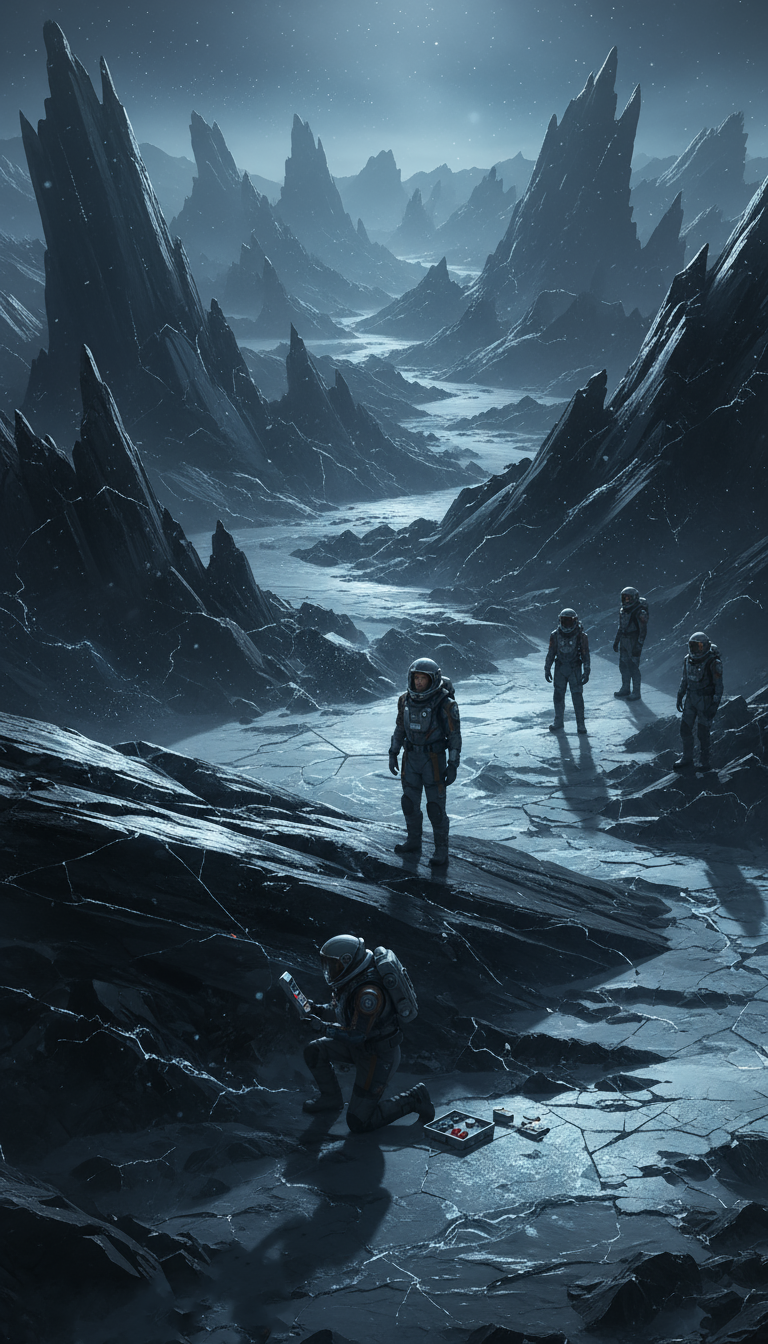
Day 14: Arrival
We landed in the early hours beneath the cold light of three moons. Their glow washed the valley in silver and pale gold, casting long shadows that shifted like living things as the wind moved through the rocks. The air here is thin but breathable, sharp enough to bite the lungs with every inhale. Towering cliffs rise on all sides, their upper reaches swallowed by drifting mist, while below them stretches a wilderness of cracked stone, frozen streambeds, and fields of glimmering frost.
It is beautiful in a way that refuses warmth—a beauty born of silence, scale, and stillness. I stood for a long time after disembarking, taking in the valley and remembering exactly why we came this far into the unknown. The others are eager to begin the survey, but there is a heaviness to this place none of us can quite name. Even the air seems to be holding its breath.
Day 15: The Frozen River
This morning we began our first survey along what appears to have once been a major river system, now frozen into jagged ribbons of black and gray stone. Every step rang faintly through the brittle crust beneath us, and scattered through the exposed surface were glints of a deep reflective mineral threading through the rock. Patel collected samples, and preliminary scans suggest a rare silicate-metal compound. The way it bends light is extraordinary. In places it looks less like stone than liquid glass trapped beneath the surface.
The wind through the cliffs carries a haunting resonance. It almost sounds like voices whispering across the valley, though we know it is simply air moving through narrow passages in the rock. Even so, the effect unsettles me. Clara said she felt as though the land itself were aware of us. I laughed when she first said it, but now, when the wind falls quiet for a moment, I find myself listening more closely than I should.
Day 17: The Mist
At dawn, a strange mist rolled through the valley floor—low, deliberate, and impossibly graceful, curling around the rocks like luminous smoke. It shimmered faintly as it moved, carrying hints of green and blue beneath the pale morning light. Our instruments detected bioluminescent particles suspended in the vapor, possibly microbial in origin. If that finding holds, it would mark the first confirmed living organism discovered on this world.
What unsettles me is the way the mist appears to respond. When we approach, it withdraws. When we stop, it returns, drifting inward as if studying us in turn. Clara extended her hand into it, and for a brief moment the vapor wound itself around her fingers before dissolving back into the cold air. Patel insists it is only a temperature differential causing localized movement. He may be right. But I cannot ignore the feeling that the mist recognized our presence and chose, in its own way, how close to come.
Day 19: The Sky’s Shift
The valley changes every day, but this morning it changed in a way none of us will forget. All three moons rose together, and the sky transformed into a deep, luminous violet. Across that strange twilight, waves of light rippled along the horizon like living auroras—far brighter and more structured than anything recorded on Earth.
Our readings became erratic almost immediately. The energy patterns defied easy classification, fluctuating in sequences too ordered to feel random and too complex to reduce to simple atmospheric behavior. For hours, we stood in silence watching the colors fold and pulse above us. Beneath our boots, the ground vibrated faintly, as though the planet itself were breathing in time with the sky.
It was breathtaking, but it was not comforting. Clara described it as a symphony—the sky and land moving in perfect rhythm. She may be right. There is harmony here, but it belongs to a system so old and so complete that we can only glimpse it from the outside.
Day 21: The Crater Lake
Today we followed the valley deeper and found a sight that left all of us speechless. At the center of a wide impact basin lay a vast frozen lake, its surface smooth and unbroken, gleaming beneath the moons like polished glass. The cold in the crater was sharper than anywhere else we have measured, and the air carried a faint static charge that prickled across exposed skin even through the suit layers.
When Patel drilled into the ice to extract a core sample, the cracking sound echoed across the entire basin. A deep, resonant hum followed, traveling up through the ice, the rock, and our own bodies. We felt it in our boots and in our ribs. The readings that came back were extraordinary. Beneath the frozen surface lies a mass of immense density, and the water below glows faintly with shifting bands of green and blue—colors uncannily similar to the mist we encountered earlier in the expedition.
Clara believes the lake could support microbial life, perhaps even something more complex than we have yet imagined. The possibility has electrified the whole team. We have decided to establish a temporary base camp along the crater rim and continue deeper analysis from there.
Day 23: The Whispers
The winds have changed.
They are louder now, and the resonance within them no longer feels like chance. What once resembled distant murmuring has grown clearer, almost structured. Patel insists it is still no more than air and geology producing acoustic artifacts. Clara swears she heard her own name carried through the gusts this evening. I have said nothing to the others, but last night, in the darkness just beyond camp, I thought I heard mine as well.
Shortly after midnight, another tremor passed through the valley—brief, but strong enough to rattle equipment cases and wake half the camp at once. Moments later, the lake answered with that same low, interior hum. The longer we remain here, the harder it becomes to believe these phenomena are separate. The cliffs, the mist, the ice, the light, the trembling ground, the voice-like wind—they feel less like individual events and more like parts of a single living system.
I stood at the edge of the lake this evening and looked down into the dark beneath the ice. For the first time in a long while, I felt small in a way that was not frightening. Whatever this world is, it is alive in its own fashion, and we are only temporary guests in a story already unfolding without us.
Day 25: The Symphony of Nature
Our mission is ending, but I do not think any of us will leave this valley unchanged.
Every moment here has felt like part of a larger design—a song too vast for us to hear in full, but one whose fragments we have been allowed to witness. The light in the sky, the bioluminescent mist, the frozen lake, the trembling earth, the whispers carried by the wind—each phenomenon seems to move with purpose, as though all of them belong to an ancient harmony that predates our arrival by ages beyond comprehension.
There are no ruins here. No monuments. No crafted relics waiting to prove significance in terms familiar to us. The planet itself is the mystery, and its beauty lies in the fact that it does not need translation to be profound. As I pack for departure, I find myself accepting something I once would have resisted: understanding is not always the highest goal. Sometimes it is enough to witness, to listen, and to leave with more reverence than certainty.
I know I will leave a part of myself here—in the valley, in the wind, in the hum beneath the ice. I am grateful to have stood in a place that does not need to be known in order to be magnificent.
Exploration Journal of Dr. Megan Wilson
Location: Unnamed Planet, Sector 97-B