
Kunlan Outpost Chronicles
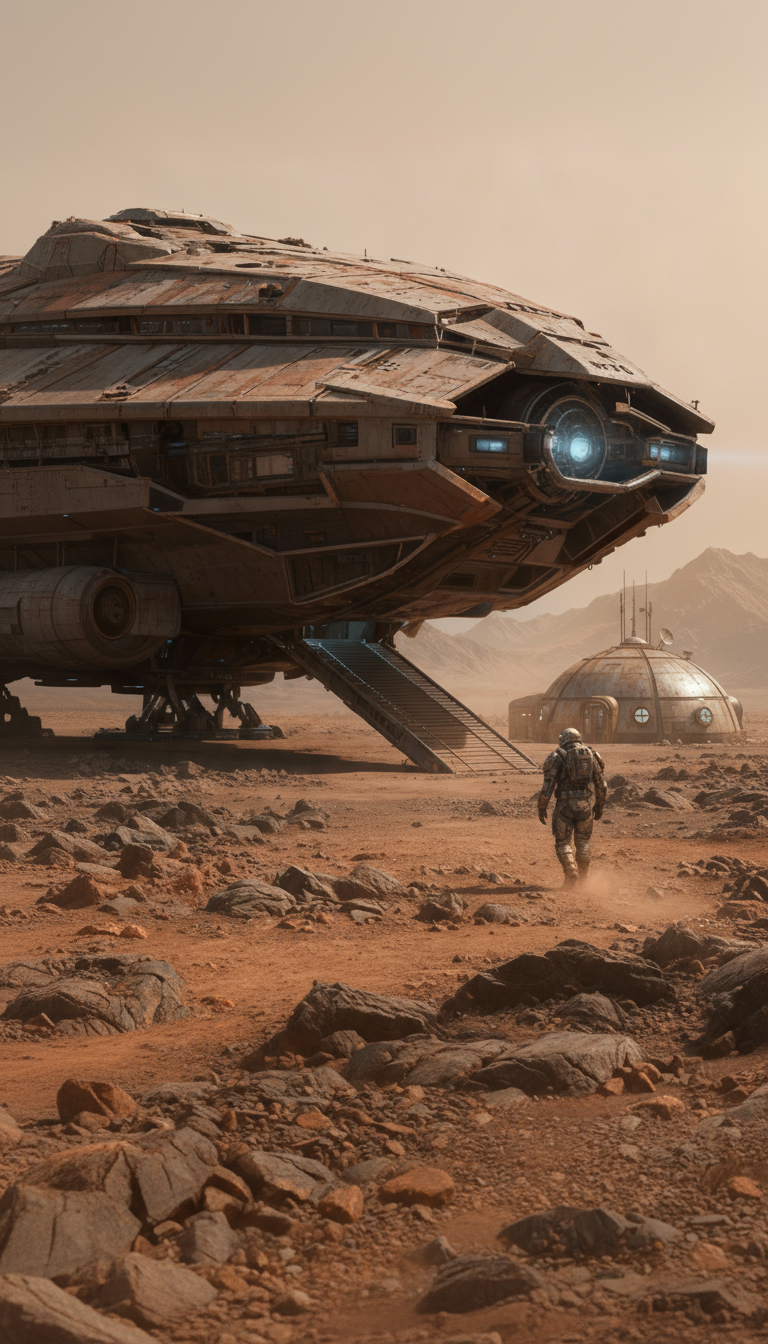
Day 1: Arrival at the Trader Outpost
We touched down on Kunlan this morning, the Wayfarer’s engines groaning in protest as they settled into silence. The sound vanished almost immediately into the stillness outside, swallowed by a world that seemed determined to mute everything that entered it. Above us, the sky hung in a heavy slate-gray sheet, low and oppressive, while rust-colored dust coated the ground in shifting drifts that moved at every step as though the planet itself were restless beneath our boots.
Kunlan is not barren, but it is merciless. The land offers little freely and seems to resent every attempt to tame it. Even so, people come. They always do.
The trader outpost stood against the emptiness like a challenge thrown at the planet’s face—a dome of reinforced plating, scarred by weather and time, built to endure storms, bad luck, and the desperation of those who passed through it. It was the kind of place that seemed to collect stories in its walls: bargains made in haste, fortunes won, fortunes lost, and promises that probably should never have been trusted. As I stepped down the ramp, the crunch of gravel under my boots reminded me that even here, light-years from Earth, we keep building footholds wherever we can.
Day 2: The Faces of the Outpost
The outpost was busier than I expected. Traders, miners, drifters, and contract crews moved through its corridors in a steady current, each carrying the dust of Kunlan and whatever history had driven them this far from safer worlds. Frontier stations always develop their own gravity. People arrive for cargo, repairs, or shelter from the storms, and somehow end up staying long enough to become part of the machinery.
I met Dax in one of the maintenance bays, half-buried beneath a service rig with both hands blackened by grease. He was the station’s chief mechanic, a man with rough hands, a dry sense of humor, and the kind of tired eyes that usually belong to people who have seen too much and survived anyway. He had a scar running down one side of his jaw, pale against skin darkened by work lights and bad weather.
“Welcome to the edge of nowhere,” he said, tightening a bolt without looking up.
Later, over a shared flask of something strong enough to strip varnish, he told me the scar came from a deal that had gone wrong. He smiled when he said it, but the smile never reached his eyes. Men like Dax do not survive outposts like Kunlan by explaining more than they have to.
Day 4: Trade and Tensions
Trading on Kunlan is as severe as the landscape. Nothing comes easy, and every negotiation feels one step removed from a fight. We came in carrying rare alloy stock and needed to leave with medical supplies and purification units for the next leg of the run. On a softer world, that would have been straightforward. On Kunlan, even necessity has to be wrestled into agreement.
A sect of Gliesean traders watched us from across the exchange floor, saying little and missing nothing. Colonists and opportunists both, they measured every word, every crate, and every hesitation as if deciding whether we were fellow merchants, useful fools, or future prey.
The bargaining itself was handled by Old Man Soren, the outpost’s lead trader and the sort of man who looked as though he had been carved from the same rock as the surrounding badlands. His voice was a rasp worn down by years of dust and bad air, but it still carried enough force to stop a room from pretending it held leverage.
“This isn’t Earth, Captain,” he told me, narrowing his eyes across the table. “Out here, you earn every drop.”
He meant every word of it. In the end, we traded half our alloy stock for the supplies we needed. By Kunlan standards, it was a fair exchange—which is to say we walked away with enough left to call it a success.
Day 6: The Storm
They warned us about Kunlan’s storms, but warning and experience are never the same thing.
The sky darkened so quickly it felt unnatural, as though the sun had been smothered behind a curtain of ash. Then the wind hit. It came screaming across the outpost in a wall of force, carrying razor-fine dust that hammered the dome plating like shrapnel. We barely got the Wayfarer locked down before visibility disappeared entirely.
Inside, the entire station shuddered under the assault. Power flickered in uneven pulses, throwing the corridors into alternating flashes of dim light and absolute blackness. Somewhere in the dark, I heard boots scraping across metal decking, someone whispering a prayer under their breath, and Dax’s voice moving through it all—steady, calm, directing people toward the emergency shelters as though this was simply another part of the day.
I still had the flask Soren had passed me after the trade. I took a long pull from it while the storm beat against the walls. The burn in my throat felt like a small act of defiance against the cold violence outside.
When the winds finally eased, the silence that followed struck harder than the storm itself. The world beyond the dome had been rearranged. Boulders had shifted. Paths had vanished. Red dust lay over everything in thick sheets, like the planet had thrown a burial cloth across its own face. And yet the outpost was still there—scarred, battered, and standing, much like the people inside it.
Day 8: Departure and Reflection
The storm has passed, the trade is done, and it is time to leave Kunlan behind. As I climbed the ramp back into the Wayfarer, I turned for one last look at the outpost. From a distance, it seemed impossibly small, a defiant metal shell set against an endless ocean of rock, wind, and dust. But perhaps that is what humanity has always been at its core: a collection of small, stubborn footholds carved into places that never wanted us there.
“Ready for takeoff, Captain?” Javi’s voice crackled over the comm.
I looked once more toward Dax and the others, their figures already fading into the red haze beyond the landing zone.
“Ready,” I said.
The Wayfarer rose through the dust on a pillar of engine thunder, carrying us away from Kunlan and its weathered outpost. Its stories would remain behind, waiting for the next wave of traders, drifters, and hard-luck dreamers willing to gamble their lives on the edge of nowhere.
— Journal of Captain Jenna Moran