
The Biologist’s Field Journal
Day 1: Arrival and First Impressions
We established base camp today at the edge of the Aurion Basin, a bioluminescent wilderness that stretches for hundreds of kilometers in every direction. Even before our first full survey, it was clear this place does not resemble any ecosystem in the Terran record. The air itself seems alive, carrying a low, almost musical hum beneath the canopy of color-shifting flora. Every scan returns complexity upon complexity—dense biodiversity, unfamiliar chemical signatures, and life forms unlike anything previously cataloged. It is beautiful in a way that feels almost deliberate, as though the basin is not merely inhabited by life, but structured by it.
Day 3: First Flora Specimen — Aurion Bloom
Our first major botanical specimen is what we have designated the Aurion Bloom, a remarkable flowering organism that shifts in color from deep violet to luminous amber as daylight fades. Its nectar contains a complex sugar analog with promising biofuel potential, though the substance is unstable once exposed to air. As it oxidizes, it releases a sweet vapor that appears to attract predatory insectoids from considerable range.
We learned that lesson at an unpleasant cost. Dr. Reyes was stung while collecting a sample and is still recovering under observation. The incident has forced a necessary adjustment in our handling protocols. The basin does not tolerate carelessness, and nothing here should be mistaken for harmless simply because it is beautiful.
Day 5: First Fauna Specimen — Plasma Beetle
Today we encountered a swarm of what we are calling Plasma Beetles, luminescent insectoid organisms that feed primarily on Aurion Bloom nectar. Their bioluminescence intensifies dramatically when threatened, producing a burst of light powerful enough to disorient or temporarily blind nearby predators. The defensive display is both elegant and highly effective.
We successfully captured one specimen for observation. Preliminary behavioral analysis suggests a form of hive-level communication, likely mediated through light pulses and short-range bioelectrical signaling. If confirmed, it would represent a highly sophisticated social structure in an organism whose outward simplicity is deceptive. As with nearly everything in the basin, the deeper we look, the more complexity we find.
Day 7: Predator Sighting — Razorback Lurker
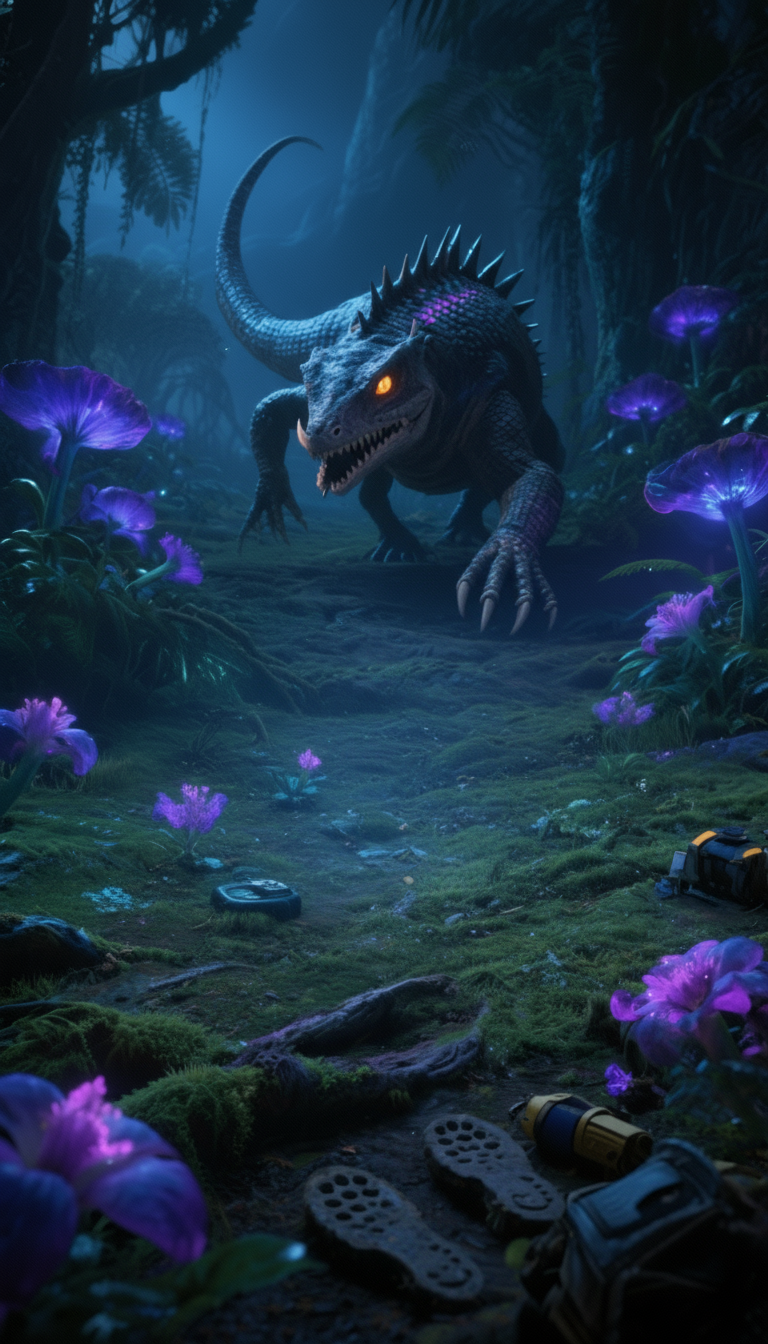
We had our first confirmed sighting of a major predator tonight. The creature emerged near the perimeter of camp shortly after dusk—a reptilian quadruped roughly the size of a Terran bear, moving with unnerving patience through the undergrowth. Its scales carried an iridescent sheen, and the raised ridge along its spine emitted a faint glow in the dark, giving it an almost spectral outline beneath the basin canopy.
We observed it stalking and killing a smaller animal with extraordinary precision. There was nothing wild or wasteful in the attack. Every movement was measured, efficient, and controlled. It was one of the most unsettling displays of predation I have ever witnessed. Magnificent, yes—but magnificent in the way a weapon can be magnificent.
Day 9: The Living Forest
The deeper we moved into the basin, the stranger the ecosystem became. Today we confirmed that many of the larger tree-like organisms are linked through low-frequency vibrational signals transmitted along their root systems. The pattern is strikingly reminiscent of Earth’s mycelial communication networks, though the level of coordination here appears far more advanced.
These signals seem to regulate spore release, synchronized growth responses, and localized environmental adaptation. In effect, the forest is not merely a collection of individual organisms sharing the same terrain. It functions as an integrated biological network. The implication is difficult to overstate. This forest is not simply alive. In a meaningful ecological sense, it may also be aware.
Day 10: Ghost Striders
At dusk we sighted one of the most extraordinary life forms yet encountered: six-limbed translucent organisms that drift just above the ground with such smooth motion they seem almost unreal. We have designated them Ghost Striders. Their movements were not random. They appeared to synchronize with the low-frequency vibrations moving through the surrounding trees, suggesting some form of symbiotic or responsive relationship with the larger forest network.
Tissue analysis from residual skin material indicates the presence of anti-toxic proteins with significant medical potential if they can be replicated synthetically. It is too early to speculate on practical applications, but the possibility alone is extraordinary. This world does not simply challenge our understanding of biology. It expands it.
Day 12: Hostile Symbiosis
Today we witnessed one of the most brutal examples yet of how fluid the lines between predator, prey, and environment truly are in the Aurion Basin. A class of carnivorous flora we have named Crimson Snares appears capable of parasitizing larger fauna through rapid neurotoxin injection followed by direct nutrient extraction.
We observed a full-grown Razorback Lurker become entangled in one of these organisms and drained within minutes. The event was swift, efficient, and horrifying. On Terra Secundus, even apex predators are never fully secure. Every advantage seems temporary, every niche contested. The balance here is not stable in the comforting Terran sense. It is dynamic, ruthless, and constantly shifting.
Reflections and the Bigger Picture
With each passing day, it becomes harder to think of Terra Secundus as merely a colony world. It is something far more profound—a living laboratory of evolution, adaptation, and ecological complexity on a scale we are only beginning to understand. What makes this place so extraordinary is also what makes it dangerous. Its beauty and its brutality are not opposites. They are expressions of the same underlying truth.
As I prepare my report for the Colonial Science Directorate, I am left with a growing sense that the Aurion Basin is not an anomaly, but a beginning. If one region of this world holds this much wonder, this much biological ingenuity, and this much danger, then there is no telling what waits beyond it. Terra Secundus may yet prove to be one of the greatest scientific revelations in human history—or one of the most humbling.
Field Scientist: Dr. Eliza Marlowe
Location: Aurion Basin, Terra Secundus
Mission: Catalog Flora & Fauna for Colonial Science Directorate
Log Period: Days 1–12