
Orbital Drop onto Pittman
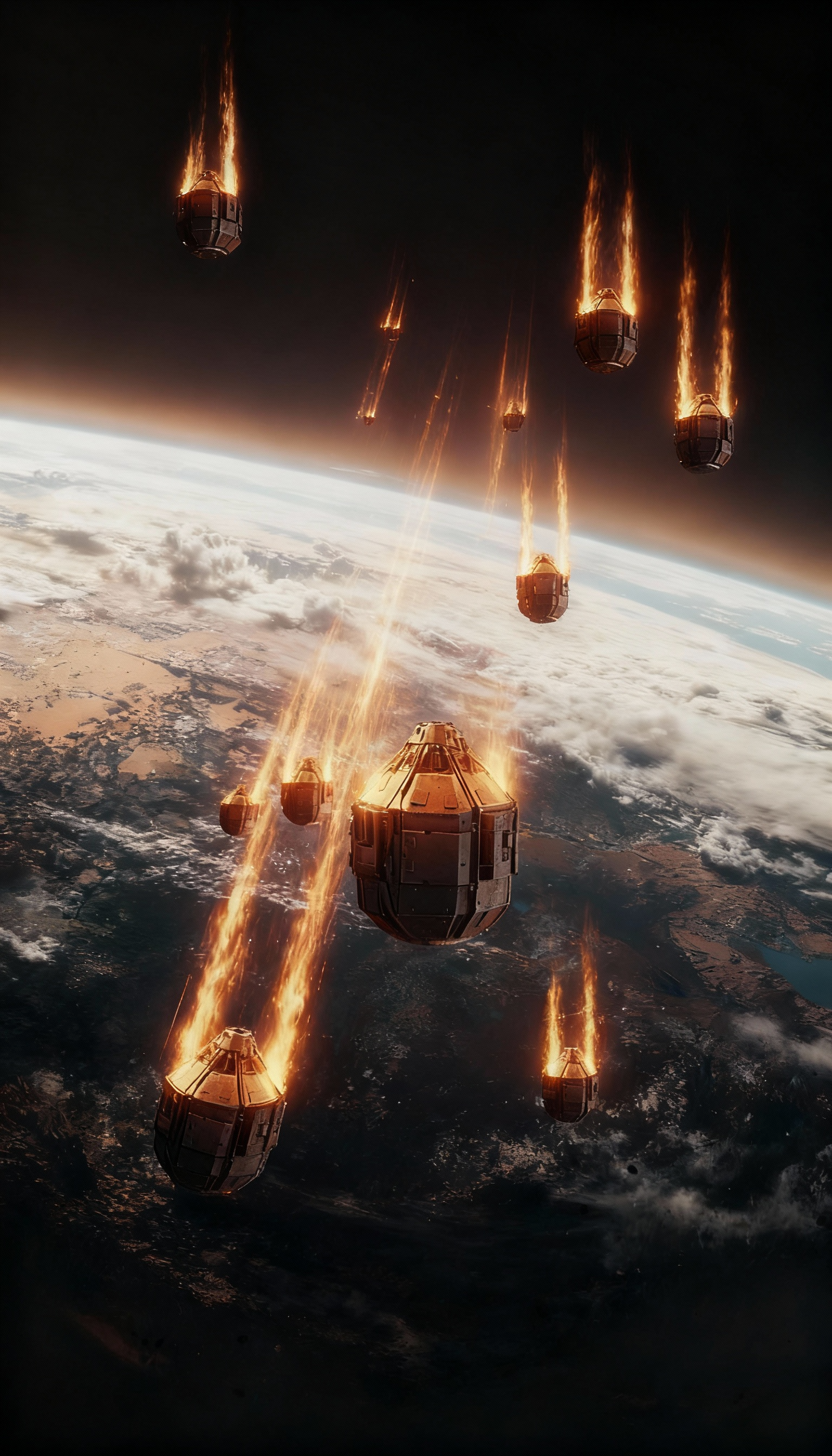
Day 1: Deployment Orders
The briefing was quick—too quick. We were already aboard the USS Liberty, holding orbit over Pittman, when the captain gave the order for a full combat drop. Details were scarce, which usually means the situation below is worse than command wants to say out loud. What little we were told was enough: an MDF garrison on the surface had been under siege for days by an unidentified alien force. Reports described them as fast, lethal, and equipped with technology beyond anything we had previously encountered.
That was all we needed to hear.
Within minutes we were suiting up. Training prepares you for procedure. It does not prepare you for the silence that settles over a unit when everyone understands they are about to jump into something no one fully understands. My drop pod was sealed and ready. I checked my weapon, my ammunition, my seals, then checked them again, less because I doubted the gear than because ritual gives your hands something to do when your mind starts looking too far ahead.
The usual jokes were gone. No chatter. No false bravado. Just Marines running final checks in silence, each man alone with his own thoughts. We had all seen combat. But facing another human force is one thing. Dropping toward an enemy no one can properly describe is something else entirely.
Day 2: The Drop
The inside of a drop pod feels like a coffin designed by engineers—tight, functional, and mercilessly impersonal. There is no room to move, only the restraint harness across your chest and the constant vibration of onboard systems humming through the seat frame. My HUD came alive in a wash of tactical overlays, mission prompts, and biometric data, but all of it blurred into irrelevance. The only thing that mattered was the countdown in the corner of my display.
When it hit zero, gravity seized us.
The descent was violence from the first second. The pod shook so hard it felt as if the hull might split apart around me. Friction turned the exterior into a furnace as we tore through Pittman’s upper atmosphere, and every passing kilometer registered in my bones as much as on the display. Ten thousand meters. Eight. Five. Then impact.
The landing hit like the hand of God trying to drive us through the planet. The shock absorbers held, barely. For one disorienting instant all I could see was smoke, sparks, and warning glare blooming across the display. Then the hatch charges fired, the pod opened, and the battlefield rushed in.
Day 2: Touchdown
The heat hit first. Then the smell—burned metal, dust, ozone, and the bitter edge of plasma fire. I sprinted from the pod and joined the others as we formed up at the designated rally point. Pittman’s surface was worse than the orbital scans suggested: a shattered wasteland of jagged rock, crater fields, and scorched ridgelines, as though war had become the planet’s natural geography.
In the distance, I could see the MDF garrison still holding a defensive line, if it could still be called that. Their armor was blackened, their movements exhausted, and even from range I could see the deadened look in their eyes. These people had been fighting too long with too little and had somehow not broken yet.
Our objective was straightforward on paper—reach the garrison, reinforce the perimeter, and push the enemy back. But one look at the ground between us and them made the truth obvious. Nothing about this operation was going to be simple.
Day 3: Contact
We never reached the garrison before first contact.
A sharp, high whine tore across the ridge line, and a heartbeat later plasma fire ripped through the rocks around us. The ground erupted in glass and debris. We dove for what cover we could find and scanned for targets through smoke and dust. That was when I saw them clearly for the first time.
Tall, slender figures moving with impossible speed. Their armor did not look manufactured so much as grown—organic, shifting, alive in the way it changed color and texture as they moved. Their weapons were sleek and almost silent, but their effect was anything but. Every shot cut through steel and flesh with frightening precision. I shouted for the squad to return fire, and we did, but it felt like trying to hit shadows with bullets.
One of our Marines went down beside me. His chest plate had been burned through so cleanly it looked as though the armor had simply given up and melted away.
We fought our way back toward the garrison in bursts—fire, movement, cover, repeat—but even then it did not feel like battle in any familiar sense. It felt like being stalked. We were not meeting an enemy line. We were being hunted.
Day 4: Defensive Line
We have been pinned inside the garrison for more than twenty-four hours now. The attacks come in relentless waves, never leaving enough time to recover, reorganize, or even think clearly for more than a few minutes at a stretch. Every lull is spent patching wounded, redistributing ammunition, checking barricades, and bracing for the next impact.
The MDF troops are still fighting, but they are running on fumes and discipline alone. Whatever reserves they had were burned away before we ever touched down. Captain Duvall, the garrison commander, briefed us this morning with the kind of expression officers wear when they know the facts are worse than their words. Reinforcements are still days away. Officially, we are ordered to hold. Unofficially, everyone understands what that means. We are being told to survive if survival is possible.
What frightens me most is not their weapons. It is how quickly they adapt. Every tactic we use works once, maybe twice, then loses value. Their fire cuts through armor like paper, and I have watched them cross killing ground with a speed that makes normal targeting feel useless. From the line, it looks almost as though they are learning us in real time.
Day 5: The Night Attack
They came after sunset.
Plasma fire painted the sky in violent blue-white arcs, turning the darkness into something feverish and unreal. The walls shook under each impact. I was on the eastern perimeter when the outer barricade gave way. One of them came through the smoke straight at me—seven feet tall, armor rippling like liquid metal, its eyes lit with a cold, unreadable blue. It raised its weapon, and I threw myself behind cover an instant before a beam carved the air where I had been standing.
After that, the whole perimeter collapsed into chaos.
Shouting. Flashing fire. Explosions echoing across the compound. Energy weapons turning the dark into a strobe of death. Somehow, somehow, we pushed them back before they could fully overrun the breach. But the cost was brutal. Dozens of Marines are gone, and the supply situation is beginning to turn desperate. We are holding the line now by exhaustion, anger, and sheer refusal to lie down and die.
Day 6: Close Call
The northern barricades fell at first light.
We were already moving when the enemy broke through—fast, silent, and close enough that rifles became secondary to instinct. The fight turned immediately into close quarters. Knives. Rifle stocks. Hands. Desperate violence at distances too short for thought. Their strength is unnatural, their movements precise in a way that makes them feel less like living soldiers and more like execution machines. Three more Marines died within arm’s reach of me before we drove the attackers back behind the breach line.
I have not slept in days. None of us have, not really. The adrenaline keeps us standing and the fear keeps us moving. Every pause feels like the calm before extinction. At some point there stopped being room in my mind for anything beyond the next magazine, the next target, the next wall that needs to hold for five more minutes.
Day 7: The Turning Point
We thought we had already seen the worst they could send against us. We were wrong.
Scanners picked up new energy signatures just before the next assault wave arrived, stronger and denser than anything recorded in previous contacts. Then they came into view. Massive figures—heavier, broader, heavily armored, carrying weapons that emitted a deep subsonic vibration before firing. The sound hit the chest before the shot ever landed. We started calling them Bashers.
One of them hit the western wall and tore through concrete and steel as if both materials were cloth. We threw everything we had at it—rifles, rockets, grenades, anything that could still fire—and still it kept advancing. The fight that followed was less a defense than an act of collective desperation. Somehow we forced the attackers back before they broke the entire line, but by the end all they had left behind was wreckage, scorched stone, and the reek of ozone hanging over the compound.
The garrison still stands.
Barely.
Day 8: The Plan
Captain Duvall gathered what remains of us this morning. Reinforcements are still too far away, and our defenses are failing faster than we can rebuild them. But the Bashers gave us something we did not have before: a trail. Our sensors traced their energy signatures back toward a source deep in the surrounding mountains—what command now believes is an alien command site or staging node.
So we are going after it.
At dawn, we strike the mountains.
It is a desperate gamble, but waiting here to be ground down one wall at a time is not strategy. It is execution by delay. Better to hit first. Better to die moving than sit behind broken concrete waiting for the next breach.
My company has been chosen to lead the assault.
If this is my last entry, let it stand on record that we fought with everything we had. Pittman will not fall quietly.
— Sergeant Michael Raines, United States Marine Corps, Forward Detachment, Pittman Surface Campaign