
Business on New Atlantis
Day 1: Arrival on New Atlantis
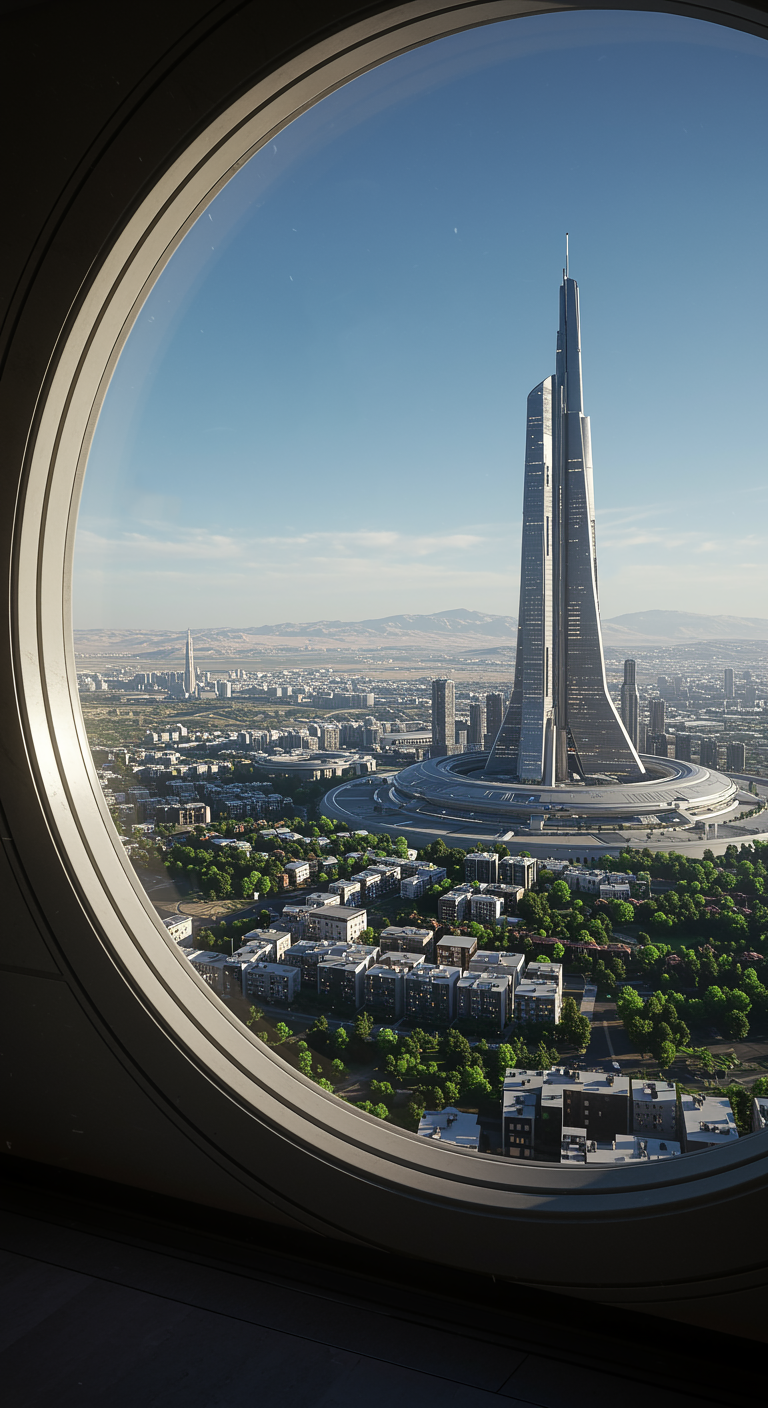
The descent to New Atlantis was smoother than I expected. The orbital shuttle slipped through the planet’s thin atmosphere with barely a trace of turbulence, giving me my first clear view of New Europa—the sprawling capital set within the Thames Valley. It is difficult to reconcile what I saw below with the historical records. This land was once barren, transformed over decades of disciplined terraforming into a thriving metropolitan and agricultural center. When I stepped off the shuttle, the lighter gravity was immediately noticeable, though still substantial enough to feel grounded. It will take time to adjust.
The city is an elegant blend of modern precision and deliberate echoes of Earth. It feels as though its planners wanted to honor the past without becoming trapped inside it. I have come for the annual convention on bioengineered crops, one of the fastest-growing sectors on the planet. New Atlantis has become a leader in agricultural innovation, producing strains uniquely adapted to its soil chemistry, atmospheric conditions, and climatic volatility. The implications for off-world development are enormous, and I intend to see as much of it firsthand as possible.
For now, however, the first order of business is simpler: check in at the hotel and prepare for the week ahead.
Day 1: The Royal Horizon
The Royal Horizon is even more impressive than I was led to expect. My suite sits high above the valley, framed by wide circular windows that open onto a sweeping view of New Europa and the agricultural belts beyond it. From this height, the fields appear as an immense living mosaic, green and silver beneath the pale light of the local sun. It is hard to believe this was once a landscape of dust and stone.
The hotel itself is a study in controlled luxury—glass, metal, and ambient light held in near-perfect balance. The service is effortless in the way only the very best hospitality can be, each need anticipated before it fully becomes a request. Standing at the window this evening, watching the sun fade over the valley, I found myself thinking less about commerce and more about scale. Entire worlds reclaimed. Entire ecosystems coaxed into existence through science, capital, and patience. It is difficult not to feel humbled by that.
Day 2: Opening Day of the Convention
Today marked the beginning of the Bioengineering Convention at the New Europa Convention Center, a vast complex of white stone, luminous glass, and blue architectural lighting. As a field representative for AstroGenetics, my objectives are straightforward enough: secure contracts, build relationships, and leave with partnerships worth defending in the boardroom when I return home.
The keynote speaker, Dr. Amira Shehzad, opened the event with a compelling address on planetary resilience through engineered agriculture. Her central point was difficult to ignore: on worlds like New Atlantis, agriculture is not merely economic infrastructure. It is civilizational infrastructure. Without it, settlement remains fragile. With it, entire futures become possible.
The day’s presentations focused on crop strains designed to endure the planet’s harsher conditions—elevated ultraviolet exposure, mineral-rich but nutrient-poor soil, and abrupt temperature swings across growing zones. One of the most significant breakthroughs unveiled was a wheat variant requiring thirty percent less water while reaching maturity in half the time of its closest Earth equivalent. The energy in the hall was unmistakable. No one attending this convention doubts what is at stake. These innovations will not simply sustain colonies. They will shape them.
By evening, I had spoken with researchers, investors, and policy advisors from across multiple systems. My notebook is already full of names, proposals, and technical leads worth pursuing. Tomorrow promises a deeper dive into gene adaptation for alien environments, which is where the truly transformative work begins.
Day 3: Exploring New Europa
After another long day at the convention, I took several hours to explore the city. New Europa—or New London, as many locals still prefer to call it—has a character unlike anywhere else I have visited. The streets carry a certain old-Earth charm, but the skyline belongs entirely to the future. Hovercraft move between towers layered in vertical gardens, while solar veins run across rooftops and structural skins like visible arteries of the city itself. New Europa does not merely function efficiently. It seems to breathe efficiency.
I walked along the reconstructed Thames, now engineered as a coordinated canal network feeding agricultural zones across the valley. The name remains nostalgic, but the waterway itself is resolutely practical. Even so, there is beauty in that practicality. Families gathered along the embankments. Vendors sold fruits cultivated beneath alien suns. Markets spilled color and scent into the walkways. Everywhere I looked, I saw evidence not just of survival, but of abundance.
Back in my suite, I found myself standing at the window again, unable to tire of the view. Those fields below are more than assets or trade opportunities. They are proof of persistence—that life, once properly understood and carefully guided, can take root almost anywhere.
Day 4: Business and Opportunity
Today belonged entirely to negotiation.
The convention floor thrummed with ambition from the moment the doors opened. Representatives from across the colonies moved from meeting to meeting with the focused urgency of people who understand that access to the right seed line or cultivation protocol can alter the fate of an entire world. New Atlantis has refined something the rest of the settled sphere urgently needs: crops capable of adapting to low gravity, thin air, unstable chemistry, and environmental unpredictability that would make conventional farming impossible.
My strongest lead came from Agritech Corporation out of Mars. Their delegation is interested in partnering with AstroGenetics to test several of the new bioengineered strains under Martian conditions. If the agreement holds, the implications could extend far beyond a single commercial success. It could reshape food production across the inner systems.
In the afternoon, I attended a panel titled Sustainable Agriculture for the Next Century. The discussion was less about increasing yields and more about building fully self-supporting ecosystems—agricultural systems capable not merely of enduring hostile environments, but of transforming them. That idea stayed with me long after the session ended. We are not just selling crops. We are cultivating worlds.
I left the center this evening with a sense of purpose sharpened by practical optimism. This work matters. It always has. Here, that truth feels impossible to ignore.
Day 5: The Bio-Dome Demonstration
The final day of the convention was also the most inspiring. We were transported north to the bio-domes for a live field demonstration, and seeing the operation firsthand changed the scale of everything I had been hearing all week. Beneath transparent domes stretching across the valley, fields of engineered wheat extended in ordered bands beneath the light of a distant sun. Wind turbines turned slowly beyond the glass, and the crops moved in long, coordinated waves as if the entire dome were breathing with them.
The effect was breathtaking. It felt less like an agricultural facility and more like an act of planetary artistry.
The closing keynote reminded us that New Atlantis is only the beginning. Every successful harvest here becomes a proof of concept for other worlds—barren spheres waiting to become green. Standing inside those domes, looking across fields that should not have existed by any old Terran standard, I finally understood the full scale of what has been achieved. Humanity has not simply learned how to cross the stars. It has learned how to make them bloom.
That evening, I watched the sunset over the Thames Valley from my room. The city glowed beneath me, alive with light, traffic, and purpose. I am leaving tomorrow, but I already know I will return. New Atlantis is not merely a market. It is a model of what comes next.
Day 6: Departure
My shuttle departs in a few hours, and I find myself reluctant to leave. New Atlantis exerts a particular kind of pull—a mixture of ambition, beauty, and clarity of purpose that lingers once you have experienced it. I barely had time to see beyond the convention district and the central valley, which is reason enough to justify another trip as soon as circumstances allow.
The convention exceeded every expectation. The agreements I made here will matter back home, certainly, but the business value is not what will remain with me most strongly. What stays is the sense of hope. From dust and stone, humanity is building new Edens. Standing at the window one final time, watching light move across the farmlands, I understood something that felt larger than commerce.
We are no longer merely surviving among the stars.
We are learning how to thrive there.
— Martin R. Hale, AstroGenetics Field Representative, New Europa, New Atlantis