
Combat Walker Training on Fenghuang
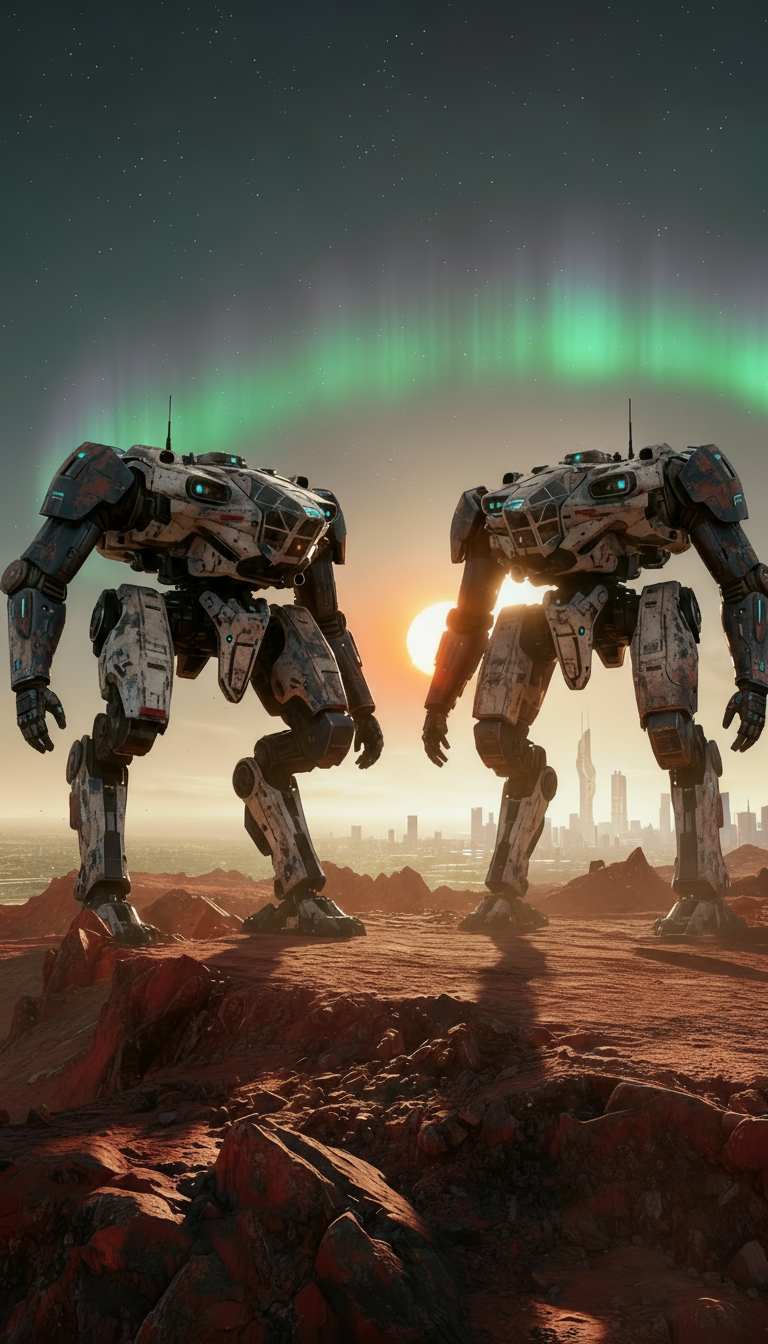
Day 1: Arrival on Fenghuang
The moment our boots touched the rugged ground of Fenghuang, I knew this world had been built to break weakness out of us. The journey from Earth had been long, filled with cramped transit hours, routine checks, and the quiet pressure of expectation. At the academy, Fenghuang was spoken of in near-mythic terms—the proving ground, the place where pilots were stripped down to instinct and rebuilt into something harder. Standing there beneath its harsh light, I understood why.
The landscape stretched before us like a living challenge. Jagged cliffs rose over dense forests that bent and hissed beneath alien winds, while wide plains burned red beneath the glare of twin suns. Even through my suit’s filtration system, the air carried a sharp metallic tang, thick with minerals and ozone. Along the ridge, our combat walkers stood in formation like iron sentinels awaiting judgment. My own machine, Baihu, caught the light across its scarred armor and sleek forward frame, and for a moment it seemed almost eager. I could feel my pulse quickening with that familiar mixture of nerves and anticipation every pilot knows before the first true test.
Day 3: First Maneuvers
The opening drills were brutal. Fenghuang’s terrain refuses predictability. Ground that looks stable collapses without warning, and the wind can turn a clear horizon into a crimson wall of dust in seconds. Every maneuver feels less like driving a machine and more like balancing on the edge of control.
Today the Thunder Wolves ran convoy-defense simulations through broken highland terrain. I took point at the vanguard, tracking sensor flashes and visual movement along the ridgelines. Captain Zhang’s voice cut through the comms with his usual precision. “Don’t think—react!” he snapped.
I tightened my grip on the controls as Baihu surged forward, hydraulics humming through the chassis like muscle under skin. The ground shifted beneath us, but this time I adjusted instead of resisting, letting the walker move with the instability rather than against it. That was the lesson Fenghuang kept forcing on us: control is not always resistance. Sometimes it is adaptation. By the end of the exercise, I had earned at least a little of the world’s respect.
Day 6: Combat Exercises
Today we faced the Iron Dragons, a rival squad known for precision, speed, and an almost arrogant level of aggression. The simulation zone was set in one of Fenghuang’s dense bioluminescent forests, where towering twisted trees glowed faintly when disturbed, washing the battlefield in eerie shifting light. It was ideal terrain for ambushes and close-quarters chaos.
We advanced carefully, each heavy footfall of our walkers sending tremors through the ground. Inside the cockpit, the air felt close and tense. My co-pilot, Wei Ling, remained steady beside me, her breathing even as the HUD tracked overlapping heat ghosts between the trees. Then the forest erupted.
Plasma fire tore through the canopy in sudden blue arcs, slashing past Baihu’s frame. I answered with an EMP burst, and for a heartbeat the forest flashed white as energy cascaded through branches and undergrowth. One enemy walker dropped to a knee, its systems overloaded. “Incoming right!” Wei Ling shouted.
I pivoted hard. Baihu’s servo arms crashed into the opposing frame with a violent shriek of metal, the impact reverberating through the cockpit. For a few seconds the fight became pure instinct—target, adjust, strike, recover. Time stretched thin under the pressure. When the final whistle sounded, I realized I had been holding tension in every muscle for what felt like hours. The match ended in a draw: bruised pride, battered armor, no clear victor. The Thunder Wolves held the line.
Day 8: Lessons Learned
Captain Zhang’s debrief was as unforgiving as Fenghuang itself. “Good isn’t good enough,” he said, fixing each of us with that iron stare of his. “Out there, ‘almost’ gets you killed.”
No one argued.
The rest of the afternoon vanished into recalibration drills and systems review. Baihu’s targeting suite had started to lag in dense cover, so I rewrote part of the predictive tracking algorithm to better read movement through obscured terrain. Wei Ling joked that if I kept refining the system like that, we ought to give the onboard intelligence a name. She said it was beginning to feel less like software and more like a third member of the cockpit.
For a brief moment, I laughed. On Fenghuang, moments like that matter more than you expect.
Day 12: The Storm Test
Today Fenghuang showed us what it really was.
We were midway through a navigation drill when the sky turned red so quickly it looked as though the world itself had started bleeding into the air. Then the storm hit. Wind screamed across the plains with such force it felt alive, carrying dust so thick it erased the horizon in seconds. Visibility collapsed. Sensor returns fractured into static. The world outside the cockpit became nothing but motion and noise.
“Stay close!” I shouted into the comms, though even my own voice sounded swallowed by interference.
Baihu moved almost by instinct after that—one deliberate step at a time, guided by fragments of telemetry and the faint shadow of Wu’s walker somewhere ahead of us. Every motion carried risk. Every second felt like it might be the one that pulled the squad apart. But somehow we held formation. Not cleanly, not perfectly, but together.
When the storm finally broke, the silence that followed felt almost unreal. Dust settled in slow red sheets across the armor plating. Then Captain Zhang’s voice returned through the static. “When things go wrong, we see who you really are.”
He was right. Today we saw fear. We saw discipline. We saw the fragile thread of trust that keeps a unit alive when training gives way to chaos. We came through the storm because no one let go of that thread.
Day 14: Final Thoughts
The end of the training cycle is close now, and I can feel the weight of it pressing down on all of us as heavily as Fenghuang’s twin suns. This world pushed us further than any classroom, simulator, or field manual ever could. It taught us how to fight blind, how to trust the machines that carry us, and how to rely on one another when judgment narrows to instinct and instinct is all that remains.
The Thunder Wolves are no longer just a squad assembled by assignment rosters and performance scores. We are something harder to define and stronger because of it—pilots and crews forged together by dust, exhaustion, impact alarms, and the choice to keep moving when easier minds would have folded.
When deployment comes, we will be ready. Whatever waits beyond training grounds and simulation zones, Baihu and I will meet it at the front without hesitation. Fenghuang tempered us in fire and storm, and what leaves this world will not be the same as what arrived.
— Journal of Lieutenant Ren Tao, Thunder Wolves Squad