
Pittman Outpost
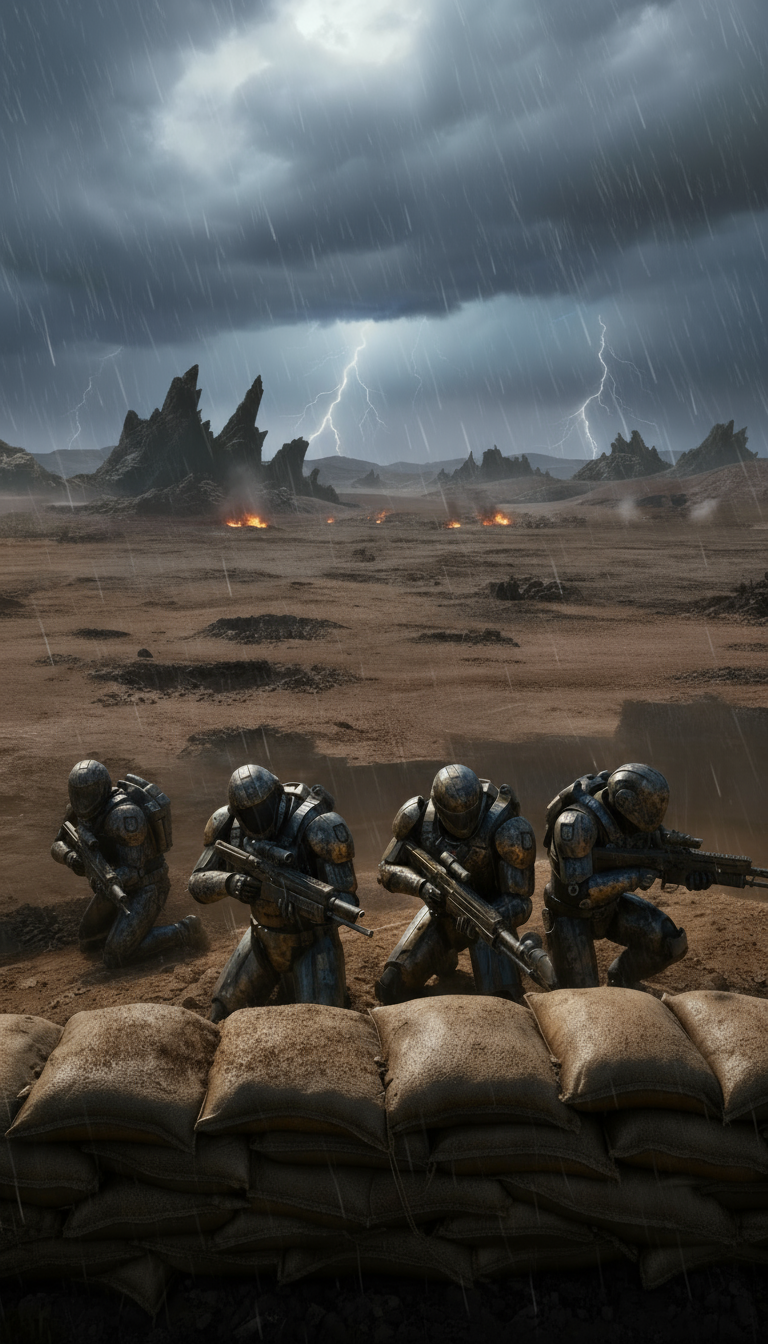
Day 17: Pittman Outpost
Pittman is not a world for the faint of heart. The landscape stretches in every direction as a barren wasteland—scarred, broken, and burned by more battles than anyone can count. I stood watch this morning looking out across plains littered with craters, some of them still smoldering from yesterday’s fighting. Jagged ridges rise from the earth like broken teeth beneath a sky that never seems to soften. Everything about this planet feels hostile, as if the world itself wants us gone.
Our outpost is little more than a cluster of armored bunkers, reinforced trenches, and barriers welded together in haste—a temporary fortress trying to hold back an enemy that never seems to tire. The Marines here live in a constant cycle: fight, patch, reload, repair, and rest when there is time to steal it. Exhaustion shows in every face, but no one speaks of stopping. On Pittman, stopping is how you die.
By midday, the sky had filled with storm clouds, lightning crawling along the horizon while thunder rolled somewhere beyond the ridges. Even the weather here feels like part of the war. But the real threat lies closer. Alien scouts move just beyond the edge of our sensors, never fully committing, never fully withdrawing. They watch. They wait. That may be worse than a direct attack.
Day 18: After the Battle
Last night was brutal.
They came in waves—fast, silent, barely visible until they were already inside effective range. We lost three Marines before we could mount a proper response. By the time the firing stopped, the field outside the wire had become a tangle of shattered barriers, smoking debris, and bodies from both sides.
The medics worked through the dark without pause, treating burns, plasma trauma, and fragmentation wounds while the smell of scorched metal and ozone settled into everything. I did not sleep. Every time I shut my eyes, I saw them again—their armor catching the lightning, their movements disappearing back into the storm as though the darkness itself had taken shape and learned how to kill.
By morning, the outpost had gone quiet. The wounded were moved to the med-bunkers, and the rest of us were sent out to sweep the perimeter. The enemy had left nothing behind. No wreckage. No identifiable remains. No tracks. No evidence except ruin. It was like fighting ghosts that bled just enough to prove they were real.
Day 19: The Calm Before the Storm
Today was quiet, and that made it worse.
There is a kind of silence on Pittman that works its way into your nerves. No one trusts it. We spent the day reinforcing the perimeter, resetting firing lanes, replacing damaged barricade panels, and checking ammunition stores for the next assault everyone knows is coming. The work was constant, but the talking was not. Most of us kept to ourselves. The tension said enough.
I walked the outer line before dusk. The plains stretched away in every direction, blackened by old impacts and littered with twisted fragments of metal, some Terran, some not. Hard to believe this was ever called a colony world. Now it feels more like a graveyard—one still being dug, one battle at a time.
As the light faded, the outpost settled into uneasy stillness. No one said it aloud, but everyone understood the truth. The quiet never lasts here. It only gathers weight before the next blow falls.
Day 20: The Sky Burns
The attack came before dawn.
It started as a low hum beneath the storm wind. Then the sky split open with the scream of engines as alien fighters tore over the outpost, their plasma trails burning through the clouds like wounds of blue fire. The bunkers shook under the first impacts. Alarms erupted across the camp, and I grabbed my rifle and ran for the line before I was fully awake.
The Marines poured from the shelters and opened fire with everything we had. Darkness vanished beneath waves of light—red tracer bursts cutting through curtains of blue plasma, flashes of detonations turning rain and smoke into something almost unreal. Then the rain came down hard, drenching the battlefield until mud, ash, blood, and burning debris became one churning mess under our boots.
Half the time we could barely see what we were firing at. We shot at movement, at muzzle flashes, at shapes crossing the ridges, at anything that looked like death coming closer. The comms were filled with shouted coordinates, casualty calls, and voices I knew trying hard not to sound afraid.
They attacked with terrifying precision, but somehow we held.
When dawn finally broke through the clouds, their forces had pulled back beyond the ridgelines. What they left behind was a field of shattered armor, smoking trenches, and scorched ground torn open by fire. The rain washed away the blood quickly enough. The craters remained. They always remain.
Day 21: Reflection
I do not know how much longer we can last here. Pittman is not a place you survive in the ordinary sense. It is a place you endure. The storms, the terrain, the enemy—everything about this world seems built to break the people sent to fight on it.
And yet, somehow, it has not broken us.
Every day we wake, we fight, and we endure one more cycle. That is the whole of life here. No glory. No certainty. Just the stubborn refusal to fall while there is still a line to hold.
Looking out over the battlefield tonight, I find myself wondering how long this war can continue. How many more names will be added to memorials on worlds far from here. How many of the dead will be remembered by people who never saw the sky they died under.
Still, one truth remains. Pittman has not broken us yet.
We are Marines.
We fight until there is nothing left to fight for.
— Journal of Private First Class Jayden, 2299