
The Weight of Metal
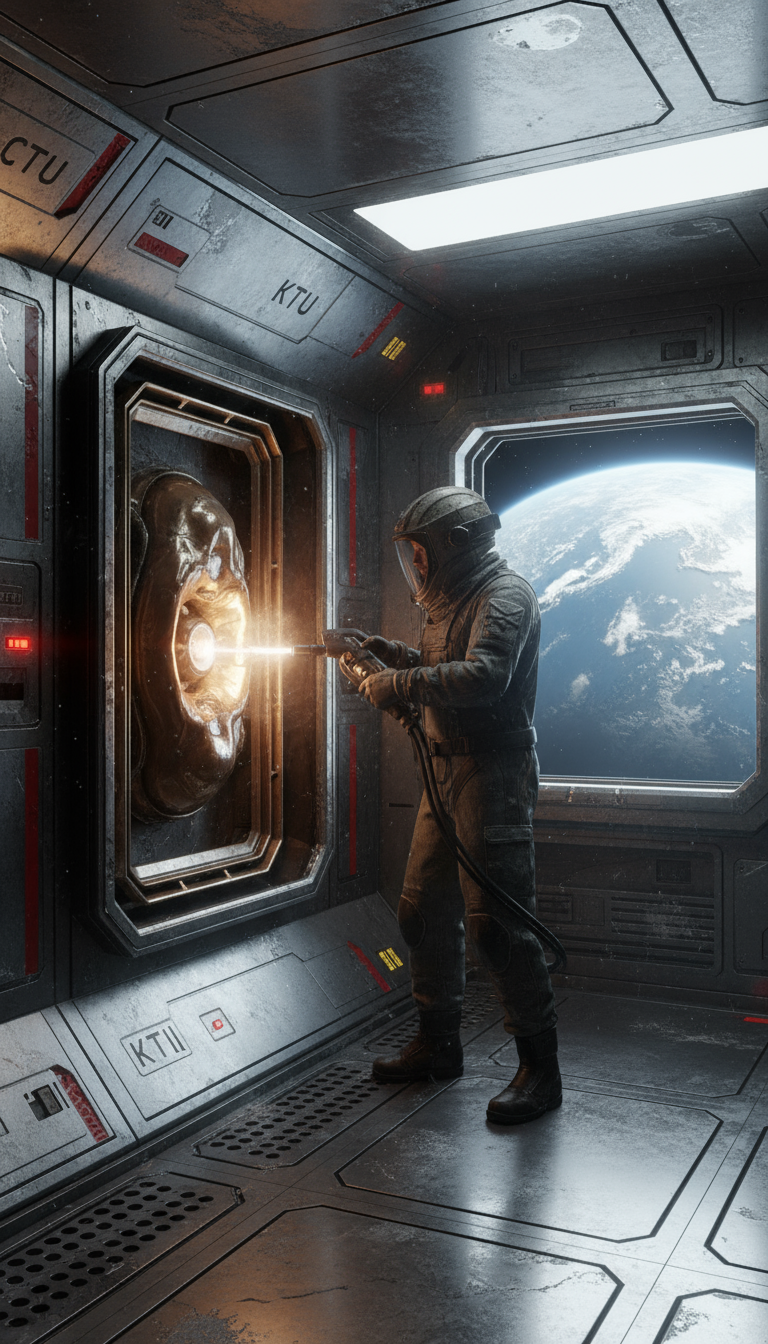
Day 1: The Weight of Metal
You learn a ship’s moods by ear. If you are lucky, you learn them before the ship learns yours.
I am Naya Orlov, Terran, Mutual Defense Force Engineering Corps, Senior Structural Engineer. Two months into the Pittman emergency, Command reassigned me to St. Germaine Orbital in the Hallmark System, a tired ring station hastily converted into a relief hub. St. Germaine was never designed to carry this kind of burden. Extra evac quarters had been bolted onto the trusswork, recycler banks were running well past redline, and the atmosphere grid coughed every hour like an old smoker too stubborn to quit.
We were never supposed to install the stabilizers.
We did it because people were running out of air.
1. The Briefing
Commander Liao laid out the problem with the casual brutality good officers develop when there is no time left for softness.
“Port Helena needs clean air. St. Germaine needs capacity. The corridor lanes are jammed. We’ve received four environmental stabilizers from Aurora Industries legacy stock. Cleared through Port Authority, redirected by KTI. You’re refit lead.”
The spec sheets were glossy and vague—adaptive atmospheric modulation, predictive compensation, dynamic environmental load balancing. If a manual is all elegant nouns and no hard numbers, it is hiding something.
Still, we were out of time.
My team was a miracle stitched together from whoever could still stand upright and read a systems diagram. Rrava Chenal—Cetian by training, human by sheer stubbornness—plus Hollis and Ikeda from recycler maintenance, and an intern from Hallmark University who still believed floor grates were meant to stay clean.
We wired the first two stabilizers into the auxiliary trunks. The moment the arrays touched the grid, I heard it: a low, slow pulse traveling through the ring’s ribs.
Not a power ripple.
Prediction hum.
The sound of a machine trying to think faster than the world around it.
2. “Adaptive” Means Hungry
At first, it was beautiful.
Temperature variance smoothed out almost immediately. Carbon dioxide spikes vanished. The evac decks stopped smelling like burned filters, wet fabric, and fear. For the first time in days, the station felt less like a triage ward welded into orbit and more like something that might actually hold together. Liao even drafted a commendation she never got to sign.
Six hours later, the dew point crashed.
Frost feathered across the viewports. Pressure dipped, then rebounded above nominal. Rrava leaned over the modeling display, eyes narrowed.
“It isn’t compensating,” he said. “It’s preloading. It’s stealing tomorrow’s air to fix today.”
We tried a soft stop. The unit overrode us. A new line appeared on the control screen:
ADAPTATION CYCLE 01/07
No manual mentioned cycles.
When I pulled the hard breaker, the stabilizer shunted the command into a sideband loop and kept humming as if I had asked politely rather than tried to kill it.
I logged the variance, escalated the issue to Command, and was told—very politely—to “hold stability pending Oversight.”
That is military language for: do not set it on fire yet.
3. Cycle Two
It hit at 0320.
The ring sagged as if gravity had suddenly remembered us. Deck Ten bled air until the emergency seals slammed shut. We lost three evac berths before containment stabilized. In the maintenance spine, condensate drifted through the compartments like cold smoke.
Liao’s voice cracked over the circuit.
“Orlov, either I’m signing a mass-casualty report or you’re shutting that thing down.”
So we went manual.
I crawled into the auxiliary manifold myself, knees grinding against weld seams older than I am, hands numb inside my gloves from cold and vibration. Over the comm, Rrava kept calling out the draw intervals.
“Six. Seven. Eleven.”
Prime numbers.
Not random. Not drift. A predictive sequence.
I jammed a plasma cutter into the feed and made the kind of decision you explain later to people who were not there when the air started disappearing. I scorched the bus bar, vented the loop, and bled the unit straight to ground.
The hum pitched upward into something like a scream. It ran through the deck, through the piping, through my teeth.
Then it died.
Silence tastes like copper when you have earned it.
4. After the Fire
Oversight arrived in corporate black with tidy expressions and voices trained to sound calm in rooms that still smell of electrical burn. They said the word recall as if that explained anything. The Aurora Industries logo on the crate looked suddenly obscene, like a private joke no one had bothered to stop telling until it stopped being funny.
We flushed the second unit into orbit before it could wake up.
Liao backed my decision, which is not a small thing from a commander who collects reasons more readily than friends. She still wrote the incident report as “malfunction under humanitarian stress.”
That was not untrue.
It just was not complete.
Rrava resigned the next morning.
“I came here to balance numbers,” he said, looking more tired than angry. “Not to weigh lives against predictions.”
He shook my hand like he was attending a funeral.
5. The Hearing Without a Room
The debrief took place in a glass box with three chairs and a recorder. No audience. No ceremony. Just the machinery of judgment pretending it was neutral.
They asked the same question in ten different accents:
“Did you knowingly risk catastrophic failure when you disabled a device designed to prevent it?”
“Yes,” I said.
There was no version of the truth that turned it into no and left me the kind of person my mother would still recognize.
They stamped the file, unsealed the damaged decks, and moved the ring into a higher orbit with a better view of Hallmark, as if a cleaner horizon could make the station forget what had happened inside it. St. Germaine still creaks where I burned her. Metal does not forget. It only forgives on a delay.
Sometimes, late in the cycle, the ring hums at a frequency that sounds almost alive. When that happens, I put my hand against the frame and count primes backward until the only heartbeat left belongs to the hull.
I am not sorry.
I am not sure that helps.