
Escape from Pittman
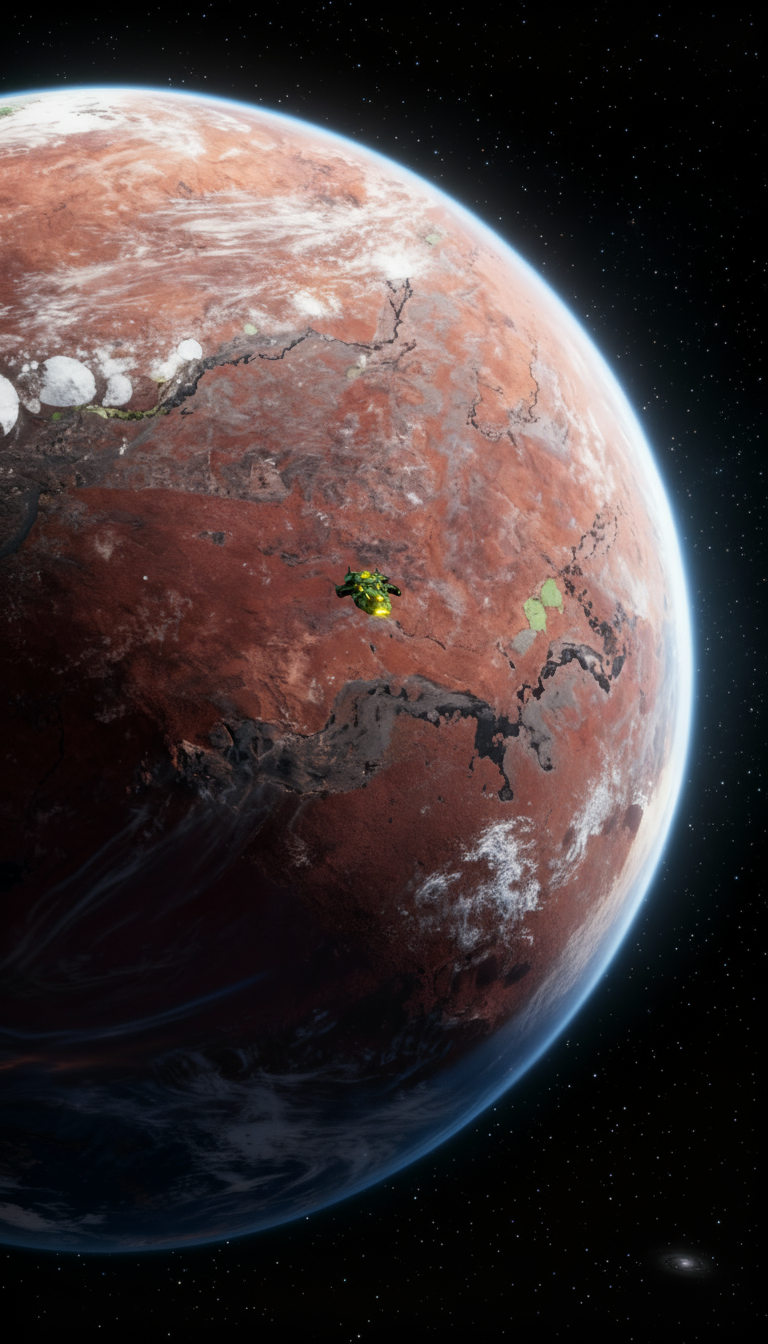
Day 1: Deployment to Pittman
We were already in orbit over Pittman when the orders came through. The situation on the surface was deteriorating by the hour. An MDF garrison had been under siege for days by an unidentified alien force, and command no longer believed it could hold without immediate reinforcement. Captain Harper and I briefed the crew at once. Our mission, on paper, was simple enough: deploy our Marine complement, maintain orbital position, and provide fire support for as long as the surface engagement required.
The USS Liberty is a Sierra-class assault ship, built for exactly this kind of operation. We have executed orbital insertions before—hard ones, ugly ones, missions no one aboard was eager to repeat—but this felt different from the start. The reports reaching us from the ground were too thin, too fragmented, too uncertain. Fast. Advanced. Unpredictable. That was the entirety of our actionable intelligence.
We launched the drop pods in sequence, one after another, and watched them burn through the upper atmosphere toward the war below. Each carried Marines descending into a fight they could not fully understand. Our role was to remain above them, their shield in orbit, their line of support if the surface collapsed.
At least, that was the plan.
Day 2: First Contact
Less than a day after the drop, the operation changed from difficult to catastrophic.
The first sign came as a distortion at the edge of long-range detection, a flicker so slight the sensor team initially flagged it as interference. Then the contacts resolved. Unknown vessels appeared almost on top of us, moving with a speed and precision that made conventional intercept logic useless. They did not emerge in any pattern we understood. They were simply there, and then they were attacking.
The USS Javelin and USS Olympus Mons, our two destroyer escorts, were hit first. Both ships were lost within minutes. Their hulls broke apart under sustained energy fire of an intensity none of us had seen before. Whatever these enemy craft were, their capabilities outclassed ours so thoroughly that the engagement never felt like a contest. It felt like an execution carried out by something faster, colder, and utterly certain of the outcome.
Captain Harper ordered immediate evasive maneuvers, but the Liberty was never designed to outrun predators like these. We returned fire with everything the tactical grid could still bring to bear—missiles, railguns, point-defense volleys, every system available—but our response might as well have been ceremonial. They broke formation around us with impossible fluidity, cutting through our screen as though we had already been measured and found inadequate.
I stood at the tactical display and watched the task force die faster than I could process it.
Day 2: Desperate Escape
It became clear very quickly that staying in orbit meant losing the Liberty and everyone aboard. The Olympus Mons came apart under sustained fire, her structure failing deck by deck until she vanished into a cloud of incandescent debris. The Javelin followed soon after.
Captain Harper gave the order to divert all available power to shields and engines. We had one chance: break orbit, punch through the kill zone, and pray the ship held together long enough to escape Pittman’s gravity well.
Harper’s voice never wavered, but I knew him well enough to see the cost behind the calm. We had already sent our Marines to the surface. We had promised them support, and now we were being forced to leave them behind in a battle no longer under our control. As the Liberty clawed upward under maximum burn, I caught one final glimpse of the MDF communications relay on the tactical feed. Its signal flickered weakly, then vanished into static.
They were on their own.
The alien ships pursued us for a time. Then, without warning, they broke off.
I still do not know why.
Perhaps we were no longer worth the effort. Perhaps their objective had never been our destruction alone. Whatever the reason, they let us go.
The Liberty was the only ship to escape.
Day 3: Regrouping in Deep Space
We are adrift now, well beyond Pittman’s immediate orbital envelope. The jump systems were damaged in the attack, and engineering has been working without pause to restore even partial functionality. Progress is slow, complicated by cascading failures and systems held together by improvisation more than confidence. Our long-range communications array remains offline, leaving us effectively cut off from the fleet and from any certainty about what still survives behind us.
I have sent emergency pings on every frequency the ship can still generate, though I do not know whether anyone is receiving them. It could be days before we know.
The bridge has grown unnaturally quiet. Captain Harper is keeping the crew steady through force of discipline and presence alone, but the strain shows even in the silence. We were meant to be the Marines’ lifeline. Instead, we are limping through deep space trying to remain operational long enough to avoid becoming another drifting wreck.
I cannot stop thinking about the enemy ships—the way they moved, the way their weapons tore through armor and hull plating as though matter itself offered no resistance. We have fought human powers before. We have fought insurgents, raiders, and fleets built by rival governments. This was different. This was not an enemy we recognized in any strategic language we already possessed.
I keep asking myself what is happening on Pittman now.
Are our Marines still fighting?
Or has the planet already been lost?
Day 4: Damage Report and Survival
We are running dark while repair operations continue. The Liberty survived the engagement, but only barely. Partial propulsion has been restored, life support remains stable, and the engineering crews have prevented the damage from cascading into a full systems collapse. Our weapons, however, are effectively gone. If the enemy finds us again before we reach safety, there will be no second battle. Only the end of one.
Harper and I spent most of the day in the ready room reviewing what options remain. Without communications, we cannot request support. Without certainty about the enemy’s range or patrol patterns, we cannot risk turning back. Even if reinforcements were dispatched now, they might already be too late to save Pittman. The decision was made to head for the nearest transit corridor and repair the tunnel drive en route. It is a bitter choice, but there is no strategic honor in dying pointlessly beside a system we no longer have the strength to help.
Leaving Pittman behind may be the most necessary order I have ever obeyed and the hardest one I expect I ever will.
Day 5: The Long Wait
Repairs are nearing completion, but morale is slipping.
Deep space has a way of making silence feel heavier than noise. The ship hums around us with the tired rhythm of damaged systems still fighting to remain useful. I have spent the quiet hours walking the corridors, speaking with the crew wherever I can, offering reassurance I am not always certain I believe myself. They need to see confidence. Command presence matters most when certainty is gone.
We are moving farther now from 279 G. Sagittarii, and though every kilometer increases our chance of survival, it also deepens the sense that we are abandoning something we may never reclaim. No one speaks the thought aloud, but it is present in every compartment of the ship.
We left our own behind.
That fact sits in the eyes of the Marines who never made the drop, the deck crews who watched the pods burn into atmosphere, and the officers now trying to compose reports that will never be adequate to what happened. When we finally make the jump, the war will change. Command will demand answers. Pittman—whatever remains of Pittman—will demand more than that. It will demand retribution.
Day 6: The Transit
The tunnel drive is back online.
It took longer than engineering first estimated, and more than once I doubted we would get this far. Supplies are thinning, fatigue is everywhere, and the strain of remaining undetected has worn the crew down to something close to raw nerve. Still, we are ready.
The bridge is silent now in a way I suspect I will remember for the rest of my life. No one needs to say what everyone is thinking. The Marines on Pittman went down there believing we would hold orbit and cover them until the fight was finished. Instead, they are alone with an enemy we barely understand and a battlefield we could not protect.
We are charted for Sector Delta. If the transit holds, we should be able to reach a repair station, restore full communications, and finally report what happened here. Once that report reaches command, the real questions will begin—how the Liberty survived when the rest of the task force did not, what kind of vessels struck us, whether Pittman can still be saved, and whether the conflict now unfolding is not a localized disaster, but the opening act of a larger war.
I do not have all the answers.
But I know this with absolute certainty:
Pittman was only the beginning.
— Commander Elias Trent, Executive Officer, USS Liberty, Sierra-class Assault Ship