
Hellscape
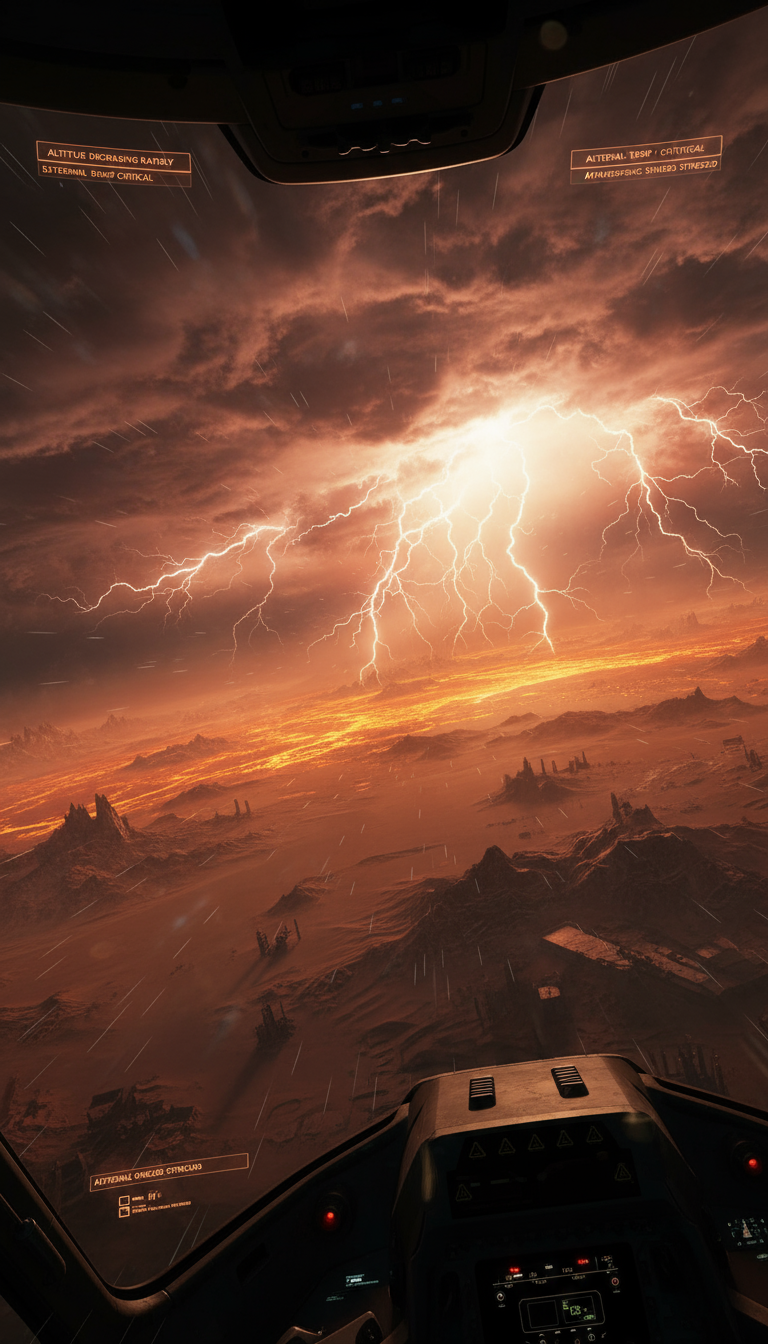
Among Terran forces, Pittman is known by many names, but none fits it better than Hellscape. From orbit, it can almost pass for peaceful—a golden-brown world wrapped in storm belts and veils of drifting dust. That illusion dies the moment you breach the atmosphere. The descent alone is a trial. The upper layers churn with savage winds that would tear apart anything not properly shielded, while lightning flashes so often it turns the sky into a constant storm-lit furnace of orange and white.
I arrived at Pittman with the 38th MDF Recovery Division, assigned to assist in an evacuation effort that had already gone catastrophically wrong. The planet had been declared uninhabitable decades earlier, yet people still remained—desperate settlers, abandoned miners, refugees with nowhere else to go. Pittman has a way of punishing that kind of desperation. Its atmosphere corrodes anything left exposed for too long, and the heat in the equatorial zones is so extreme it fuses whole fields of sand into sheets of blackened glass.
Our drop pods screamed through the clouds, their hulls glowing as friction fire licked across the plating. Beneath us, the world opened into a vast mosaic of rust-red dunes, shattered plains, and black craters. Massive dust storms crawled across the landscape like living things, swallowing landmarks and reshaping the horizon hour by hour.
When we touched down, the first thing I noticed was the silence beneath the wind—that deep, oppressive quiet that makes you feel small the moment you step into it. The air smelled of iron and ozone. The ground shifted under every step, unstable and treacherous. Our suits fought constantly against the planet, filters clogging with grit, cooling systems straining, servos groaning under relentless heat stress.
We found the remains of a settlement half-buried beneath fused glass and storm-thrown sand. The colony domes had melted long ago, their skeletal frames twisted into blackened arches like the ribs of some ancient carcass. Inside one shattered habitation shell, I found a child’s toy shuttle, a cracked family photograph, and what had once been a journal, now melted into a slab of slag. Everything left behind felt less like debris and more like an echo—evidence of people who had refused to surrender, even after the world had already decided otherwise.
Further inland, we reached the evacuation site. A single transport—or what remained of it—lay broken in a crater, surrounded by the wreckage of automated loaders and collapsed shelters. It looked as though the storm had struck in the middle of disaster and then simply stopped time. The evac beacon still pulsed weakly, repeating its signal into the wasteland for a crew that had been dead for years.
We stayed for three days. Each night, the horizon burned with electrical fire as dust fronts rolled in from the north. Our forward shelter shook under the assault of the winds, and the ground trembled often enough to make sleep impossible. Between the heat, the noise, and the endless pressure of that dead landscape, I began to feel as though the desert itself were watching us. There was a presence to Pittman, not alive exactly, but old—something buried beneath the dunes and storm glass, waiting in silence beneath the ruin.
On the final day, one of our sensor drones detected movement near the crater’s edge. I went out with two engineers to investigate. What we found was not human.
It was a machine—or the remains of one. A humanoid frame, half-buried in the sand, its metal blackened, corroded, and scarred by age and exposure. There were no visible identification marks. The Omnium denied ever deploying ground units on Pittman, and MDF archives showed no record of anything similar. But it moved. Only slightly, just enough to make the moment unforgettable—a small, involuntary motion, like the last reflex of a body that had not yet accepted it was dead. We removed the head and brought it back for analysis.
When we finally lifted off, I looked down at Pittman one last time from orbit. The storms were still moving, slow and deliberate, sweeping across the land as though erasing every trace we had ever been there. Pittman is not just a planet. It is a graveyard—for settlers, for machines, and for every ambition that ever believed it could conquer the wrong world.
Sometimes I still dream about it. I dream of lightning tearing across the clouds, of dunes glowing under storm fire, and of that machine’s dim blue eye staring back at me through the dust.
— Lt. A. R. Casden, MDF Recovery Division