
Liberty’s Mechanic Log
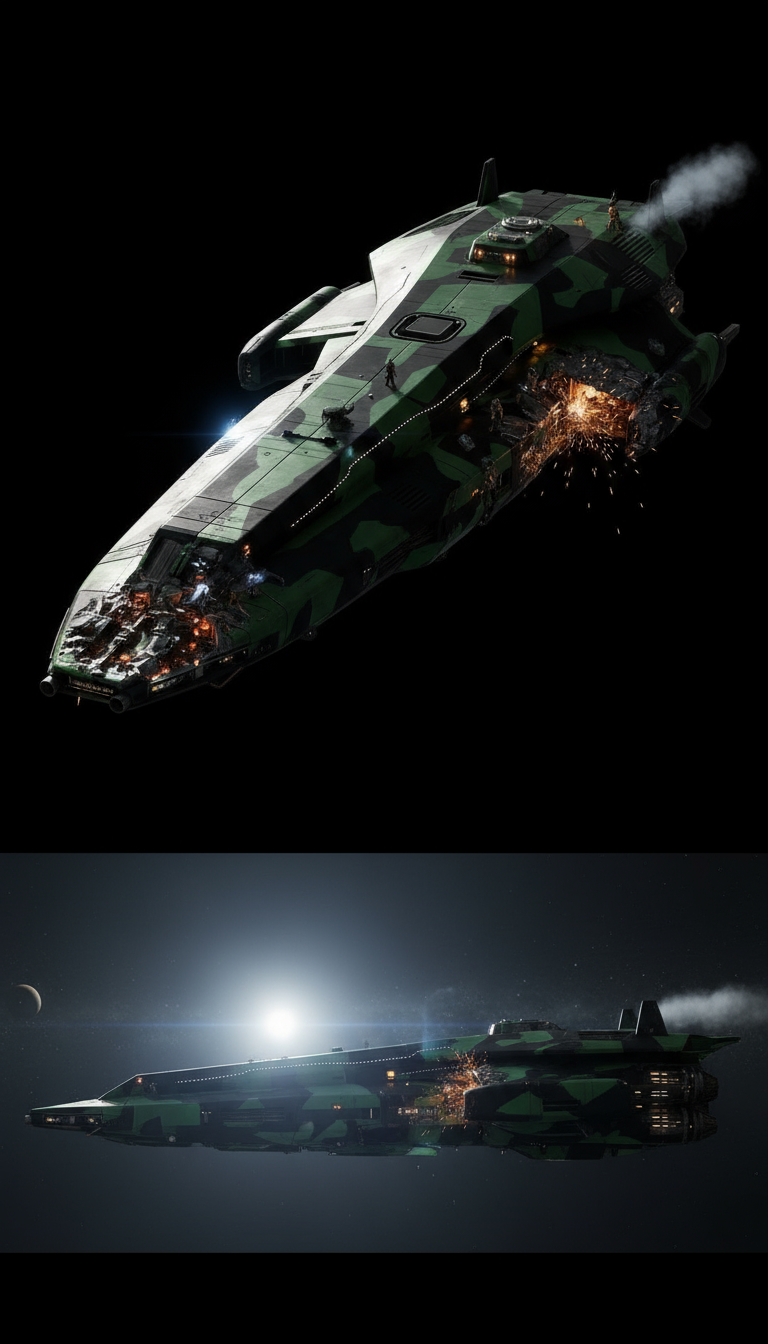
Day 1: Aftermath of the Escape
Liberty is limping.
We barely clawed our way out of the Pittman system alive, and the ship carries the evidence of it in every deck and corridor. Burned circuitry stings the air. Half the bulkheads remain sealed after the decompression alarms that tore through the aft sections during our retreat. It is a miracle we did not lose the engine core when the shields collapsed behind us.
The crew is shaken, but there is no time to indulge that. My engineering teams have been working without real pause, patching hull breaches, rerouting power through auxiliary grids, and keeping systems alive that should by all rights be dead. The main reactor is down to sixty percent output, and every hour we keep moving feels borrowed. Captain Harper asked me for an estimate on full restoration. I told him the truth.
“Soon, if we don’t die first.”
He did not laugh.
Day 3: Shield Emitters Fried
We stabilized the primary grid today, but the shield emitters are finished. Alien fire tore through the system with an efficiency that still makes no sense to me. Their plasma strikes overloaded the generators with energy signatures unlike anything in Terran combat records. Our shields did not fail in the way shields are supposed to fail. The rounds seemed to slip through them as though the barrier was barely there at all.
I have teams scavenging usable parts from the wrecks we hauled out during the retreat. Two support craft have already been stripped down to frames, every salvageable component ripped out and hauled into Liberty’s maintenance decks. It is ugly work, improvised work, the kind of engineering manuals never account for. But patchwork survival is our reality now. At this point, the ship is being held together by recycled parts, exhausted hands, and pure refusal to let go.
Day 7: Reactor Overload Scare
For five minutes today, I was certain we were dead.
A pressure surge in the plasma conduits kicked off a cascade failure in the coolant network, and engineering lit up with alarms so fast the noise blurred into one continuous scream. The reactor temperature climbed hard and fast. We managed to stabilize it, but only by venting nearly a third of our coolant reserves into space.
Now we are running hotter than I am willing to tolerate and leaner than I can justify. I filed a requisition to Fleet Command for emergency coolant resupply, though I have little faith anyone will answer in time. If we are forced into another engagement before replenishment, then that will likely be the end of us—not because the crew failed, but because there are only so many ways to cheat physics before physics finally collects.
Day 10: The Alien Fragment
One of the science officers brought me something today that may matter more than any repair we have made so far: a fragment of alien technology recovered from a projectile impact. It is only a shard, likely part of a kinetic round, but the fact that it survived entry and impact at all is remarkable.
The material does not behave like any alloy I know. It feels smooth, almost fluid under the fingers, yet tests harder than anything in our current inventory. More unsettling is the way it responds to directed energy. Under a specific frequency, the structure appears to knit itself back together, restoring minute fractures as though it is remembering its original shape.
If we can understand that process, it could change everything about how we build defensive systems. I handed the fragment off to materials analysis, but I intend to follow every stage of the research myself. Out here, curiosity is no longer academic. It may be the difference between the next ship surviving or breaking open like ours nearly did.
Day 15: Repairing Morale
It is not only the ship that is coming apart. The crew is fraying with it.
Weeks of tension, exhaustion, and unspoken guilt have worn everyone thin. Wainwright nearly swung on Jacobs today over a misplaced wrench. On the surface, it was about tools. It was not about tools. No one aboard has fully forgiven themselves for leaving Marines behind on Pittman, even though most of us know, somewhere beneath the anger and grief, that retreat was the only reason any of us are still alive to carry that guilt.
After shift, I brought the engineering teams together in the engine bay and opened a stash of Jovian ale I had been saving for a better day. The drink was terrible. The laughter, for once, was not. Sometimes holding a ship together means more than sealing fractures and tuning reactors. Sometimes it means reminding the people inside it that they are still a crew and not just a collection of exhausted bodies waiting for the next alarm.
Day 20: Jury-Rigged Upgrades
Progress, at last.
Today we managed to rebuild one of the secondary shield emitters. The repair is fragile, inelegant, and held together with enough improvisation to give a proper systems engineer heart failure, but it works. Response time across the emitter improved by twelve percent in the first round of testing. That is not enough to make us safe, but it is enough to make us less doomed than we were yesterday.
The captain authorized us to apply the same modifications across what remains of the array. It will take days, and there is no guarantee the entire system will hold under real combat stress. Even so, this is the first time since Pittman that I have allowed myself to think in terms beyond immediate survival. For the first time, the ship feels as though she might someday fight again instead of merely endure.
Day 25: Quiet Moments
A strange calm has settled over the ship.
The alarms have gone silent, at least for now, and last night I slept a full cycle for the first time in weeks. During my break, I sat on the observation deck and watched the stars drift beyond the glass. It is easy to forget, buried in ruptured conduits and scorched plating, that space can still be beautiful. Distance softens nothing, but it does remind you there is more to the void than war.
Liberty still carries her scars. She probably always will. But she feels alive again. Every weld, every sealed fracture, every patched circuit feels like an act of defiance written directly into her hull. She is not the newest ship in the fleet, nor the cleanest, nor the strongest. But she is ours, and she is still flying.
Day 30: Incoming Orders
Fleet Command finally responded.
New orders came through this morning. We are to rendezvous with the Seventh Fleet at Space Base Vega for resupply, repair, and a full overhaul. The thought of docking beside another friendly hull—of seeing a station that is not on fire, under attack, or half a step from collapse—feels almost unreal.
Until then, my teams will keep doing what they have done every day since we escaped Pittman: holding this vessel together with skill, sweat, ingenuity, and a level of stubbornness I suspect now counts as a military resource in its own right. Liberty does not shine. Not anymore. But she endures.
As long as she keeps flying, so will we.
End of Log
Chief Mechanic’s Log: Chief Engineer Rylan Tormek, USS Liberty