
First Steps
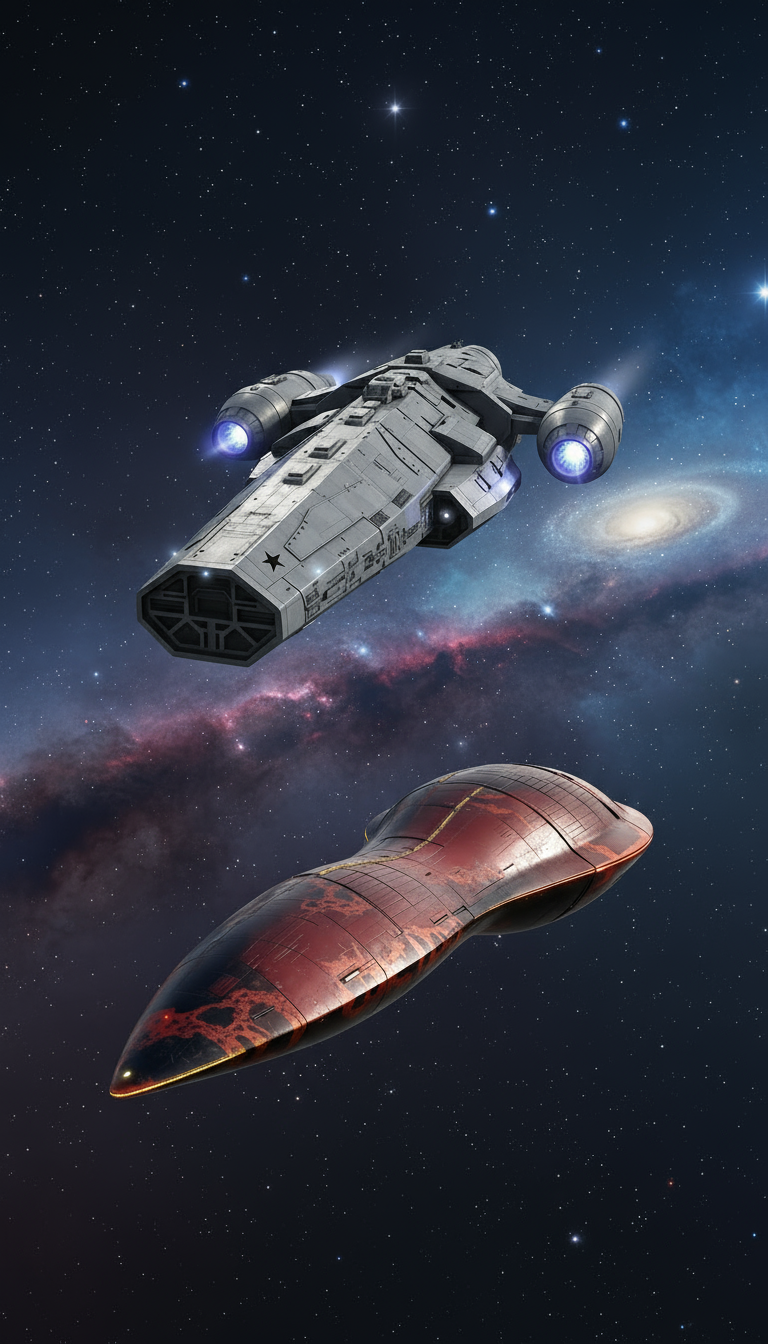
Kunlan Colony, Chinese Sector, January 17, 2157
The year 2157 marked a turning point in human history, though those living through it could not yet know how profound that change would be. At Kunlan Colony, in the Chinese Sector, the rhythms of frontier life were interrupted by an anomalous transmission detected far beyond the established perimeter of Terran settlement. Deep-space scanners registered a signal of unmistakably artificial origin in a region long believed to be empty.
Dr. Li Wei, head of the planetary science division, reviewed the data personally. The more she studied the pattern, the more certain she became that it could not be dismissed as natural interference or instrumentation error. “This is no natural phenomenon,” she said quietly, already understanding that the discovery carried implications far beyond Kunlan itself. The transmission originated near the Terran Corridor, in a sector officially charted yet still assumed to be uninhabited.
Her recommendation was immediate. Within days, the exploration vessel Qingdao, under the command of Captain Zhou Han, was cleared for launch. Zhou was a veteran officer, experienced in deep-space operations and formally trained in first-contact procedures few believed would ever be needed in earnest. As the ship’s engines ignited and the Qingdao lifted from Kunlan’s surface, he is said to have carried the distinct sense that the mission ahead would alter far more than a single colony’s fate.
Terran Corridor, February 2, 2157
Upon reaching the coordinates of the signal in what would later be designated GL 54, the Qingdao encountered a formation of unknown vessels positioned near an asteroid cluster. Their hulls glistened like polished black glass and moved in a silent, disciplined formation unlike anything in Terran records. No design feature matched known Terran, colonial, or rival-state construction.
Captain Zhou ordered a full sensor sweep. Before the scan could complete, one of the unidentified craft emitted a pulse that disrupted the Qingdao’s systems almost instantly. Instrumentation failed across multiple stations. For several seconds, the bridge was plunged into uncertainty.
Then the interference resolved into sound.
Using emergency translation routines, the ship’s linguistic systems pieced together a message: “We are the Cetian Consortium. State your purpose.”
Zhou’s reply, later preserved in the official archives, was measured and direct. “We are explorers from Kunlan, representing the Chinese colonial administration. Our mission is peaceful. We seek understanding.”
The bridge remained silent after he spoke. Then, after a long pause, the answer came back: “Your species is unknown to us, but your intent appears genuine. Let us establish a dialogue.”
Near Cetian Vessels, February 3 to 10, 2157
For several days, the Qingdao held position near the alien formation while both sides exchanged fragments of language, technical data, and controlled cultural references. Translation progressed cautiously, advancing through patterns, mathematics, symbolic structures, and iterative linguistic comparison. What emerged from those first exchanges would transform human understanding of its place in the galaxy.
The Cetians revealed that they had observed humanity for decades, monitoring its expansion beyond the Terran Core and following the development of its interstellar capabilities with growing attention. They had chosen this moment to reveal themselves because the Qingdao, carried by Tunnel Drive technology, had crossed into routes the Consortium already considered strategically significant.
During a later briefing, Dr. Li summarized the revelation with characteristic precision: “Our arrival was no accident. We crossed their trade routes.”
Formal negotiations began soon after. The Cetians proposed an exchange of knowledge and resources. They offered navigational data and access to mineral rights in return for Terran mining expertise and industrial cooperation. It was the first sustained diplomatic dialogue between humanity and an extraterrestrial civilization, and it began not with force, but with cautious curiosity on both sides.
Kunlan Colony, March 27, 2157
News of the encounter reached Earth within weeks and ignited immediate debate across the Terran Core. Some saw only danger in the appearance of a technologically advanced nonhuman power. Others saw a historic opportunity—proof that humanity’s isolation in the stars had ended and that the age of interspecies diplomacy had begun.
The Chinese government responded with public caution and measured optimism, even as it quietly increased patrol strength along the Terran Corridor and commissioned deeper intelligence reviews of Consortium capabilities. The central questions were obvious and deeply unsettling: What else had the Cetians observed, and how much did they already know about humanity before choosing contact?
On Kunlan itself, the consequences were immediate. New administrative departments were established to manage extraterrestrial relations. Scientists, linguists, military analysts, and policy officials worked in parallel to draft procedures for future communication, resource negotiation, and security coordination. For the first time in recorded history, humanity was being forced to consider how it would present itself not as scattered nations and colonies alone, but as a species.
Qingdao, Return to Kunlan, April 5, 2157
As the Qingdao withdrew from Cetian space, Captain Zhou stood on the bridge and watched the alien vessels recede into the dark. One line from his return log has endured through every later retelling: “History has a strange way of finding us.”
The crew returned exhausted, but fully aware that their mission had become something larger than exploration. They had not simply encountered a new intelligence. They had opened humanity’s first real doorway into a wider interstellar community.
Kunlan Colony, 2158 to 2160
The years that followed reshaped the political and economic landscape of known space. The Chinese colonial administration and the Cetian Consortium constructed a partnership built on trade, scientific exchange, and carefully managed strategic cooperation. Cetian advances in quantum computation, materials engineering, and systems design began to influence Terran research institutions, while Terran expertise in propulsion, extraction, and heavy-industry operations entered Consortium networks.
Kunlan itself was transformed. Its markets expanded rapidly, fueled by hybrid goods and joint ventures that blended Terran and Cetian processes in ways previously unimagined. Spices from Terran agriculture appeared beside Cetian bioproducts. Industrial alloys were refined through techniques adapted from alien materials science. Delegations traveled to Earth to brief the United Nations, while the major Terran powers opened increasingly quiet but urgent internal discussions about the strategic meaning of the new relationship.
Kunlan Colony, Central Plaza, May 7, 2161
Four years after first contact, Kunlan’s central plaza hosted a public ceremony commemorating the event that had changed both colony and species. Captain Zhou, now retired from active command, stood beside Dr. Li Wei as she addressed the gathered crowd.
“We have seen the potential of cooperation,” she said. “We have learned that curiosity is the first bridge between worlds.”
The words were celebrated, but they did not erase underlying caution. The Cetians had shared much, yet many uncertainties remained. Their motives, while outwardly cooperative, were still only partly understood. In response, the Chinese government established the Resource Exchange Bureau to monitor all flows of material, technology, and knowledge between both parties. The guiding principle was clear: trust, if it was to survive, would have to be balanced by vigilance.
Terran Corridor, Joint Outpost, September 3, 2167
In the years that followed, the Cetian Consortium and the Chinese government began constructing shared stations along the Terran Corridor. What had once been treated as empty passage became a thriving route of commerce, diplomacy, and strategic observation. The outposts stood as visible symbols of cooperation, but also as quiet reminders that every alliance is watched most carefully where interests overlap.
Military analysts continued to voice private concern. Some believed the Cetians’ sphere of influence extended far beyond what had been disclosed—into regions beyond Terran maps and beyond the limits of human certainty. If true, then the meeting at Kunlan had not introduced humanity to the full extent of the wider galaxy, but only to its first visible edge.
Earth, United Nations Headquarters, February 14, 2192
Decades later, historians would identify the events at Kunlan as the moment that redirected humanity’s interstellar future. What began as an anomalous signal in the Chinese Sector evolved into the first durable framework for human relations with an extraterrestrial civilization. The colony that had once stood at the edge of the known frontier became, in time, one of the most important centers of Terran diplomacy.
The Cetians, too, had taken a calculated risk in opening contact with a young and ambitious species still defining its place among the stars. Together, both civilizations began the slow and uncertain work of building trust across difference, distance, and strategic caution.
Even now, the legacy of that first meeting endures. Every new alliance, every interspecies accord, and every step humanity takes into the unknown can trace some part of its origin to those first moments near GL 54—moments shaped not by conquest, but by restraint, curiosity, and the willingness to answer the unknown with words instead of weapons.
— Recorded Entry, Chinese Colonial Archives, Kunlan Colony