
Deep Discovery
Day 1: Arrival at Ceres
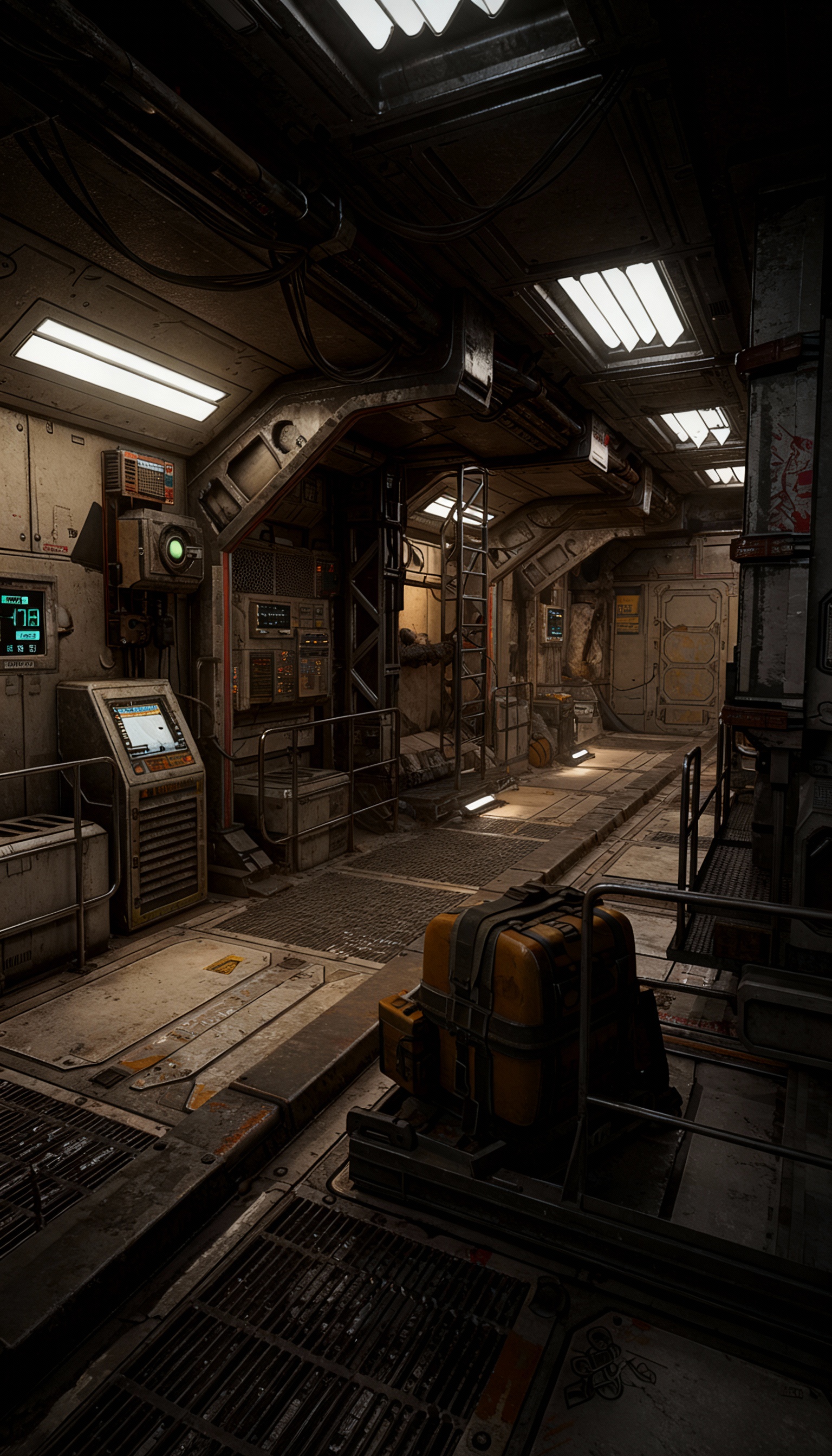
It has been a long journey from GenCorp headquarters in Atlanta to this frozen rock. I always understood that accepting an assignment to Ceres meant trading Earth’s comforts for a harsher kind of life, but understanding it in theory is not the same as stepping into it. Mining Station A-17 is one of the older facilities in the belt—long steel corridors, aging machinery, failing seals, and a permanent skin of dust that seems to settle over everything no matter how often it is cleaned.
My quarters are narrow and utilitarian, but at least they are private, which counts as luxury here. Most of the crew live in shared bunk halls and crowded common spaces built more for endurance than dignity. The atmosphere aboard the station is brittle. This is a hard posting, and morale reflects it. Officially, I have been sent to assess profitability and oversee a production increase. Unofficially, there is something else drawing GenCorp’s attention—something beneath the southern quadrant, buried under old reports, collapsed shafts, and years of avoidance.
According to the active manifests, the station’s yields remain tungsten, iron, and trace rare elements. But rumors persist of something deeper, some undiscovered resource the company never stopped thinking about. If there is truth in that, GenCorp wants answers.
So do I.
Day 3: Meeting the Crew
Today was my first full day on-site. I met Chief Engineer Marlow, a grizzled veteran of the belt mining circuit who looks as though he has spent more of his life inside stations like this than under any real sky. He is efficient, blunt, and not remotely impressed by corporate visitors. In that, at least, he is honest.
According to Marlow, the rigs are aging faster than the replacement schedule can keep pace, maintenance is behind in nearly every section, and the crew has been stretched thin for months. The miners themselves are a hard mixture of engineers, ex-contractors, belt drifters, and long-haul laborers—people who trust work more readily than they trust institutions. They look at me and see another executive sent from Earth to squeeze more production out of a station already close to its limits. I cannot say they are wrong to think it.
Marlow mentioned, almost in passing, an old sealed shaft in the southern quadrant—abandoned years ago after a series of collapses. Some of the crew think it was just bad geology. Others think the story goes deeper than that. Tomorrow I intend to review the archive records. Rumors this persistent rarely begin from nothing.
Day 5: The Archive Incident
The archives are in worse condition than I expected. Decades of incomplete survey logs, corrupted files, half-erased maintenance records, and technical entries that end without explanation. Still, beneath all that noise, I found something worth the search: an old geological report referencing “exotic mineral deposits” in the southern quadrant.
There was no follow-up analysis. No excavation summary. No closure notation. Just a single entry, isolated and abrupt, as though someone had begun documenting a discovery and then chosen, or been ordered, not to continue.
When I raised the matter with Marlow, he shut down immediately. He said the shaft was unstable, nothing more, and not worth revisiting. But his expression betrayed him. There was too much restraint in the answer, too much effort spent keeping the subject buried. Later, during shift change, I spoke with several of the miners in the mess. They had heard the same rumors in one form or another—a big find, a sealed shaft, a decision made quickly and never properly explained. Some dismissed it as station folklore. Others said it was the kind of thing people would kill for.
Day 7: The First Signs
Today the excavation teams recovered a new core sample from the southern quadrant, and with it came the first concrete evidence that the rumors were never just rumors. Embedded in the sample was a metallic trace unlike anything in the station database. I sent it directly to the lab for analysis.
Preliminary scans suggest the material does not correspond to any known industrial element or standard alloy on record. Even the technicians seemed reluctant to speculate too soon, as though naming the anomaly might somehow make it more dangerous.
Marlow was not surprised when I showed him the report. He only exhaled, long and tired, and told me not to dig deeper. That, of course, is exactly why I am here. If there is something valuable in the southern quadrant, GenCorp will want it identified, secured, and claimed.
And if I am being honest, I want it too.
Day 10: Tensions Rising
The lab results confirmed what we suspected: the metal is unique. Its molecular structure resembles no recorded alloy, and its internal energy profile is far beyond anything normally associated with naturally occurring ore. Whether it is synthetic, unknown, or something that defies our current categories entirely, it has value beyond ordinary mining economics. If authenticated and stabilized, it could alter GenCorp’s position across multiple sectors overnight.
But stations like A-17 do not keep secrets well. Word has spread through every corridor and work bay. The miners speak now of the “cursed shaft” with a seriousness that no longer feels superstitious. Two workers refused to report near the southern dig line. Marlow has grown colder by the day and now avoids me whenever he can. He knows more than he has said, and I suspect the rest of the crew knows enough to fear the shape of what remains unsaid.
Day 12: The Big Push
I confronted Marlow directly today.
He resisted at first, but eventually the truth came out in fragments. Years ago, the company ordered the shaft sealed after a chain of cave-ins, equipment failures, and disappearances no one ever properly explained. Officially, it was documented as a safety closure. Unofficially, Marlow believes the station found something that frightened the company enough to bury it—not only beneath rock, but beneath paperwork, silence, and time.
Despite his warning, I authorized a full excavation team to reopen the shaft.
The decision is dangerous. I know that.
But discoveries of this magnitude do not come without risk, and no one rises in a company like GenCorp by stepping away from the edge when the reward is visible beneath the dust.
Day 14: Breakthrough
We broke through today.
Beneath the old tunnel lies a vast metallic vein—a luminous blue-silver substance embedded deep in the rock, extending farther than our first scans can reliably measure. The moment the debris fell away and the vein came into view, every instrument in the shaft began reporting values so extreme they bordered on useless. Conductivity. Density. Magnetic distortion. Energy discharge. Everything is off scale.
Even Marlow stood silent before it.
I transmitted a priority report to GenCorp immediately, but the distance lag means it will be days before any meaningful response reaches us. Until then, I have ordered continuous excavation and expanded mapping. Whatever this substance is, it is beyond rare. It may be beyond price. We are only beginning to understand the scale of what we have uncovered.
Day 16: The Cost of Ambition
Two miners were killed today in a cave-in during the expanded dig.
The rescue crews worked for hours in the collapsed section, but there was nothing to recover except shattered supports and compressed rock. Marlow blamed me, and he was right to do so. I gave the order. I pushed the timeline. I chose discovery over caution.
The crew has grown openly hostile now. Some whisper that the shaft should never have been reopened. Others say the deaths were inevitable the moment we ignored the warnings built into the station’s own history. I would like to tell myself that the loss can still be justified by what we may gain, but the words do not come as easily as they did a few days ago.
And yet I cannot stop.
We are too close now, too deep into something that may define not only this station, but the future of faster-than-light industry itself. Every instinct tells me this is why GenCorp sent me here. Every other instinct tells me the station is waiting for a price none of us have fully counted yet.
Day 20: The Vein
The mapping teams completed their first full survey of the formation. The metallic vein extends at least half a kilometer beneath the southern quadrant, glowing faintly through the rock as though it carries some internal current of its own. The science staff have begun calling it Ceresium, a name born of awe as much as convenience.
But the deeper we cut into it, the stranger the station becomes. Instruments fluctuate without cause. Magnetic fields twist and hum through the lower levels. Unexplained vibrations travel through the flooring in long, low pulses. Marlow has formally requested a halt to excavation, arguing that we are disturbing something we do not understand. I denied the request.
That should have felt decisive. Instead, it felt like one more step taken after the point where decisions are entirely rational.
I still believe GenCorp sent me here to find value, and I still intend to deliver it. But I can no longer ignore the sensation that the deeper we drill, the more the asteroid itself seems to answer back.
Day 34: The Outcome
The GenCorp science division arrived two weeks after the breakthrough and confirmed what the station could only hint at. The element—now officially designated Gravitonium-X—exhibits properties that, if stabilized at scale, could make faster-than-light travel far more efficient than current Terran systems allow. The implications are staggering. Entire industries may be restructured around what was found here. Supply chains, drive design, strategic infrastructure, everything.
History will remember this discovery.
It will record the breakthrough, the science, the commercial implications, and the transformation that followed. What it may not remember as clearly is the cost at the point of origin—the tension in the corridors, the men who died reopening a sealed shaft, the warnings ignored because ambition outran caution, and the sense, difficult to articulate but impossible to dismiss, that we may have uncovered more than a resource.
For those of us who were here when it began, the achievement carries weight. We paid for progress in blood. We may yet pay for it in other ways still unseen.
— Journal of Carson Welles, GenCorp Executive, Mining Station A-17, Ceres