
Hover Training at Fort Independence
Day 1: Arrival at Fort Independence
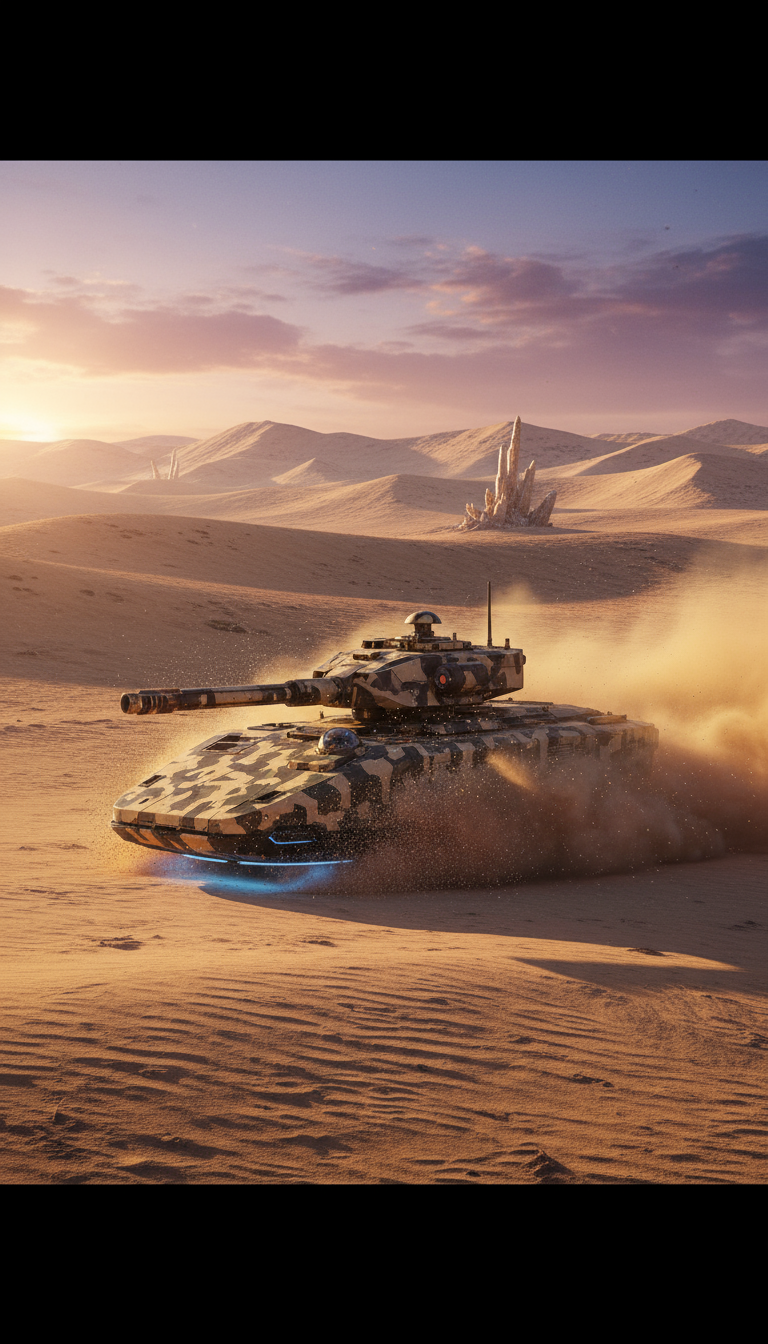
Americana stretches to the horizon in waves of red sand and punishing heat, a world where dust settles into everything and never truly leaves. They say you have not known grit until you have trained here, and after one day at Fort Independence, I believe it. The base spreads across the desert in a sprawl of reinforced bunkers, maintenance yards, and long lines of hover tanks, each one standing in the hard light like a promise of violence waiting for direction.
My tank, Hellhound, sat among them with her armor gleaming beneath a fresh coat of polish, as if she already knew she was being judged. Seeing her there felt like seeing an old friend after too much time apart. Familiar, reassuring, and just dangerous enough to remind you not to get sentimental.
We started almost immediately. That is how Americana works. There is no easing into the cycle, no generous adjustment period—only the immediate pressure of expectation. My crew was the same as always: Davis on the gun, Ortiz on systems and technical support, Price on navigation. We have been together long enough to trust one another without wasting words, but every new cycle strips you back to fundamentals. Out here, experience helps. Complacency kills.
Day 2: The Sand Trials
The Sand Trials began before sunrise, when the desert was still holding the last of the night’s cold and the horizon looked like a wound opening under the first light. Hellhound came alive beneath us with a low, violent hum as we pushed into the dunes. The sand on Americana is unlike anything back on Earth—finer, looser, almost fluid under pressure. It shifts beneath the tank in ways that force every maneuver into a contest between machine weight, pilot instinct, and terrain that seems actively hostile to both.
Davis stayed locked on the cannon feed, dropping virtual targets the moment they broke the ridgeline. Ortiz monitored engine strain and coolant flow, calling out temperature spikes before they turned into problems. Price kept us moving through terrain that changed by the second, reading slope, drift, and sink patterns like she could feel the desert thinking ahead of us.
Then the storm hit.
It rolled over us with almost no warning, a wall of red dust that swallowed the horizon and cut visibility to nothing. For a few hard minutes, the world outside the canopy ceased to exist. There was only instrument light, engine noise, and Price’s voice guiding us through hidden drops and shifting ground while the hull took the beating. By the time the storm passed, Hellhound was buried beneath a coat of red grit and all four of us were running on tension and instinct. But she was still moving. So were we.
Day 4: Urban Combat Simulation
The next major exercise dropped us into an urban-combat simulation staged in a ruined training town on the edge of the base perimeter. The zone was built for ambushes—tight streets, broken sightlines, collapsed structures, and enough vertical cover to make every intersection feel like a trap. Our objective was simple in theory: clear the area of hostile drones programmed with erratic movement patterns and reactive tactics.
In practice, it was chaos.
Hellhound moved through the concrete corridors on her hover system with that eerie, almost predatory glide only a well-tuned combat platform can manage. Davis kept his attention fixed on the targeting overlay while Price fed him angles and movement predictions a half-second ahead of contact. The first drone broke from behind a barricade and the cannon answered with a blast that echoed through the training blocks like real war. After that, they came in waves—from rooftops, alley mouths, broken windows, and blind corners.
Ortiz shifted power between shielding and thrust with almost no lag, keeping us balanced when the kill zones tightened. Price called turns with perfect timing. Davis tore through targets before they could settle into attack patterns. By the time the final drone dropped, the mock city was littered with smoking wreckage and fractured concrete. We climbed out tired, overheated, and more satisfied than any of us cared to admit aloud. The run had been clean. More importantly, it had been ours.
Day 6: Live Fire Exercise
Today was different. Simulation always carries a layer of distance, no matter how realistic the scenario. Live fire strips that away.
We rolled out to the range just after midday, heat shimmering off the open ground while steel targets stood waiting at staggered distances across the flats. Some moved in steady lines. Others cut unpredictably across the course, forcing rapid adjustment and disciplined timing. The moment the signal sounded, the range came alive in thunder, recoil, and dust.
Davis was exceptional. Every command I gave was answered almost before the words had finished leaving my mouth.
“Target left.”
The cannon turned. Fired. Hit.
Steel tore apart in sprays of debris and echoing impact. Ortiz managed the energy load with practiced calm, balancing weapons demand against shield draw and drive stability. Price tracked angles, speed, and spacing, keeping Hellhound positioned exactly where she needed to be. It is easy to make one crew member look good on a range. It takes the whole crew to make it look effortless.
When the smoke cleared, every target on the field was gone. Hellhound had performed flawlessly. Still, none of us confused a clean training score with comfort. Steel targets do not shoot back. The next ones will.
Day 8: Night Operations
The desert changes after dark. Heat falls away fast, the sand hardens under the cooling air, and the whole battlefield begins to handle differently. Distances feel longer. Sound carries farther. Every movement seems louder than it should be.
We ran the exercise under thermal optics and night-vision overlays, the cockpit lit only by instrument glow and target trace. Outside, the dunes looked like frozen waves under a black sky. Price guided us through the terrain with her usual calm precision, feeding course corrections in that measured tone of hers that never changes, no matter how bad things get.
Then the ambush triggered.
Drones fitted with night optics rose out of the dark and opened fire in bright arcs that cut across the dunes like sudden lightning. Hellhound reacted almost before I did, her thrusters biting hard as we slipped between ridgelines and returned fire from partial cover. The air inside the cockpit tightened immediately—target calls, system updates, energy shifts, and the rhythmic violence of the gun cycling through the dark.
By the end of it, sweat was running down my back despite the cold outside. Adrenaline makes its own weather. The last drone went down in a spray of sparks beyond a dune crest, and for a second the desert was quiet again. That silence felt earned. The night had tested us, and for those few hours, it belonged to Hellhound.
Day 10: Graduation
Today closed the cycle.
Command assembled the crews for final review, going over every maneuver, every target solution, every systems choice, every mistake avoided and every mistake made. Hellhound and her crew passed with high marks across the board. Clean report. Strong timings. Precise weapons performance. Efficient coordination. The sort of evaluation you work for and pretend not to care about until it is read aloud.
I looked across the bay at Davis, Ortiz, and Price and felt that familiar, unspoken certainty that only comes from shared pressure. Americana tested us the way it tests everyone—with heat, dust, fatigue, and the constant demand to perform without excuse. But it also did what places like Fort Independence are built to do. It burned away hesitation and left only what could hold under stress.
For hover-tank crews, this world is more than a training ground. It is a crucible.
Tomorrow we deploy to whatever waits beyond the range and the simulated kill zones. I do not know where command will send us next, or what kind of battlefield will be waiting when we get there. But I know this much with absolute certainty: Hellhound is ready.
So are we.
Journal of Captain Noah Reeves, Hover Tank Training on Americana