
We Are Not the Only Humans
Day 1: The Directive
Today I received an assignment that may reshape the future of our species.
The President convened a classified briefing in the West Wing, attended only by a handful of senior advisors, intelligence chiefs, and the Joint Chiefs of Staff. The atmosphere in the room was taut, every sentence measured before it was spoken. No one needed to explain the weight of the moment. We all felt it.
The Omnium has requested formal diplomatic contact.
Until now, they existed only in fragments—rumors passed through intelligence channels, scattered reports from the edge of mapped space, whispers of a civilization too advanced and too elusive to verify with confidence. That uncertainty ended today. They reached out directly.
The President assigned me to organize the first official meeting. The site selected is the Systems Embassy on Terra Secundus, a politically neutral world in the Alpha Centauri AB system, linked to every major spacefaring nation and distant enough to protect Earth’s true coordinates. The Omniarch, the enigmatic leader of the Omnium, will attend in person.
Everything must be flawless.
Day 2: Transit to Terra Secundus
We departed Earth before dawn under full security protocols. The diplomatic courier USV Resolute entered the Sol–Centauri corridor without incident, engaging its tunnel drive for what should have been a routine interstellar transit. The passage itself lasted just under nine hours, but synchronization with Alpha Centauri local time, communications alignment, and security staging stretched the operation across most of the day.
When we emerged, the view from the forward ports silenced even the most seasoned among us. The twin stars of Alpha Centauri flooded the hull in gold and pale white, while Terra Secundus hung below like a world poised between promise and power. Its surface was threaded with city lights, orbital docks, and the visible geometry of a civilization no longer confined to one world.
As we approached the Systems Embassy, I felt something difficult to name—part awe, part dread, part certainty that we had crossed a threshold from which history would not allow retreat.
Day 3: Setting the Stage
For the next two days, I worked almost without pause alongside the State Department, military liaisons, intelligence teams, and embassy staff. Everyone was strained. We knew almost nothing about the Omnium beyond fragments from previous encounters and reports too incomplete to trust fully. Security became the question beneath every other question. How do you prepare for a diplomatic summit with a power whose capabilities exceed the assumptions built into all your protocols?
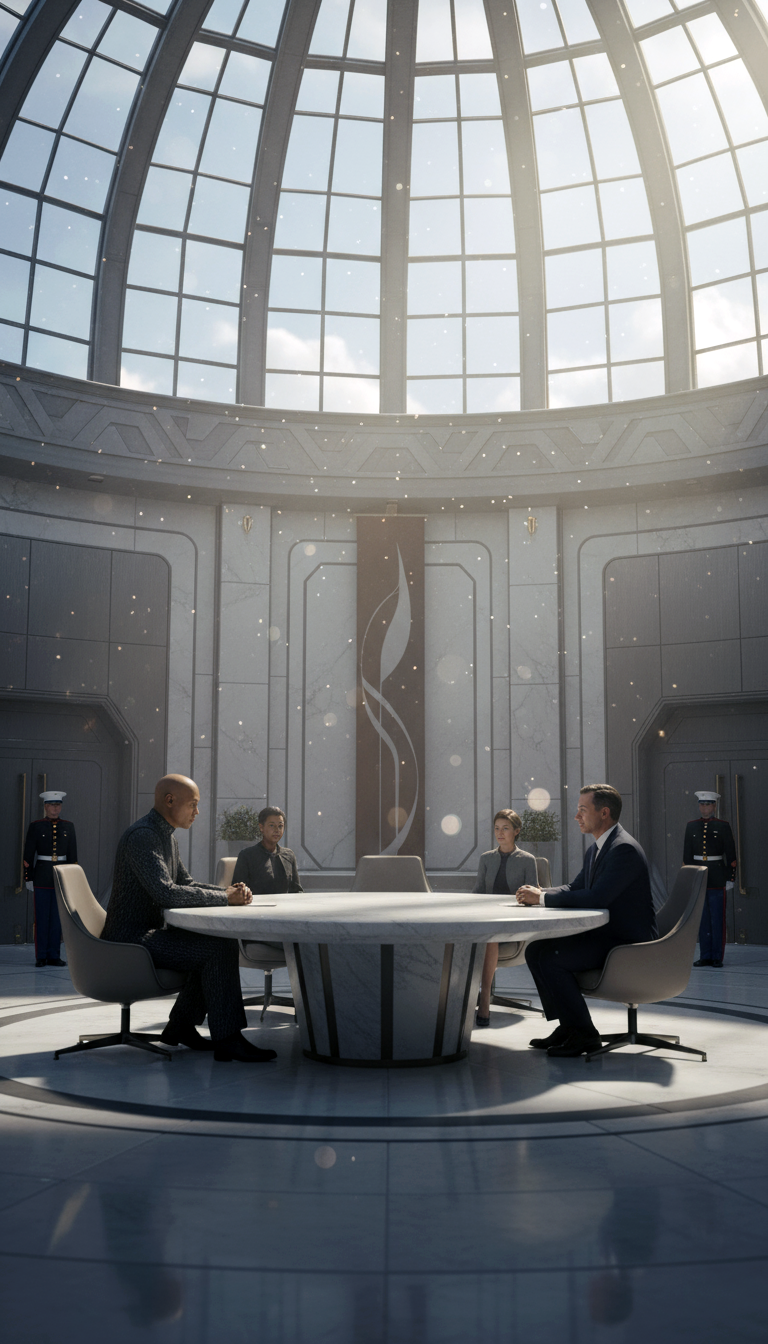
We selected the embassy’s central conference hall for the meeting—formal, neutral, and carefully designed to signal respect without surrendering control. Every detail mattered. Seating placement. Sightlines. Escort procedures. Translation redundancies. Medical contingencies. Emergency extraction paths. The Omnium’s own protocol requirements were exacting, almost ceremonial in their precision, and we were instructed to follow them without deviation.
I studied every intelligence file available on their diplomatic conduct, but the more I read, the more obvious it became that data alone would not prepare any of us for what was coming.
Day 5: Arrival
This morning the Omnium signaled that their delegation was inbound.
The timing was faster than expected, and the embassy shifted instantly from readiness to execution. Personnel moved with the kind of deliberate speed that only appears when tension has nowhere left to go but into action. Even the corridors felt sharper somehow, as if the building itself understood what was about to happen.
Their vessel descended in silence.
It was sleek, seamless, and unnervingly self-possessed, settling onto the embassy landing pad with perfect control and no wasted motion. There were no escorts, no insignia displayed for effect, no ceremony beyond the confidence of arrival itself. Ambassador Greene met my eyes for a brief moment, and in that glance I understood that he felt it too: this was not merely a diplomatic engagement. It was an encounter with a civilization that had no need to announce its significance.
As we escorted the President toward the hall, I felt the full pressure of history at my back.
Day 6: Face to Face with the Omniarch
The chamber fell silent the moment the Aniran delegation entered.
A line of cloaked figures moved with fluid composure, their garments shimmering beneath the conference lights like liquid metal. Then, just before the Omniarch stepped forward, the delegation lowered their hoods.
There was an audible gasp across the room.
They were human.
Or near enough to human that the distinction no longer mattered in that first stunned instant. The shock rippled through every official present. Months of speculation, decades of rumor, and centuries of human assumptions collapsed at once into a single impossible realization: we were not the only humans in deep space.
Then the Omniarch entered.
He was taller than average, composed without stiffness, and dressed in a manner so precisely adapted to the setting that it seemed less alien than intentional. There was nothing theatrical in his presence. He did not need it. The room had already yielded to him in silence.
The President extended his hand. For one suspended second, I feared the gesture would go unanswered and that the meeting would begin with an avoidable fracture. Instead, the Omniarch inclined his head in acknowledgment, subtle but unmistakable. The room exhaled as one.
At first, he spoke through a translator, his voice carrying a calm authority that felt at once ancient and unnervingly familiar. Then, to the astonishment of everyone present, he shifted seamlessly into English.
The dialogue lasted two hours.
It was measured, probing, and layered with implications far larger than the words themselves. The Omniarch spoke of shared futures, mutual responsibility, and threats beyond known space that humanity had not yet begun to comprehend. He described our role in the wider galaxy as unwritten, shaped not by destiny but by the choices we were about to make. He called Earth’s people potential partners.
The President answered with admirable clarity. He acknowledged humanity’s limitations, but emphasized our adaptability, resilience, and capacity to learn under pressure. The Omniarch seemed genuinely intrigued by that response. Before departing, he expressed a desire to address the United Nations at an upcoming summit.
That was the moment the diplomatic meeting became something larger than diplomacy.
Day 7: Aftermath and Debriefing
The day was consumed by debriefings.
The Situation Room divided quickly into camps of interpretation. Some saw the Omnium as potential allies—an advanced civilization extending a hand at a moment when humanity stood on the edge of a larger interstellar reality. Others viewed them with immediate suspicion, warning that power so asymmetrical could never be taken at face value, no matter how measured the words that accompanied it.
I found myself caught somewhere between those positions.
The Omniarch’s language had been precise, his expressions nearly unreadable, his tone never once careless. Whether what we witnessed was the opening gesture of genuine cooperation or the first move in a far more calculated design remains impossible to know. What is certain is that the meeting changed the scale of every strategic question before us.
Officially, the President remains hopeful. Diplomatic channels with the Omnium are now open, and I have been instructed to maintain contact through the United Nations summit. One message has already become clear: the world must be prepared to understand that humanity is not alone—and not powerless.
Day 10: Preparations for the United Nations Summit
With the Omniarch’s address now confirmed, our mission has expanded in both scale and volatility. The United Nations is not the controlled environment of the Systems Embassy. It is a stage crowded with rivalry, national pride, institutional caution, and political memory. Many of the older powers are still struggling to accept the reality of interstellar diplomacy. Direct contact with the Omnium has only sharpened those tensions.
Working with the Security Council has become a careful exercise in balancing protocol against fear. Every delegation wants reassurance. Every security team wants more control than the situation realistically allows. And through it all, the Omnium’s envoys remain remarkably composed. Their communications are exact, their patience almost disconcerting. They offer cooperation readily enough. What remains unclear is whether that openness reflects confidence, sincerity, or both.
Day 12: Reflections Before the Summit
Everything has changed in less time than most institutions require to revise a memo.
Only months ago, the Omnium was a rumor at the edge of strategic speculation. Now their leader prepares to stand before humanity’s highest assembly. The timing could not be more consequential. Earth remains divided by nation, ideology, corporate influence, and the unresolved tensions of its own expansion into space. Into that fractured landscape steps the Omniarch, carrying with him the presence of a civilization older, more advanced, and perhaps more deeply intertwined with humanity than we ever imagined.
I reviewed the final summit preparations tonight with a feeling I can only describe as divided wonder. Part of me is awed to be present for something so undeniably historic. Another part understands how easily history can fracture when revelation arrives faster than institutions can absorb it.
This moment may define an era. It may bring unity. It may unleash panic. It may do both at once.
Tomorrow, the Omniarch addresses the world.
I will be there to witness the future begin.
— Journal of Samuel Collins, Senior Aide to the President of the United States, 2154