Cold Orbit
Day 1: Cold Orbit
You never forget the sound a ship makes when her hull cools after reentry. It is a long, tired settling of metal, like an old warhorse breathing out after a hard run. If you have spent enough years building and patching ships, you learn to read that sound. You learn when it means strain, when it means fatigue, and when it means trouble.
Tonight, the Caliban sounds troubled.
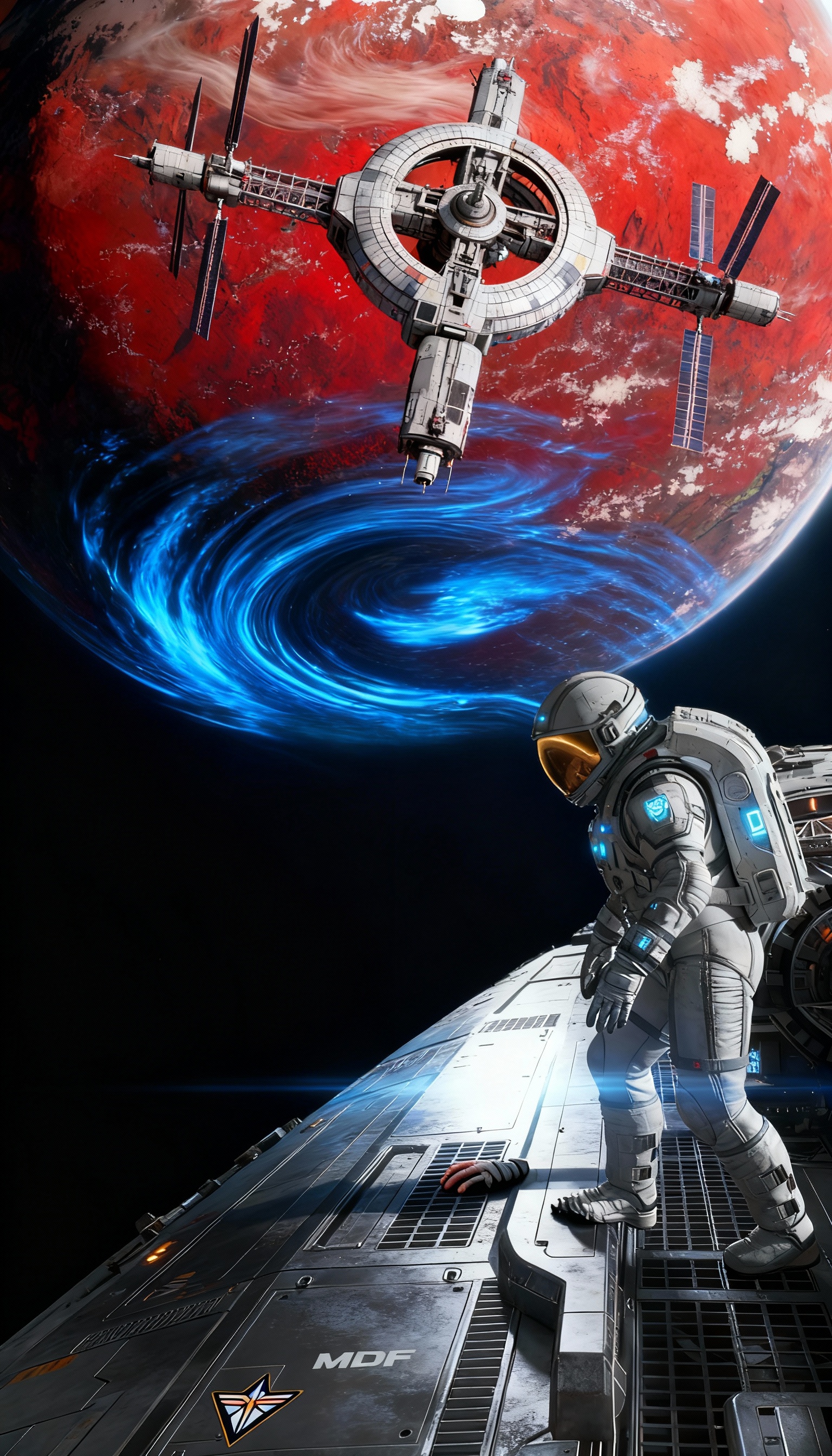
I am Senior Structural Tech Rian Velez, Terran-born, forty-seven standard years old, assigned to the Outer Colonial Defense Net aboard the MDF patrol ship Caliban. We are holding station high above Port Helena, a hard colony carved out of dust, basalt, and stubbornness. The locals do not want us here, but they want what may be coming even less.
Pittman went dark three weeks ago. Two weeks after that, our atmospheric sensor nets began catching strange echoes over Helena—pressure waves no known weather model could explain. The analysts still argue over what they mean. Nobody likes any of the answers.
1. Duty Shift
0600 hours. The dorsal frame deck smells of coolant, hot metal, and coffee gone stale an hour after brewing. Section C is thirty meters of cramped access corridors, flickering maintenance strips, and enough sharp edges to remind you the ship was built for war, not comfort.
I am halfway through reinforcing a seam weld on frame twelve when Ensign Danel’s voice crackles over the comm.
“Velez, you still chasing that crack?”
“She creaks, I fix,” I say. “You want her blowing out in atmo, be my guest.”
He laughs. Station-born. Probably never spent more than a ceremonial hour in gravity above point-eight. Kids like him think worlds are abstractions—dusty entries on a chart or places old Terrans romanticize when they have had too much to drink. They do not understand dirt under your boots, or how a planet pushes back.
Repair drones float past me in a tidy line, humming softly as they move toward the aft service spine. Good machines. Efficient machines. But I still trust my hands more than any of them. A drone reads tolerances. A good structural tech listens. Stress talks if you know how to hear it—the subtle complaint of expansion strain, the dry whisper of a hairline fracture beginning to open, the wrongness in a weld that looked clean until the ship started breathing around it.
By 0800 the Caliban is fully awake. Three orbital sweeps, one scheduled surface check-in, and a command crew already stretched thinner than they want to admit. Commander Tseng keeps transmissions short and clipped. She is Terran, same as me, but years on the colonial line have changed her voice. The vowels are longer now, the patience shorter. Port Helena resents every MDF hull in orbit. To them, warships mean inspections, delayed freight, armed questions, and fresh rumors that the sky has turned haunted.
2. Rumors in the Mess
1200 hours. The mess smells like reheated protein, machine-cleanser, and the recycled air of too many bodies in too little space. The main newsfeed loops Bureau footage from Pittman—cloud bands folding inward into perfect spirals, electrical discharges climbing upward instead of falling, luminous veins moving beneath the storm fronts like circulation beneath skin.
Chief Tora stares at the screen over a forkful of stew. “That’s not weather.”
“No,” someone mutters from farther down the table. “Geoforming tech. Has to be.”
“No,” I say before I can stop myself. “Geoforming arrays collapse inward. They regulate, compress, stabilize. These patterns are climbing, unfolding. That is not the same thing.”
The table goes quiet for a beat.
“Then what is it?” Tora asks.
I keep my eyes on the footage. On those impossible spirals. On lightning moving with the discipline of something engineered instead of born.
“Someone with the tools,” I say, “and the arrogance to play with the sky.”
Tora snorts. “That usually means us.”
A few people laugh, but not many. Nobody is really in the mood for it. The footage loops again. Silver distortions twist through the cloud tops, almost elegant in the way they deform the weather. I cannot shake the feeling that the Caliban has already noticed them too. Ships know when something is wrong long before the command staff is willing to say it aloud.
3. Down to Helena
1700 hours. Command sends me planetside with Danel to verify the latest atmospheric anomalies in person. Shuttle Mercury Two rattles all the way through descent, every panel and fastener singing its own note as if the craft is trying to shake itself apart before we touch down.
Port Helena spreads around the crater rim in a rough ring of prefab domes, thermal stacks, vent towers, cargo pads, and defiance. It looks less like a settlement than something determined not to die.
The air tastes like rust and static even through the suit filters.
People watch us as we cross the landing lane. Relief on one face. Resentment on the next. Soldiers mean trouble, and trouble has a way of finding soldiers first.
Commander Tseng meets us outside the outer dome at a wind-scoured ridge of black rock. Dust snaps against our suits in thin, hissing sheets.
“You’re here about the disturbances,” she says.
“Yes, ma’am.”
She does not waste another word. She just turns and points toward the western horizon.
At first I think it is heat shimmer. Then the sky flexes.
Not metaphorically. Not visually. It flexes.
The atmosphere ripples outward in a widening arc, as if something enormous has pressed a thumb into the upper air and let it rebound. My suit telemetry spikes immediately. Pressure drops across three bands. Wind direction stutters. Static climbs the inside of my jaw.
Danel swears under his breath.
“Every fourteen hours,” Tseng says. “Like clockwork. It isn’t seismic, and it isn’t surface-based. Whatever is causing it is above the ionosphere.”
I record the event and force my breathing to stay level. All my training keeps reaching for explanations—resonance, reflected waveforms, orbital interference, a damaged climate relay—yet none of them fit. This does not feel random. It feels measured.
It feels like intent.
4. The Signal
Back aboard the Caliban, I run the atmospheric readings through structural harmonics, then comm traffic, then a broad-spectrum anomaly parse. By 2310 hours I stop pretending I am looking at noise.
The pulse is structured.
Prime intervals. Repeating. Seven. Eleven. Thirteen. Seventeen.
Jin from comms leans over my shoulder, close enough that I can smell synth-caffeine on his breath.
“That’s not random.”
“No,” I say. “It’s a handshake.”
He straightens. “You think someone’s calling us?”
I study the sequence again. The spacing. The restraint. The precision.
“Not us,” I say. “Through us.”
The waveform stabilizes further, pulse over pulse, each repetition cleaner than the last. Then Eidolon, the ship’s tactical intelligence core, cuts into the lab channel.
“Unidentified signal shares point-four percent correlation with archived Cetian subspace protocols.”
Jin blinks. “Cetian? That can’t be right.”
“Correlation confirmed,” Eidolon says. “Origin indeterminate. Cross-reference incomplete.”
I lean back from the console and feel the cold work its way up my spine.
The Cetians are many things, but careless is not one of them. They keep to their own lanes, trade when it suits them, vanish the moment politics turns noisy, and speak in ways that always leave you wondering whether they told you the truth or simply the part of it they found useful. They do not cast blind signals into Terran channels. They never have.
“Could it be a relay?” Jin asks.
“Maybe.”
“Or a spoof?”
That possibility sits between us for a second too long.
“Maybe someone wants us to think it’s Cetian,” I say.
That is worse.
The Cetians may be secretive, but they are predictable in their own way. This signal is not. It carries purpose—and underneath that, something uncomfortably familiar. Not Cetian elegance. Not alien abstraction. Precision shaped by a mind that thinks like ours, only colder.
Eidolon interrupts again.
“Amendment. Official Cetian contact records remain inactive. Probability of present nonofficial involvement: nonzero.”
I stare at the numbers washing down my screen.
The Cetians used to speak in mathematics and consequences. They built things Terrans barely understood, then withdrew the moment we started imitating them badly. If they are reaching into our lanes again—or if someone is wearing their signature like a mask—then something has changed.
And whatever changed did not do so in our favor.
5. The Breach
0330 hours. The klaxon hits before I am fully awake.
I am already halfway out of the berth when the deck shudders beneath my boots.
“Hull breach?” I shout into the corridor.
Danel’s voice answers from the command net, sharp with adrenaline. “Negative. Orbital net’s collapsing. Something’s punching through the defense grid.”
I hit the nearest tactical station just as the main displays flare alive. Around Helena, the orbital field ripples like a struck membrane. Then a blue-white bloom unfolds above the magnetosphere—clean, controlled, almost beautiful in the way a cutting torch is beautiful if it is not aimed at you.
“Source?” Captain Halden demands.
“Above the magnetosphere,” Eidolon replies. “Signature matches previously detected anomalous signal.”
The light contracts to a point and vanishes.
For three heartbeats every sensor on the ship goes black.
No data. No telemetry. No sky. No grid.
Then the systems come back.
There is something new in orbit.
Not a ship. Not exactly.
It looks like architecture someone taught to move—black spires unfolding around a hollow center, each surface turning with slow, impossible precision. No drive plume. No visible mass compensation. No emission profile that makes sense. Just structure, rotating as if it has all the time in the universe and knows we do not.
Weapons breaks over the command channel. “Orders?”
Captain Halden does not answer at once. When he does, his voice is flat.
“Hold fire. Until we know what it is.”
The object completes a single rotation.
The frequency returns, but now it is no longer a pattern on a diagnostic screen. It is inside the ship—inside the deck plates, the supports, the fillings in my teeth. My console floods with symbols, geometric cascades that fold in on themselves in ways space should not allow.
Then the comms channel opens.
A voice comes through—calm, exact, and utterly without warmth.
Terrans. You build storms and forget the sky was never yours.
No one answers.
No one even breathes.
The black structure shivers once, then begins to come apart—not exploding, not retreating, but unmaking itself. The spires dissolve into fine particulate ash that scatters outward through the crippled orbital net, glittering for an instant before vanishing into the dark.
6. Aftermath
We remain on station through first light over Helena. No fatalities. No direct structural losses on the surface. Officially, MDF command classifies the incident as a containment event pending further review.
Unofficially, nothing about Helena is stable anymore.
Surface pressure has doubled in sectors that should be calm. Wind currents have reversed over the western ridge. Atmospheric drift is moving against thermal logic. Guild channels are already spreading their own name for what happened.
The Second Warning.
I do not know if that is right.
I only know what I saw. Something breached the defense grid without effort, spoke to us like we were children playing with engines we do not deserve, and vanished before we could even decide what kind of enemy it was.
Maybe it was a threat. Maybe it was a demonstration. Maybe it was exactly what it sounded like—a reminder.
We Terrans talk like the lanes belong to us. Like the colonies belong to us. Like the laws of matter, pressure, orbit, and weather are tools waiting for a confident enough hand. Maybe we have mistaken access for ownership. Maybe the universe was only being patient.
Now the hull is cooling again.
It sounds different this time. Quieter. Not calm—never that—but listening.
I press my palm against the frame beside the service hatch and close my eyes.
Just in case the old girl is trying to tell me what comes next.