
Patch Up on Pittman
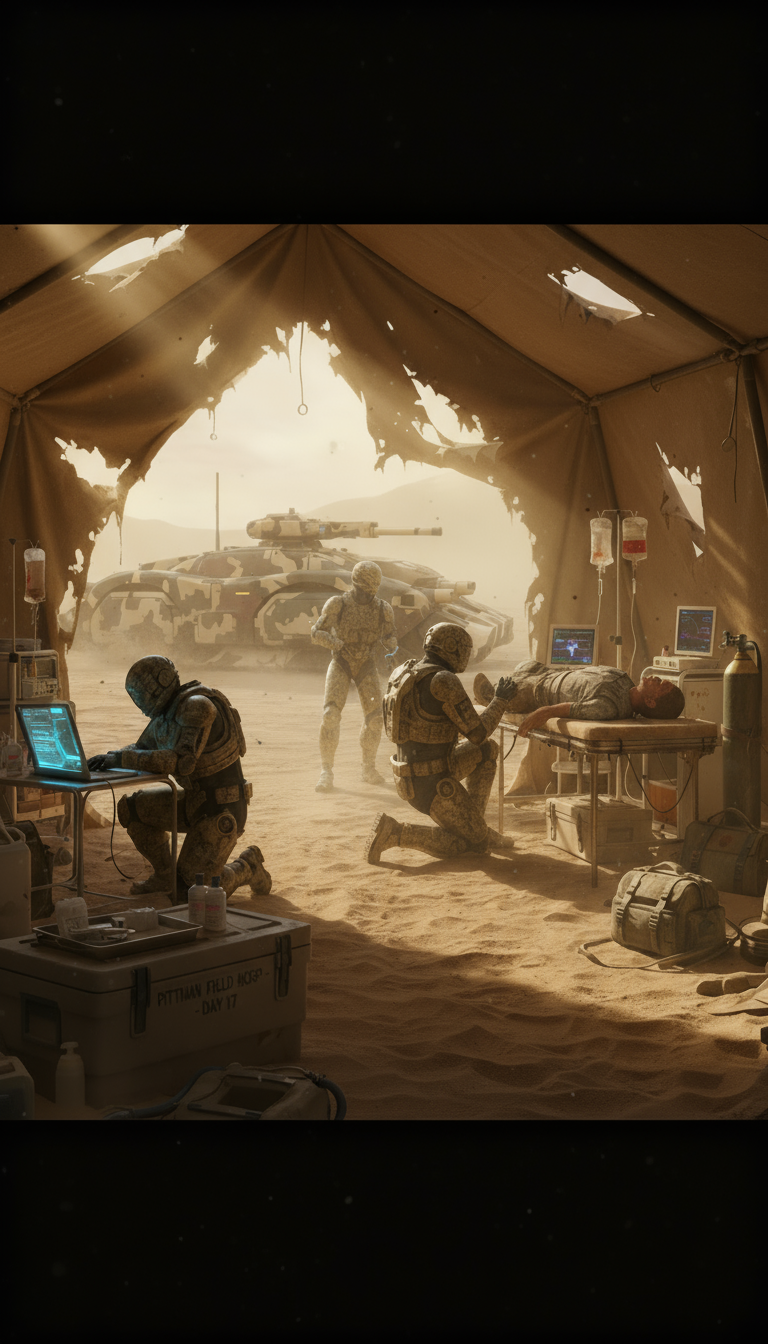
Day 17: Field Hospital Bravo
It has been seventeen days since my deployment to Pittman. The sand here never stops. It clings to everything, settles into every seam and fold of the medical tent, and returns no matter how many times we wipe down the tables or sterilize the instruments. It is a fine, relentless reminder of where we are and what this world has become.
The wounded come in waves, each one worse than the last. I have treated plasma burns that eat through flesh to the bone, and I have watched men arrive missing limbs to weapons we still do not fully understand. We live on fragments of sleep and whatever adrenaline the next emergency forces into our veins. Every time I close my eyes, I see the faces of the ones we could not save.
Day 18: The Toll
I have lost count of how many times I have had to tell soldiers they will never walk again, or that the arm they reached for is no longer there. Some stare at me in silence, their disbelief too deep even for panic. Others curse, scream, or collapse all at once. I move from cot to cot with my voice steady and my hands occupied, trying to keep my mind at a distance. Detachment is not cruelty. It is survival.
One of the younger Marines broke down while I was stitching a wound across his side. He could not have been older than nineteen. His eyes were wide and wet as he gripped my sleeve and whispered, “Why, Doc? Why are they doing this to us?” I had no answer worth giving. I told him he would stand again someday, though we both understood that he never would.
Day 21: Breakthrough in Alien Physiology
In the middle of all this ruin, we had our first real sign of progress. The science team finally made headway analyzing fragments of alien tissue recovered from the field. Their outer tissue is unlike anything we have seen—dense to the point of seeming metallic, with a cellular structure that conducts energy like a living circuit. It may explain both the nature of their plasma-based weaponry and their ability to withstand its discharge.
The team now believes those same energy pathways may be vulnerable to targeted disruption. They are working to develop compounds that interfere with the conductive pattern in the alien cells, potentially turning an advantage in their biology into a weakness. It is still theoretical, and theory does not stop bleeding on the table. Even so, the idea that something useful might come from what we have learned has given the unit something precious to hold on to. Hope is rare on Pittman. Tonight, for the first time in a long while, it feels real.
Day 23: Field Surgery at Point Delta
We were called out just after midnight. Alpha Squad had taken heavy fire near the cliffs at Point Delta, and my team deployed immediately. We established a triage station in the middle of the engagement, with smoke hanging low over the ground and the concussion of nearby blasts shaking dust from the rocks. There is something profoundly unnatural about performing surgery while the battlefield is still alive around you, but out here even the unnatural becomes routine.
Corporal Jenkins was the worst case. A direct plasma hit had torn his chest open, and there was no time to move him. We operated in the dirt, medpacks spread around us, trying to hold a life together in conditions that should have made any attempt impossible. His eyes kept fluttering open, searching for mine, pleading with me not to stop. I worked until my arms went numb and my gloves were slick, praying the sedatives would hold long enough to spare him the full pain of what was happening.
He did not make it.
I closed his eyes myself and told his squad we had done everything possible. That is the lie we tell them. Sometimes it is also the only mercy we have left to give.
Day 25: Psychological Fractures
Corporal Jackson broke today.
He snapped in the middle of rounds, shouting that he could not do it anymore. He had gone three straight days without real sleep, tending the wounded almost nonstop, and when I tried to steady him he started crying like a child. I had no choice but to send him back to base for evaluation. Losing him means the rest of us absorb even more strain, but that is still better than losing another medic to exhaustion in the middle of an operation.
And it is not only Jackson. We are all beginning to fracture. The noise never ends. The smell of blood, antiseptic, and burned tissue settles into your clothes and your lungs. The screams come day and night, and there is never enough time between them to grieve anyone properly. I can feel myself hardening inside, becoming more distant with each passing day. That frightens me more than the shelling. I do not want to become numb. But detachment is the only armor most of us have left.
Day 30: A Glimmer of Progress
For the first time in weeks, I witnessed something close to a miracle.
We treated Private Lee, whose arm had been nearly destroyed by plasma exposure. Using the experimental serum derived from alien cellular samples, we attempted to accelerate tissue regeneration far beyond normal recovery thresholds. None of us expected what happened next. Within hours, the damaged tissue began rebuilding itself—faster, stronger, and more cleanly than anyone in the tent had dared to predict.
It is too early to call it a cure, and no one here is foolish enough to celebrate prematurely. But it is the first real step we have taken toward healing instead of simply delaying death. For a few brief minutes, there were smiles in the tent. Even laughter. That single success gave breath back to a unit that had nearly forgotten what relief felt like. If we can adapt their biology to save our own, then maybe Pittman has not taken everything from us yet.
Day 34: The Price We Pay
Another day. Another loss.
I worked on a soldier this evening who whispered his mother’s name until his voice faded into nothing. I held his hand until the end because no one should die alone—not here, not anywhere. I felt his pulse weaken beneath my fingers, then slip away entirely, and a moment later I was already turning toward the next patient because there was no time to stop.
I look at my hands now and barely recognize them. The skin is rough, scarred, and permanently stained by the work. They no longer look like a doctor’s hands. They look like tools.
I do not know how much longer I can keep doing this. But I know that tomorrow, when the wounded come in again, I will be there. Because if I can save one more life—just one—then that will be enough to make me keep going.
Captain Marcus Hale, Forward Medical Unit, Pittman War Zone