
Training Program Log of Riley Shaw
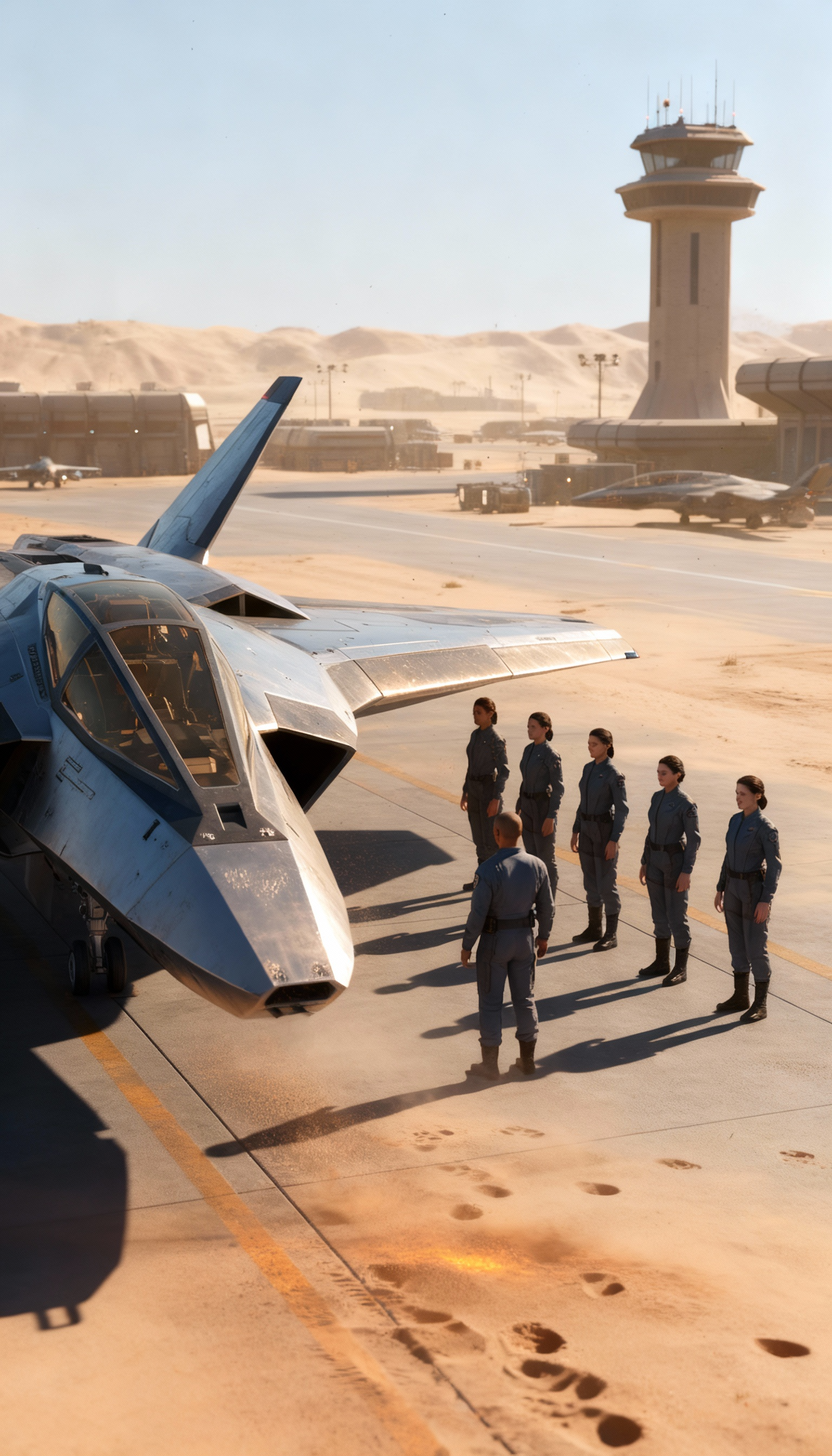
Day 1: Welcome to the Furnace
They told us it would be hard. No one mentioned it would begin the instant the shuttle touched down.
The sun was already punishing by the time we stepped onto the tarmac at Alaric Base, and the drill sergeant waiting for us wasted no time making it worse. Orders came first, insults immediately after, all delivered with the kind of precision that makes you understand very quickly this is not about courtesy. It is about breaking softness before softness gets someone killed.
The first day was orientation, though there was nothing gentle about it. The Furnace, as everyone calls it, sits at the center of the base like a reputation made concrete—the place where pilots are forged, or broken, depending on what they bring with them and what they can survive losing. My assigned flight group is Echo Five, eight cadets in total. We were issued regulation uniforms, neural-interface bands for simulator training, and a manual thick enough to stun someone titled Survival in the Void.
The dorms are bare, identical, and stripped of anything not considered essential. Each cadet is allowed one personal item. I brought a holo of Earth at sunset. I told myself it was for comfort. Deep down, I think I brought it so I would remember there was a world beyond the pressure waiting to consume us here.
Week 2: The Gauntlet
If the first week was demanding, the second was designed to teach us how little that word can mean.
The instructors threw us into what they call the Gauntlet—a relentless cycle of endurance runs, zero-gravity drills, and survival scenarios built to exhaust the body and then punish whatever weakness exhaustion exposed. The emergency-ejection simulation was the worst of it. We were launched into a debris field and ordered to reach a recovery beacon while pursuit drones tried to tag us out before we could stabilize. I lost focus twice—only for a heartbeat each time, but enough to feel how quickly one lapse could have ended the run.
I made it through without taking a hit. That should have felt like victory. Mostly it felt like relief.
By the end of the week, my entire body was one continuous bruise, my hands shook when I tried to sleep, and the neural-sync sessions left a low electrical ache behind my eyes that lingered for hours. Still, I was upright when the week ended. Around here, that counts for more than pride.
Week 4: First Simulator Mission
After weeks of theory, emergency procedures, and cockpit familiarization, we finally entered full-mission simulation. Sitting in the pod for the first time, I felt the neural link hum to life against my skin, then deeper than that, merging with thought and reflex until the separation between machine and pilot began to blur.
The system loaded the Goshawk Mk III fighter profile—fast, elegant, and unnervingly responsive, even in virtual space. The assignment sounded simple enough: navigate an asteroid belt while under hostile fire. It stopped feeling simple the moment the simulation began.
I clipped an asteroid during the final turn and earned a sharp rebuke from the instructor before the pod had even fully disengaged. It stung, but the truth was obvious. In ten minutes of simulation, I learned more about fear, timing, and aircraft control than I had in the previous three weeks combined. Only two cadets completed the course cleanly.
I was not one of them.
Not yet.
Week 6: First Loss
We lost Cadet Larsen today.
Not to death. To the program.
He packed what little he owned and walked out of the Furnace without a scene, without argument, and without looking back. The instructors always said not everyone would make it through. Hearing that in a briefing is one thing. Watching someone disappear from your formation and leave an empty bunk behind is another.
The mess hall was quiet that night in a way I had not heard before. No one wanted to say what all of us were thinking—that Larsen had not failed in some dramatic or distant way. He had simply reached the point where the strain took more than he could give back. And if it could happen to him, it could happen to any of us.
Week 8: Advanced Maneuvers
Today was our first true squad-tactics session, and it exposed a different kind of weakness.
Echo Five was tasked with defending a convoy against simulated raiders while maintaining coordinated formation through shifting attack vectors. The neural link synchronized eight pilots and eight fighters into one tactical network, and for the first time I understood how fragile formation really is. Not because it is difficult to hold when things go right, but because instinct keeps telling you to trust yourself more than the group.
I broke position to pursue a flanking attacker and immediately heard the instructor’s voice detonate across the comm feed.
“Hold formation or lose the mission.”
I pulled back into line.
The lesson landed harder than the reprimand. Skill matters. Initiative matters. But in a live combat wing, ego gets people killed faster than hesitation. A pilot who cannot hold formation is a liability, no matter how talented they are alone.
Week 10: Live Flight
At last, the real sky.
No simulator can prepare you for that first moment in a live cockpit when the Goshawk Mk III answers your touch and the neural interface makes the machine feel less like a vehicle than an extension of your own body. The engines roared beneath us as we climbed through the cloud line over Terra Secundus, and when we broke into sunlight, the canopy flooded with gold so bright it almost made me forget to breathe.
The mission profile was straightforward: maintain formation, execute a maneuver sequence, and return to base intact. Straightforward, of course, is not the same thing as easy. Gravity adds consequence to everything. I held formation to the finish, though my line wavered more than I would have liked and I felt every correction in my teeth.
After landing, the instructor gave me a single nod.
It was the first real sign of approval I had received since arrival.
It meant more than I expected.
Week 12: Combat Exercise Alpha
Everything in the program had been building toward this.
Combat Exercise Alpha is the final qualification scenario before assignment to an active wing. The simulation was brutal by design: defend a colony transport convoy against multiple attack waves while maneuvering through an asteroid field under escalating combat pressure. We started strong. Echo Five was sharp, disciplined, and coordinated in ways we had not been during the early weeks.
Then Vega, our lead, was taken out halfway through the run.
Command shifted to me.
The responsibility hit like a physical force. Every call suddenly carried the weight of everyone else’s survival. Every maneuver mattered. Every hesitation risked compounding into disaster. By the time the simulation ended, only three of us were still in the fight. The silence afterward felt heavier than any shouted debrief or formal evaluation.
The instructors tore through our performance in detail, breaking down every error, every delay, every tactical choice that had cost us position or pilots. When they finally finished, one of them looked up from the review board and said the words I had spent twelve weeks trying to earn.
“You are ready.”
Reflection: Graduation Day
Twelve weeks ago, I arrived at Alaric Base as a hopeful cadet with more determination than discipline. Today, I graduate as a certified fighter pilot of the Third Aerospace Wing.
The Furnace did more than train us. It stripped away illusions, tested every weakness, and rebuilt what remained into something harder, sharper, and less easily broken. Standing in front of my locker before final departure, I took one last look at the holo of Earth’s sunset I had carried with me since day one.
I do not see it the same way now.
The horizon is no longer something I think about returning to. It is something I think about crossing.
For Echo Five, this is only the beginning.
End Log
Location: Alaric Training Base, Terra Secundus
Cadet Name: Riley Shaw
Program: Fighter Pilot Initiation Course
Log Period: Week 1 through Week 12