




Trjava
Introduction
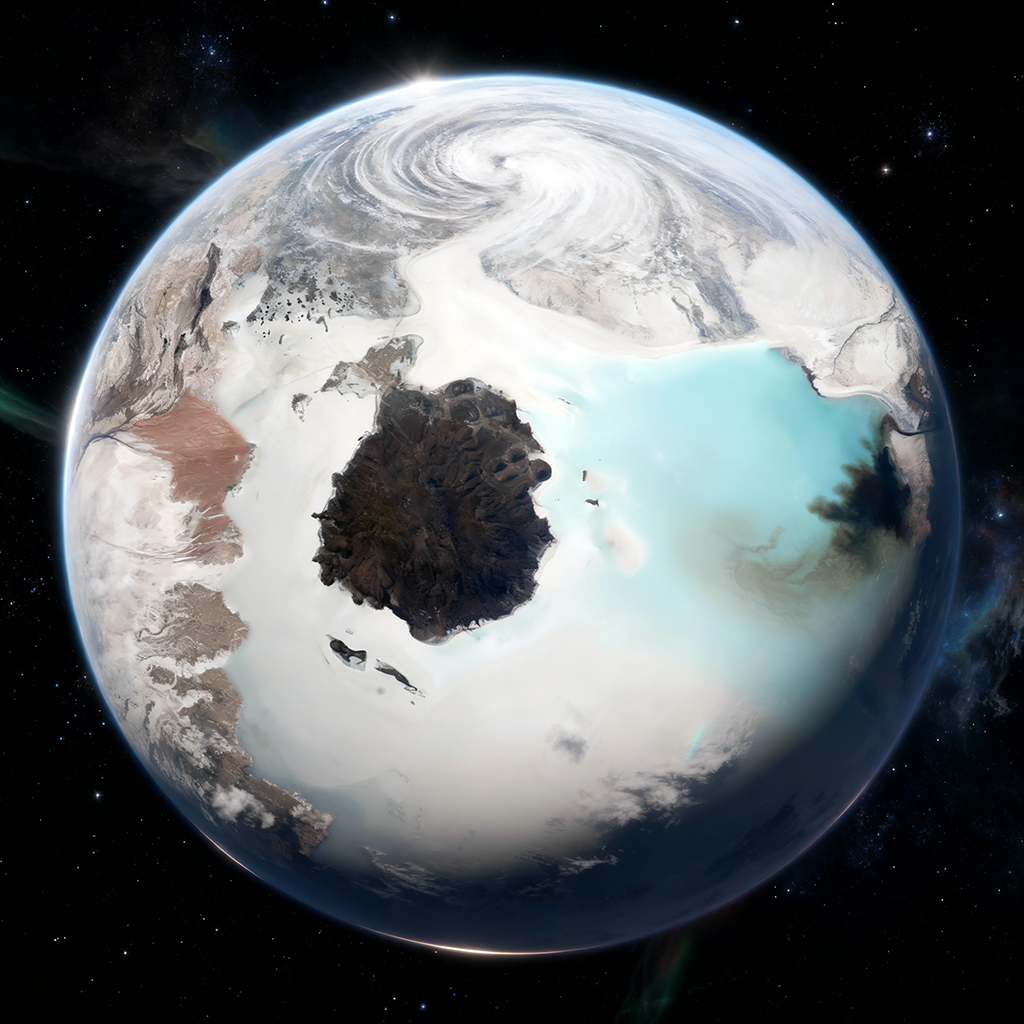
Trjava, a frozen frontier world of the Russian Federation, stands as a harsh but vital outpost on the edges of human expansion. With its icy plains, subzero temperatures, and unrelenting winds, it symbolizes endurance, unity, and technological fortitude.
Geography and Environment
Trjava’s radius of 4,895 km and gravity of 0.84G make it slightly smaller than Earth, though its challenges stem from its severe cold. With an average temperature of 250K (-23°C) and a thick atmosphere at 1.02 atm, the planet remains locked in permafrost, its surface dominated by glaciers and icebound seas. The Water/Ice Index of 58.42% marks it as one of the richest water reserves in Russian space, albeit frozen and difficult to extract.
Jagged mountain chains and volcanic outcrops break the monotony of the frozen plains, while deep crevasses and shifting ice fields make exploration perilous. Despite these dangers, the planet’s stark landscapes possess an austere beauty that inspires reverence among its settlers.
Colonization and Settlement
With a population of 751,260, Trjava’s inhabitants consist primarily of scientists, miners, and military personnel. The capital, Zvezdny Gorodok (“Star City”), serves as both administrative and industrial hub. Settlements are domed, insulated, and often built below ground to conserve heat and shield from storms. Daily life revolves around geothermal energy, community cooperation, and maintaining morale through shared social spaces and digital recreation.
Economy and Industry
Trjava’s economy centers on mineral extraction and scientific research. Rich veins of rare-earth elements and frozen water reserves make it a key supplier for the Federation’s industrial base. Large-scale mining operations, supported by advanced automation, operate around the clock. The planet also hosts cutting-edge research in cryogenics, atmospheric science, and astrogeology.
Strategically, Trjava serves as a frontier military post and early-warning station. Radar installations and deep-space communication hubs reinforce its value to the Federation’s defense network.
Challenges and Future Prospects
Trjava’s greatest challenges remain its cold climate and isolation. Infrastructure maintenance is costly and continuous, and long winters test the psychological endurance of its citizens. However, ongoing technological advancements and terraforming research may one day soften the planet’s conditions, paving the way for expanded settlements and industries.
Conclusion
Harsh yet vital, Trjava exemplifies Russian perseverance. It is both fortress and frontier, ensuring the Federation’s continued reach into deep space and standing as a monument to human willpower amid frozen desolation.