

New Atlantis

Introduction
New Atlantis is the third vertex of the Terran Triangle — a crucial world linking Earth and Terra Secundus in humanity’s interstellar expansion. Once a hidden gem, it became a focal point for colonization by the European Union and China, later joined by Brazil and other Terran powers. Today, it stands as one of the most populous and influential colonies in human space.
Geography and Climate
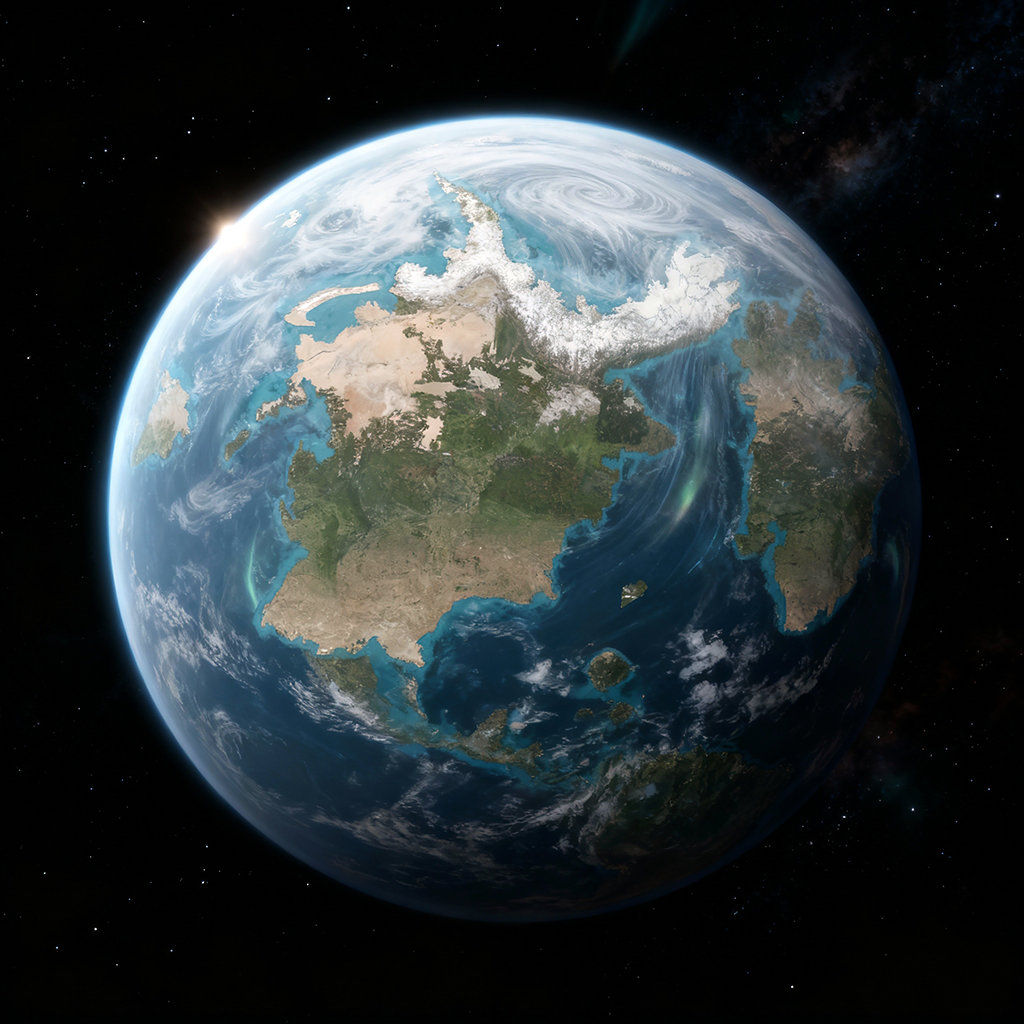
New Atlantis is defined by its massive supercontinent, Pamona, covering much of the equatorial and mid-latitude zones. The northern territories, held by the European Union, feature lush forests, fertile plains, and mountain ranges. The southern territories, under Chinese control, are marked by subtropical lowlands and agricultural heartlands. Beyond Pamona lie smaller continents and island clusters governed by Brazil, Canada, Korea, and others — each fostering vibrant maritime economies.
The planet’s climate is warm, with a mean global temperature of 316K (43°C). Its thin 0.63 atm atmosphere, rich in oxygen and nitrogen, required significant bioscientific adaptation of Terran species. Terraforming and environmental engineering have stabilized the planet’s ecosystems, enabling large-scale agriculture and urbanization.
Colonization and Development
The colonization of New Atlantis was spearheaded jointly by the European Union and China, who established distinct northern and southern hemispheric zones. The EU’s northern region evolved into a highly developed Tier IV society characterized by advanced technology, efficient infrastructure, and cultural sophistication. The southern Chinese sector, though equally industrious, exhibits a mix of Tier III and IV zones reflecting variable development priorities.
Despite geographic proximity, the two powers maintain distinct political identities. Limited trade and cautious cooperation reflect broader interstellar rivalries, though the planet’s shared prosperity fosters mutual stability.
Brazil’s Rising Influence
Brazil has become a dominant maritime force on New Atlantis through its floating oceanic cities — colossal arcologies that serve as shipyards, research centers, and hubs of trade. These oceanic metropolises grant Brazil control over much of the planet’s naval commerce and diplomatic influence, establishing it as the third major power on the planet.
Economy and Industry
New Atlantis thrives on agriculture, livestock production, and high-tech industry. Genetic modification and adaptive bioengineering have enabled Terran flora and fauna to flourish in the hot climate. The planet exports vast quantities of food, energy products, and manufactured goods, anchoring the Terran Triangle’s trade network. EU-controlled regions excel in sustainable energy and advanced manufacturing, while Chinese regions dominate in heavy industry and logistics.
Population and Society
Home to over 230 million people, New Atlantis ranks as the third most populous Terran world. Its society is a tapestry of cultures — European, Chinese, Brazilian, Canadian, Korean, and others — unified by a shared pioneering spirit. Cities are centers of learning, research, and the arts, hosting world-class universities, theaters, and museums. Residents pride themselves on their adaptability and cosmopolitan identity.
Strategic Importance
Positioned as the third point in the Terran Triangle, New Atlantis functions as a logistical and diplomatic linchpin for interstellar travel. Its location between Earth and Terra Secundus cements its importance in commerce, governance, and cultural exchange. The planet’s growing industrial and demographic strength guarantees its influence in shaping Terran civilization’s next era.
Conclusion
New Atlantis embodies the essence of human adaptability and ambition — a world of unity amid diversity. Its balance of cultures, industries, and strategic prominence ensures its continued role as one of the central pillars of human expansion across the galaxy.