




Europa
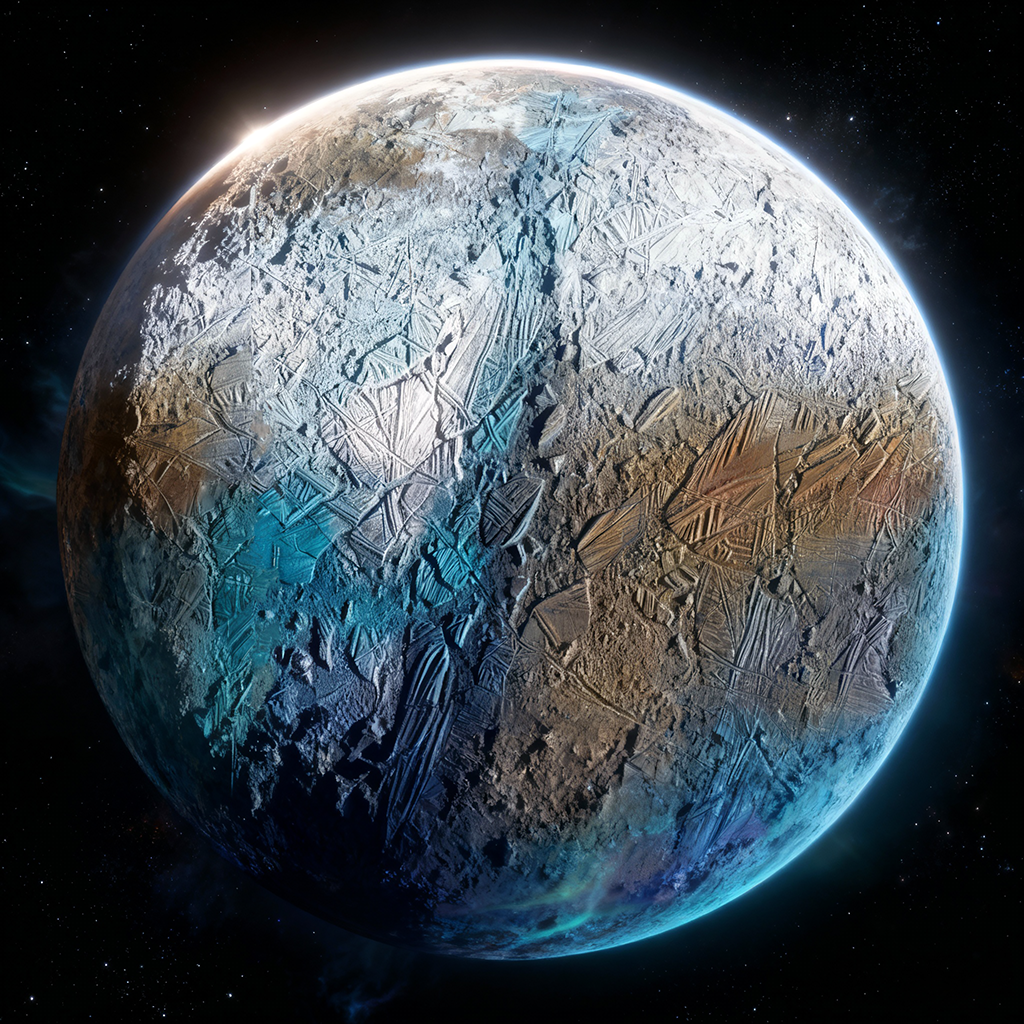

Geographical and Environmental Overview
Europa, one of Jupiter’s most fascinating moons, has evolved from an icy mystery into a thriving hub of colonization, science, and culture. With a radius of 1,560 kilometers and gravity at 0.13g, it presents formidable challenges to life—but its vast reserves of water ice and its subsurface ocean have made it indispensable to human expansion throughout the outer solar system.
Its surface is a fractured sheet of frozen brilliance—crisscrossed with ridges, valleys, and chaotic terrains shaped by Jupiter’s immense tidal forces. From orbit, Europa’s scarred white, blue, and brown plains create a hauntingly beautiful mosaic. The mean temperature, roughly 102K (-171°C), ensures that life on the surface is impossible without heavily insulated shelters. Most colonists live in ice-buried habitats or deep subsurface arcologies, shielded from Jupiter’s intense radiation belt.
Beneath Europa’s frozen crust lies a world-spanning ocean—one hundred kilometers deep and warmed by tidal heating. It holds more water than all of Earth’s oceans combined and serves as both the colony’s life-support reservoir and humanity’s best chance of discovering extraterrestrial life. Drilling and melting operations provide access to water for agriculture, habitation, and fuel production, while ongoing research probes its depths for microbial life near thermal vents.
Europa’s tenuous oxygen atmosphere offers little natural protection or sustenance, but its constant renewal through surface sublimation cycles provides a sustainable source of water vapor for industrial and life-support systems. Life here depends on a delicate balance of technology, resilience, and collaboration.
In the modern age, Europa stands as a shining emblem of human endurance—an ice world transformed into a cradle of exploration, discovery, and unity under Jupiter’s luminous gaze.
The History of Europa: From Exploration to Civilization
Europa’s transformation from mystery to metropolis is a story of scientific triumph, human courage, and cultural evolution. Its development spans centuries of exploration, settlement, and innovation, culminating in one of the most advanced societies beyond Earth.
Early Exploration and Discovery (2020s–2050s)
Europa Clipper (2024): NASA’s landmark mission confirmed the presence of a global subsurface ocean and identified areas of intense geological activity, igniting global fascination with Europa’s potential for life.
Juno Extended Mission (2027): Supplementary flybys refined our understanding of the moon’s crustal thickness and detected plume eruptions—direct evidence of dynamic processes beneath the ice.
Europa Drill Mission (2033): The “Endurance” probe, a joint NASA–ESA project, drilled through 20 kilometers of ice to reach the ocean, discovering microbial life in hydrothermal vent systems—one of humanity’s greatest scientific revelations.
Dresden Trench Station (2047): Established 12 kilometers beneath the surface, this became the first permanent human base, dedicated to oceanic biology and geology. Its success paved the way for full-scale colonization.
Amundsen Base (2052): A surface outpost monitoring Europa’s quakes and plumes, it served as a vital staging point for deeper exploration.
The Age of Colonization (2060s–2120s)
By the late 21st century, Europa’s promise had turned to reality. Major bases evolved into self-sustaining colonies, and humanity’s reach extended into its subterranean seas.
Thalassa Station (2065): Built near Conamara Chaos, this installation became a center for tectonic and biological study, forming the basis for later urbanization.
Ganymede Gateway (2074): A logistics hub orbiting Ganymede facilitated transport and trade across Jupiter’s system, effectively linking Europa to the wider economy.
Poseidon City (2092): The first true Europan metropolis, located near Thera Macula. A joint U.S.–Russian enterprise, it housed thousands of residents and marked the dawn of deep-sea habitation.
Thalassa City (2100): A European–Asian collaboration that emphasized research, art, and education, making it a cultural beacon beneath the ice.
New Atlantis (2105): Founded in the Dresden Trench, this city became the leading center of marine biology and planetary science.
Europa Prime (2110): Built on the surface near Pwyll Crater, Europa Prime became the political and administrative capital, seat of the Europa Assembly.
Hyperion City (2118): Established near Rhadamanthys Linea, this industrial powerhouse harnessed geothermal energy from the ocean floor to power the growing Europan economy.
The Golden Age (2130s–2200s)
Icarus Spaceport (2133): Europa’s primary surface gateway, enabling travel between Earth, Ganymede, and Saturn’s frontier colonies.
Olympus Station (2140): Carved into Mount Ida’s towering ice cliffs, this hybrid resort and research center became a symbol of luxury in the outer system.
Aegis Defense Network (2148): A comprehensive orbital and underwater security system, ensuring Europa’s independence and safety from piracy or incursion.
Triton Cultural Center (2162): A sprawling complex of theaters, galleries, and academies that nurtured a distinct Europan cultural identity.
Leviathan Research Complex (2175): A deep-sea scientific installation dedicated to marine robotics, biology, and exobiology, famous for discovering extremophile species.
The Temple of the Sea (2189): Constructed in Poseidon City, this serene structure blended spirituality and science, honoring the mysteries of Europa’s ocean as sacred expressions of life.
Modern Europa (2210s–Present)
Europa University (2213): A prestigious academic hub in Europa Prime, it unites scholars from across the Solar System under the banner of science and diplomacy.
The Mariner’s Arcology (2218): A massive underwater city designed for one million inhabitants, a model of post-scarcity engineering and ecological balance.