




Fenghaung

Introduction
Fenghaung, the second planet in the Gliese 880 system, stands as one of China’s most remarkable extrasolar colonies—an enigmatic world of storm, ice, and perseverance. Discovered by Chinese survey teams in the early era of interstellar expansion, Fenghaung has evolved into a symbol of endurance, resourcefulness, and the human will to thrive under the harshest conditions. Its dim skies, turbulent weather, and haunting landscapes give it a mysterious allure that continues to draw settlers seeking purpose on the edge of civilization.
Discovery and Colonization
The Gliese 880 system was identified early as a target of strategic importance during China’s first great wave of stellar exploration. Observations by the Star Snooper Telescope confirmed several small planetary bodies orbiting the red dwarf, with the second—later named Fenghaung—meeting the Rheims habitability threshold. Within a decade of discovery, Chinese colonization teams landed and established permanent outposts. Their mission was twofold: to secure a forward presence in the frontier and to unlock the secrets of a planet whose beauty was rivaled only by its hostility.
Geography and Environment
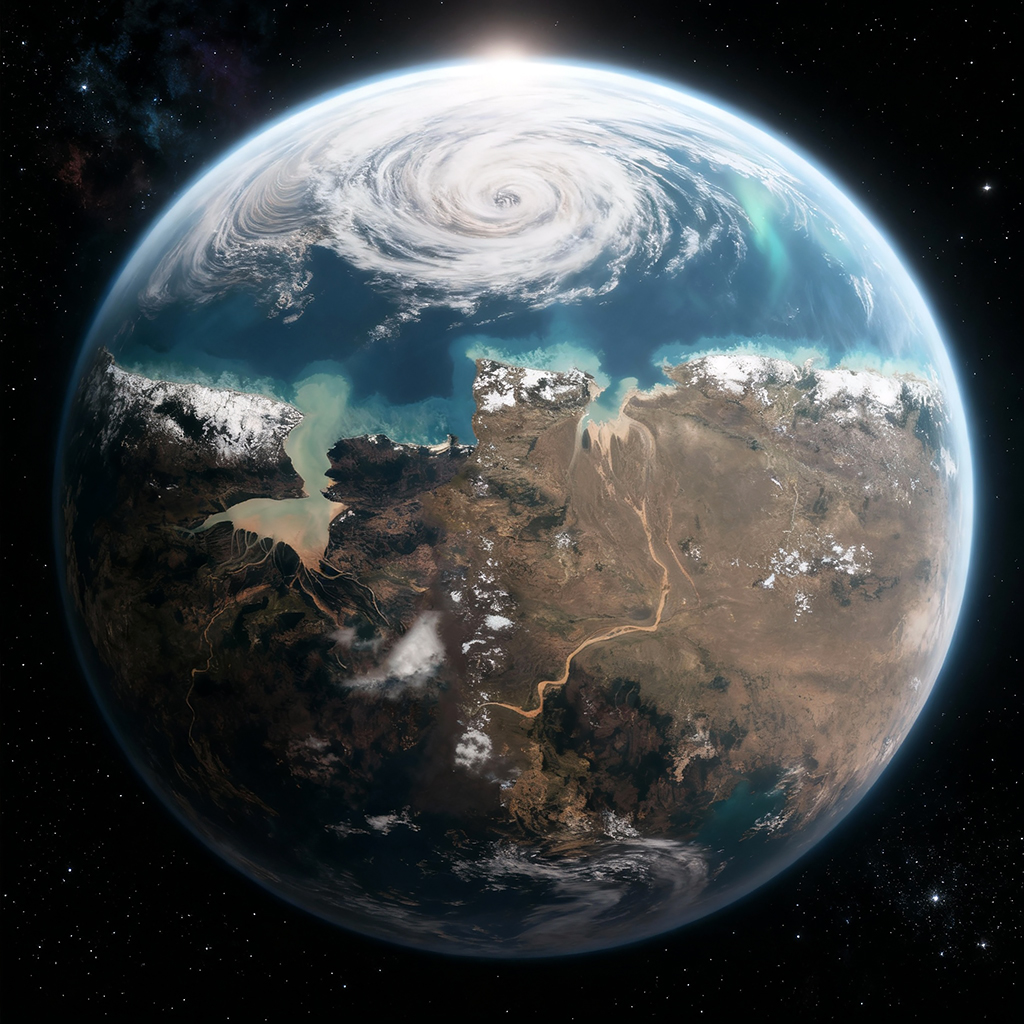
Fenghaung is a world of extremes—where rivers, deltas, and tundra-like plains meet the chill breath of endless storms. Approximately 63% of the surface is covered in water, with continents formed along colossal river valleys and coastal floodplains. The planet’s landmasses are rugged and eroded, with high plateaus, permafrost uplands, and fertile deltas that offer rare oases for settlement. The dark, mineral-rich soils sustain hardy crops despite relentless flooding, while the shallow seas, seldom deeper than 400 meters, churn violently under a constant barrage of storms.
The mean temperature of 262K (-11°C) keeps much of the world in a state of cold damp twilight. The thick atmosphere—nearly six times denser than Earth’s—creates crushing pressure and near-constant rainfall. Sunlight rarely pierces the heavy clouds, forcing settlers to rely on geothermal and hydroelectric power. Most habitats are elevated or floating, designed to endure flood surges and sustained winds that sweep across the lowlands.
Despite its brutal environment, Fenghaung’s rich uplands and freshwater reserves make it invaluable. The planet’s combination of harshness and fertility mirrors the balance of its namesake—the phoenix—rebirth amid adversity.
Flora and Fauna
Fenghaung’s biosphere is austere yet resilient, shaped by millennia of cold evolution and nutrient scarcity. Its flora is dominated by mosses, lichens, and fungi capable of surviving in perpetual damp and darkness. These organisms form spongy mats across the terrain, stabilizing the soil and sustaining the planetary ecosystem.
Fauna is limited but distinctive. Small invertebrates and amphibious fish populate the rivers and shallow seas. Chief among them is the Sand Fish, a delicacy celebrated throughout the colony. Found only in the southern oceans, it is prized for its delicate flavor but impossible to breed in captivity, elevating it to near-mythic culinary status.
Human Habitation and Culture
Fenghaung’s human settlements, though few in number, are marvels of adaptive design. The population of roughly 225,000 is spread among three principal cities built on stilts, floating platforms, and elevated plateaus. Architecture emphasizes stability and resilience—low, wide structures of composite alloys that resist both corrosion and wind shear.
Life here has forged a distinctive cultural identity—one grounded in community, perseverance, and balance with nature. Most residents are of Chinese and Southeast Asian descent, and the colony’s culture reflects this shared heritage through art, music, and ritual. Festivals mark the passing of each storm season, blending ancient traditions with futuristic expression.
The cuisine of Fenghaung is a fusion of necessity and creativity. Fungal harvests form the basis of daily meals, enriched with freshwater fish and sea protein. The famed Tinaba bread—made from the Kalab Head mushroom and Silver Fish—is both staple and symbol of the colony’s ingenuity. Dining is communal, reinforcing the unity vital to survival in so unrelenting a world.
Challenges and Future Prospects
Fenghaung remains a frontier world, both promising and perilous. Its dense atmosphere, constant storms, and limited biodiversity test every aspect of human endurance. Infrastructure must be rebuilt constantly, and agriculture relies on resilient bioengineered crops and imported supplements. Yet its mineral wealth, freshwater resources, and emerging aquaculture industries ensure continued growth.
Economic prospects center on sustainable harvesting of Sand Fish and deep-river aquaculture. Research institutions study the planet’s hydrological cycles, while expansion projects seek to create self-sufficient townships across its deltas. Immigration from mainland China and Southeast Asia continues, drawn by both opportunity and the romanticism of life on a living storm.
Fenghaung’s future lies not in conquering its environment, but in coexisting with it—learning the rhythm of its tides and tempests, and finding prosperity in harmony with its extremes.
Conclusion
Fenghaung is a paradox—a world of endless rain and enduring hope. It challenges humanity’s capacity to adapt and rewards those who embrace its tempestuous soul. For China, it stands as both a triumph of exploration and a crucible of perseverance—a phoenix world rising through struggle, its wings forged from storm and silence.