




Stark Garden
Introduction
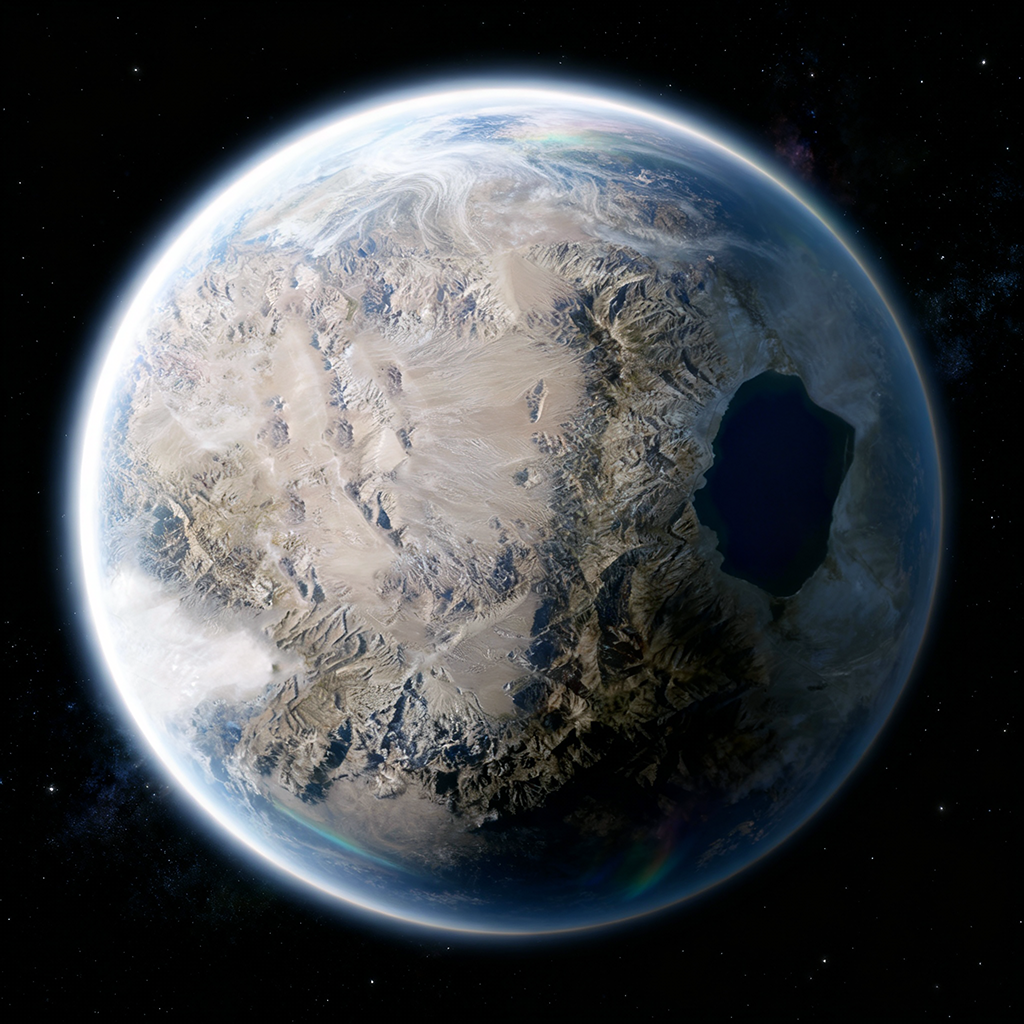
Stark Garden is a habitable world located deep within Omnium space, a region known for its strategic importance and advanced colonization efforts. Despite its name, Stark Garden is a planet of contrasts, where harsh environmental conditions meet resilient human and alien ingenuity. With a population of over two million inhabitants, this planet has become a thriving community — a testament to the Omnium’s ability to transform even the most challenging environments into livable worlds.
Geography and Climate
Stark Garden presents a harsh yet fascinating environment defined by its rugged terrain, frozen plains, and extreme atmospheric conditions. Its landscape is both forbidding and beautiful, a study in endurance and adaptation.
Surface and Terrain: With a radius of 6,599 km, Stark Garden is slightly larger than Earth and maintains a gravity of 1.03G, nearly identical to the Terran standard. The terrain is dominated by jagged mountain ranges, windswept deserts, and icy highlands, with water present but primarily trapped in glaciers and permafrost. A water/ice index of 20.3 indicates limited liquid reservoirs, rendering accessible water a precious resource.
Atmospheric Conditions: The planet’s dense atmosphere exerts a pressure of 2.58 atm, creating heavy, weighty air that alters both weather and habitation. Average surface temperature hovers near 273K (0°C), producing a predominantly cold climate punctuated by regional extremes. While life is possible, the thick air and freezing temperatures require pressure suits and breathing aids outside protected zones.
Day and Night Cycle: Stark Garden’s rotation is absent — the planet is tidally locked to its star. One hemisphere bakes in constant light, while the other lies in perpetual darkness. The narrow twilight band between these extremes serves as the habitable zone, supporting both ecosystems and civilization. This narrow strip of balance defines all life and culture on Stark Garden.
Population and Settlements
Stark Garden is home to 2,158,000 people, concentrated along the temperate twilight zones where conditions are most stable. Cities here are marvels of adaptation and engineering, self-sustaining and climate-regulated.
Urban Planning: Settlements are constructed as arcologies — enclosed habitats with their own microclimates. The largest of these, Sorran Reach, sits atop a geothermal plateau and serves as the planetary capital. Other arcologies line the twilight band in a chain connected by subterranean maglev tunnels and transit hubs, forming a continuous band of civilization encircling the world.
Living Conditions: The dense atmosphere and cold temperatures necessitate insulated, pressure-sealed environments. Energy systems recycle heat and air, while climate stabilizers maintain steady internal temperatures. Outside, exploration and mining teams use reinforced exosuits designed for the planet’s high atmospheric pressure.
Resource Management: Freshwater is drawn from deep ice wells, while hydroponic domes sustain the food supply. Energy production is split between geothermal plants, nuclear micro-reactors, and atmospheric turbines that exploit the constant jet streams near the terminator line.
Economy and Industry
Stark Garden’s economy is robust despite its environmental challenges, based on resource extraction, manufacturing, and research. The planet’s extreme conditions have driven technological innovation and specialization.
Mining and Resource Extraction: The rugged mountains conceal rich mineral seams — iron, nickel, cobalt, and silicates — mined by automated facilities and robotic fleets. The extracted materials feed Omnium’s industrial sectors, making Stark Garden an important supplier of raw materials to the wider Core systems.
Agriculture and Food Production: Agriculture is conducted entirely indoors through hydroponics and aeroponics. These facilities provide year-round crops, maximizing yields despite limited arable land. Many food products are genetically modified to thrive in low-light or artificial environments.
Manufacturing and Exports: The planet produces cold-environment machinery, pressure suits, and cryo-grade alloys designed for use on other frozen worlds. These exports contribute significantly to the Omnium economy and cement Stark Garden’s role as a frontier manufacturing hub.
Culture and Society
Life on Stark Garden has cultivated a culture of endurance, innovation, and communal unity. Its people embody the Omnium’s core virtue — survival through adaptation.
Community and Resilience: The harsh environment has forged tight-knit communities bound by necessity. Citizens value cooperation above individualism, and local councils govern by consensus. The rhythm of life follows the long artificial “cycles” established to mimic day and night, balancing work, rest, and collective celebration.
Education and Innovation: Education emphasizes applied sciences — engineering, environmental control, and biology — producing a population of highly skilled technicians and researchers. Many graduates are recruited by Omnium research agencies for projects across the empire.
Art and Expression: Stark Garden’s culture reflects its landscape. Visual art and music emphasize minimalism and light — luminous sculptures, reflective materials, and symphonies that mimic the howling winds of the high plateaus. The twilight horizon itself has become a recurring symbol of hope and equilibrium in Stark Garden’s artistic canon.
Challenges and Future Prospects
Environmental management remains a continual challenge. The planet’s dense atmosphere and fragile balance between frozen and habitable regions demand constant vigilance. Climate control and resource recycling systems must operate flawlessly to sustain life. Expansion efforts aim to colonize deeper into the twilight zones, creating new settlements as the population grows.
Strategically, Stark Garden’s position within Omnium space gives it immense logistical value. The planet’s cold-weather industries supply many frontier expeditions, and its research into atmospheric adaptation is shared across multiple colonies. As the Omnium continues to expand outward, Stark Garden is projected to become a key staging ground for deep-space operations.
Conclusion
Stark Garden is a world of beauty and severity — a frozen mirror of endurance within the Omnium. Where other planets yield to their extremes, this one thrives in spite of them. Its people have made the twilight their home, standing as a symbol of Omnium resilience and ingenuity. Through cold and light, silence and storm, Stark Garden endures — a living garden of steel and frost beneath an eternal sun.