




Misty Garden
Introduction
In the expansive reaches of the Omnium, the Gliese 473 system is home to a remarkable trio of inhabited worlds. Among them is a small yet significant habitable moon that serves as a minor colony within the Omnium. Though its population is modest, the moon holds a unique place within the system, contributing to the Omnium’s broader goals of exploration, resource utilization, and interstellar community building.
Geography and Environment
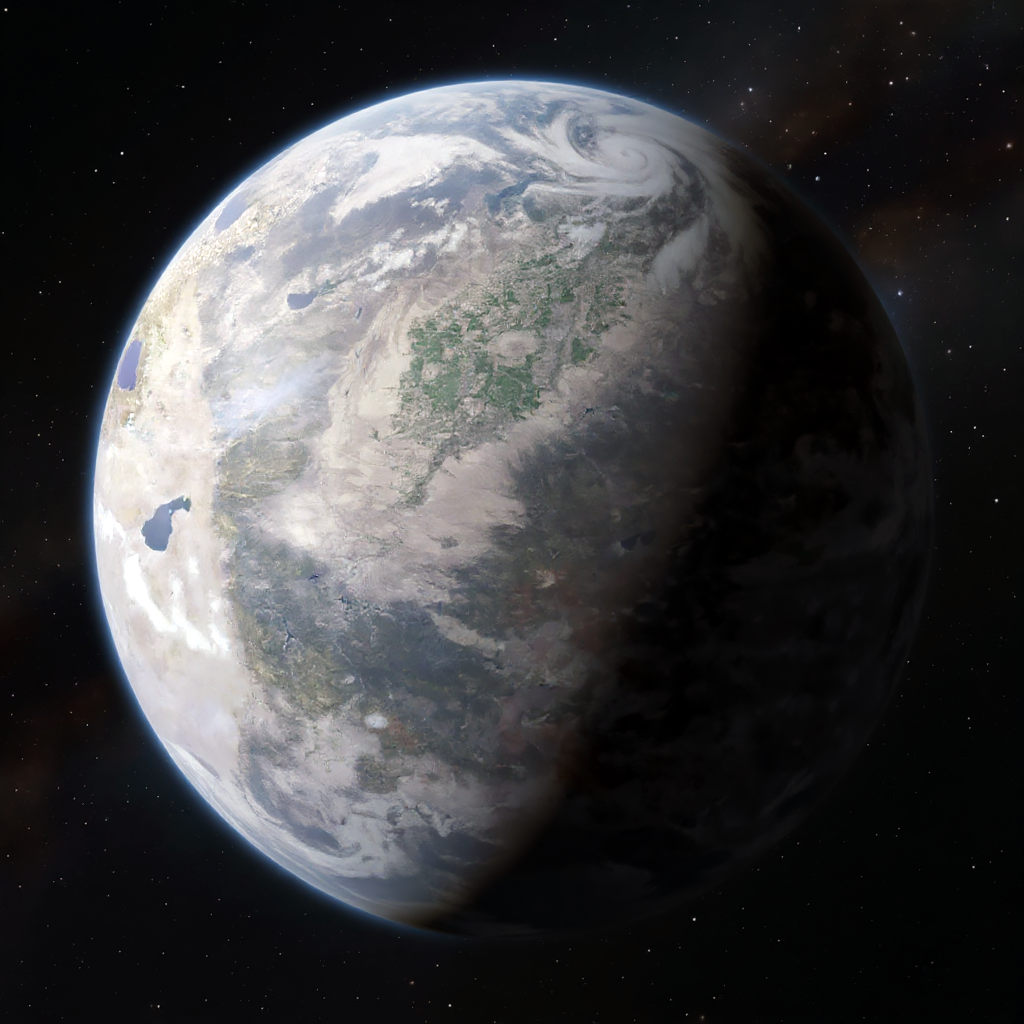
Misty Garden is a small but strategically important moon orbiting its parent world at a distance of 159,662 kilometers. Despite its modest radius of 3,934 kilometers, it supports a sustainable colony due to its balanced gravity of 0.86 G—comfortable enough for long-term habitation and easier on settlers compared to higher-gravity worlds.
Monument is a planet defined by striking contrasts between icebound highlands, volcanic belts, and sprawling shallow seas. With a radius of 5,282 kilometers and a gravity of 0.83 G, it is smaller and lighter than Earth, yet large enough to sustain a stable atmosphere. Its orbit of 35.89 years creates extended seasonal cycles that stretch across generations, while its unusual retrograde rotation of -675.6 hours produces days and nights that last nearly a full month, profoundly shaping the rhythms of life on the planet.
Climate and Atmosphere
Monument’s climate is harsh and cold, with a mean surface temperature of 261K (-12°C). The thin 0.44 atm atmosphere offers limited protection against radiation and requires settlers to live in domes, sealed habitats, or augmented structures. The extended periods of daylight cause gradual warming, allowing temporary thaws in lakes and coastal regions, while the long nights plunge the surface into deep freezes, locking much of the water into ice once more. Despite these extremes, the atmospheric mix can support human life with technological adaptation.
Surface and Hydrosphere
Monument’s Water/Ice Index of 46.5% highlights the dominance of frozen reserves across its terrain. Vast glaciers stretch across mountain ranges, while crater seas and ring-shaped archipelagos dot the lowlands, likely remnants of ancient tectonic upheaval or impact events. Shallow turquoise waters and equatorial liquid basins contrast with the barren, snow-clad ridges and volcanic zones, which continue to shape the planet with geothermal activity. These volcanic regions serve as rare heat sources, providing natural geothermal energy for settlements.
Habitability and Settlement
Though inhospitable by Earth standards, Monument’s unique geography has drawn settlers to its equatorial archipelagos, where water remains liquid longer and volcanic activity creates habitable zones. Colonies are often clustered around geothermal fields, making use of the natural heat to maintain agriculture within domes. Long days are used for construction and farming, while extended nights force reliance on energy reserves and careful rationing. Despite its challenges, Monument is considered a world of stark beauty—its ring-shaped landmasses and snow-capped ridges giving it a distinctive identity among frontier worlds.
Settlement and Role
Misty Garden serves as both a survival colony and a resource hub. Its settlements are spread across valleys and ridges where ice extraction and geothermal energy make habitation viable. While inhospitable, its relative stability and wealth of resources have made it a key support outpost for Omnium expansion into the outer territories. Life here is austere, but the name “Misty Garden” reflects the colonists’ pride in transforming a frozen moon into a place where controlled agriculture thrives inside vast domes, creating literal gardens of green in an otherwise icy wilderness.
Population and Society
The population of this moon is currently 46,100, a small yet resilient community that has chosen to make this frozen world their home. The society here is primarily composed of settlers who are driven by a sense of adventure and the pioneering spirit that has come to define the Omnium’s expansion into the frontier regions of space. These inhabitants are well-equipped to handle the challenges posed by their environment, utilizing advanced technology to maintain their way of life.
Life on this moon is centered around a few key settlements, each carefully designed to maximize efficiency and sustainability in the harsh climate. These communities are connected by a network of heated tunnels and enclosed transport systems, allowing for safe and efficient movement between habitats without exposing residents to severe external conditions.
Despite the small population, the moon’s inhabitants have developed a close-knit society. The isolation and harshness of the environment foster a strong sense of community and mutual reliance. Social and cultural activities are highly valued, with communal gatherings and virtual connections to the broader Omnium serving as vital aspects of daily life. Education and training in survival skills are also integral, ensuring that each generation is prepared to continue thriving on this remote moon.
Economic and Strategic Importance
While the moon is classified as a minor colony, it holds strategic and economic value for the Omnium. The ice reserves are a crucial resource, providing a stable supply of water that can be utilized for both local needs and export to other colonies within the system. The extraction and processing of ice, alongside other potential mineral resources, form the backbone of the moon’s economy.
In addition to resource extraction, this moon serves as an important waypoint for exploration missions deeper into the Gliese 473 system and beyond. Its location within the system makes it an ideal staging ground for scientific expeditions and logistical operations, supporting the Omnium’s broader objectives of mapping and understanding this region of space.
Moreover, the colony’s infrastructure is designed to be highly adaptable, allowing for potential expansion as the population grows or new resources are discovered. The settlements are built with modular components that can be easily reconfigured or expanded as needed, ensuring that the moon remains a viable and dynamic outpost of the Omnium.
Challenges and Future Prospects
Living on this moon presents significant challenges, particularly the need to adapt to extreme cold and low atmospheric pressure. The colony relies heavily on advanced technology to maintain its habitats, generate heat, and ensure a stable supply of food and other essentials. The thin atmosphere also poses a risk to long-term health, requiring continuous monitoring and technological intervention to prevent adverse effects on the population.
Despite these challenges, the colony’s prospects are promising. The Omnium has invested in ongoing research and development aimed at improving life-support systems, increasing resource extraction efficiency, and exploring the potential for terraforming or atmospheric thickening to create a more hospitable environment.
In the long term, the colony on this moon could serve as a model for future settlements in similarly harsh environments, both within the Gliese 473 system and in other frontier regions. The lessons learned here will likely inform the Omnium’s strategies for expansion and sustainability across its vast interstellar holdings.
Conclusion
This habitable moon in the Gliese 473 system may be a minor colony, but it plays an important role in the Omnium’s broader strategy of exploration and settlement. With a small yet resilient population, a strong sense of community, and significant economic and strategic value, the moon stands as a testament to the Omnium’s commitment to expanding its reach into the farthest corners of space. As the colony continues to develop and adapt to its challenging environment, it will undoubtedly contribute to the ongoing success of the Omnium’s interstellar ambitions.