



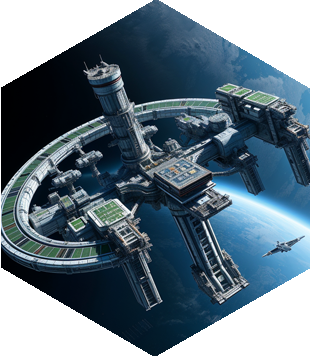
New Kiev

Classification: Corporate Industrial Colony (Analuska Charter, Russian Federation)
Radius: 3,663 km | Gravity: 0.57 g | Atmosphere: Thin (0.17 atm)
Temperature: 278 K (5 °C) | Water/Ice Index: 0.25
Population: ≈ 7,548,000 | Economic Profile: Mining, Heavy Industry, Research & Development
Introduction
New Kiev is a colony established under a charter granted by the Russian Federation to the powerful corporation Analuska. This world, located in the far reaches of Russian-controlled space, represents both a strategic and economic investment by the Federation. Despite its relatively small size and low gravity, New Kiev has emerged as a vital hub of industrial activity and resource extraction, driven by the ambitions of its corporate founders.
Geography and Climate
New Kiev is a modestly sized planet with a radius of 3,663 kilometers and a gravity of 0.57 g. Its reduced gravity has shaped everything from the movement of its inhabitants to the design of its settlements, which often rise taller and more delicately than those on higher-gravity worlds. Transport and agriculture also benefit from this lighter pull, though structural engineering must account for extended exposure to the planet’s harsh climate.
Climate: With a mean temperature of 278 K (5 °C), New Kiev is a cool world where residents contend with long seasons of chill but not unbearable cold. Its rotation period of –448.9 hours creates extended stretches of daylight followed by equally long nights, forcing settlers to adopt adaptive agricultural methods, energy storage systems, and daily routines tied more to planetary cycles than to Earth-standard timekeeping.
Atmosphere: The atmosphere is thin, at 0.17 atm, far below Earth’s standard. Breathing aids are essential outside of protected zones, while most settlements rely on sealed domes or underground habitats. This necessity has created a culture of insularity, with cities existing as self-sustaining bubbles of life amidst a mostly barren surface.
Surface and Water: The map reveals a strikingly divided geography: broad stretches of golden-orange desert dominate much of the terrain, broken by oases, crater lakes, and seasonal runoff channels. Pockets of green plains flourish where water is available, particularly along the planet’s fault valleys and impact basins. Snow-dusted ridges and rocky uplands punctuate the landscape, while a scattering of small, deep-blue lakes stand as the most visible reservoirs of fresh water. The overall Water/Ice Index is just 0.25, marking liquid water as a rare and highly protected resource. Most reserves exist underground, tapped through deep wells and heavily regulated distribution systems.
Settlement Patterns: Colonists tend to cluster around these lakes and green belts, where agriculture and grazing are possible. The deserts, though forbidding, are rich in mineral resources, driving mining operations that form the backbone of New Kiev’s economy. The contrast between fertile enclaves and barren expanses has created a patchwork civilization—small domed cities and industrial hubs separated by vast stretches of lifeless terrain.
Corporate Governance and Society
New Kiev operates under a corporate governance structure, with Analuska holding primary authority over the colony. The corporation’s charter, granted by the Russian Federation, allows it to manage the planet’s resources, infrastructure, and population with minimal interference from the central government. This level of autonomy has enabled Analuska to shape New Kiev according to its economic interests, prioritizing efficiency, resource extraction, and industrial output.
The population of New Kiev stands at approximately 7,548,000, consisting largely of corporate employees, their families, and a growing number of independent settlers who are drawn by the promise of work and the possibility of forging a new life in this frontier world. The inhabitants of New Kiev are a hardy group, accustomed to the planet’s demanding conditions and the rigorous work schedules imposed by Analuska.
Economy and Industry
New Kiev’s economy is heavily dominated by resource extraction and heavy industry, sectors that Analuska has invested in heavily since the colony’s founding. The planet’s thin atmosphere and cool climate have made it a challenging environment for traditional agriculture, so food production is limited and primarily takes place in controlled environments such as hydroponic farms. As a result, much of the planet’s food supply is imported from other Russian Federation worlds or produced through advanced agricultural techniques that maximize efficiency in limited space.
The primary industries on New Kiev revolve around mining and manufacturing. The planet’s crust is rich in valuable minerals and metals, which are extracted through extensive mining operations and processed on-site in large industrial complexes. These resources are then exported to other parts of the Russian Federation, contributing to the Federation’s broader industrial base and providing essential materials for both civilian and military applications.
In addition to its mining and industrial activities, New Kiev also serves as a hub for research and development in fields related to resource extraction, environmental engineering, and industrial automation. Analuska has established several research facilities on the planet, where scientists and engineers work to develop new technologies and processes that can be applied both on New Kiev and in other harsh environments across the galaxy.
Infrastructure and Living Conditions
Given the planet’s harsh environment, infrastructure on New Kiev is focused on ensuring the safety, comfort, and productivity of its inhabitants. The primary settlements are domed cities and underground complexes, designed to protect residents from the thin atmosphere and to maintain a stable, livable environment. These habitats are equipped with advanced life-support systems that regulate temperature, pressure, and oxygen levels, creating microclimates that are comfortable for human habitation.
Transportation on New Kiev is primarily conducted through a network of underground tunnels and surface vehicles that are specially designed to operate in the planet’s low-gravity environment. These systems connect the various industrial sites, residential areas, and research facilities, ensuring that goods, workers, and information can move efficiently across the planet.
The quality of life on New Kiev varies depending on one’s position within the corporate hierarchy. Corporate executives and skilled professionals typically enjoy higher standards of living, with access to more spacious accommodations, better amenities, and greater social mobility. In contrast, lower-level workers and independent settlers often live in more modest conditions, with less access to luxury goods and services. However, the sense of community and shared purpose is strong among New Kiev’s inhabitants, who take pride in their role in building a thriving colony in such a challenging environment.
Challenges and Opportunities
Life on New Kiev is not without its challenges. The planet’s thin atmosphere, cool climate, and long periods of daylight and darkness present significant obstacles to both the physical and psychological well-being of its inhabitants. The isolation of the planet, combined with the demanding nature of the work, can lead to feelings of loneliness and stress among the population, particularly for those who are new to the colony.
To address these challenges, Analuska has implemented a range of support programs designed to enhance the quality of life on New Kiev. These include recreational facilities, mental-health services, and opportunities for social engagement, all aimed at fostering a sense of community and helping residents cope with the unique pressures of life on the planet.
At the same time, New Kiev offers significant opportunities for those who are willing to embrace its challenges. The planet’s rich mineral resources, combined with Analuska’s commitment to industrial expansion, mean that there are ample opportunities for employment, career advancement, and entrepreneurship. For many, New Kiev represents the chance to build a new life on the frontier, contributing to the growth and development of a thriving colony that plays a vital role in the Russian Federation’s interstellar ambitions.
Conclusion
New Kiev is a testament to the ambition and resilience of both the Russian Federation and the Analuska Corporation. Despite its harsh environment and the challenges it presents, the planet has become a key asset within the Federation’s extrasolar territories, contributing valuable resources and industrial output to the broader interstellar economy. As the colony continues to grow and develop, New Kiev stands as a symbol of the potential for human ingenuity and determination to thrive even in the most challenging of environments.