




Inca
Introduction
Inca is a significant world within the Keo Terra Interstellar (KTI) domain, colonized shortly after the founding of the central planet Keo Terra. Although Inca is not classified as a garden world, it has proven to be highly habitable and strategically important. With its heavier gravity and warmer climate, Inca offers a unique environment that has fostered a thriving society. The planet has become an essential hub for agriculture, politics, culture, and even tourism within the KTI system.
Geographical and Environmental Overview
Inca’s environment presents a distinct set of conditions that have shaped the development and lifestyle of its inhabitants, defined by its heavy gravity, extreme warmth, and concentrated water sources that carve lifelines across its rugged terrain.
Size and Gravity: With a radius of 5,894 kilometers and a surface gravity of 1.11g, Inca is slightly smaller than Earth but exerts a stronger gravitational pull. This increased gravity influences every aspect of daily life, from the stamina required of its residents to the way structures and vehicles are designed to withstand heavier loads and stresses.
Climate and Atmosphere: Inca is an exceptionally warm world, with a mean temperature of 325K (52°C). Its dense atmosphere, measured at 2.05 atm, traps heat and maintains high surface temperatures across much of the planet. This climate fosters unique ecosystems dominated by heat-resistant flora and fauna, adapted to withstand prolonged exposure to high temperatures. For human inhabitants, specialized cooling technologies, lightweight fabrics, and energy-intensive infrastructure are essential for survival and comfort in the planet’s oppressive heat.
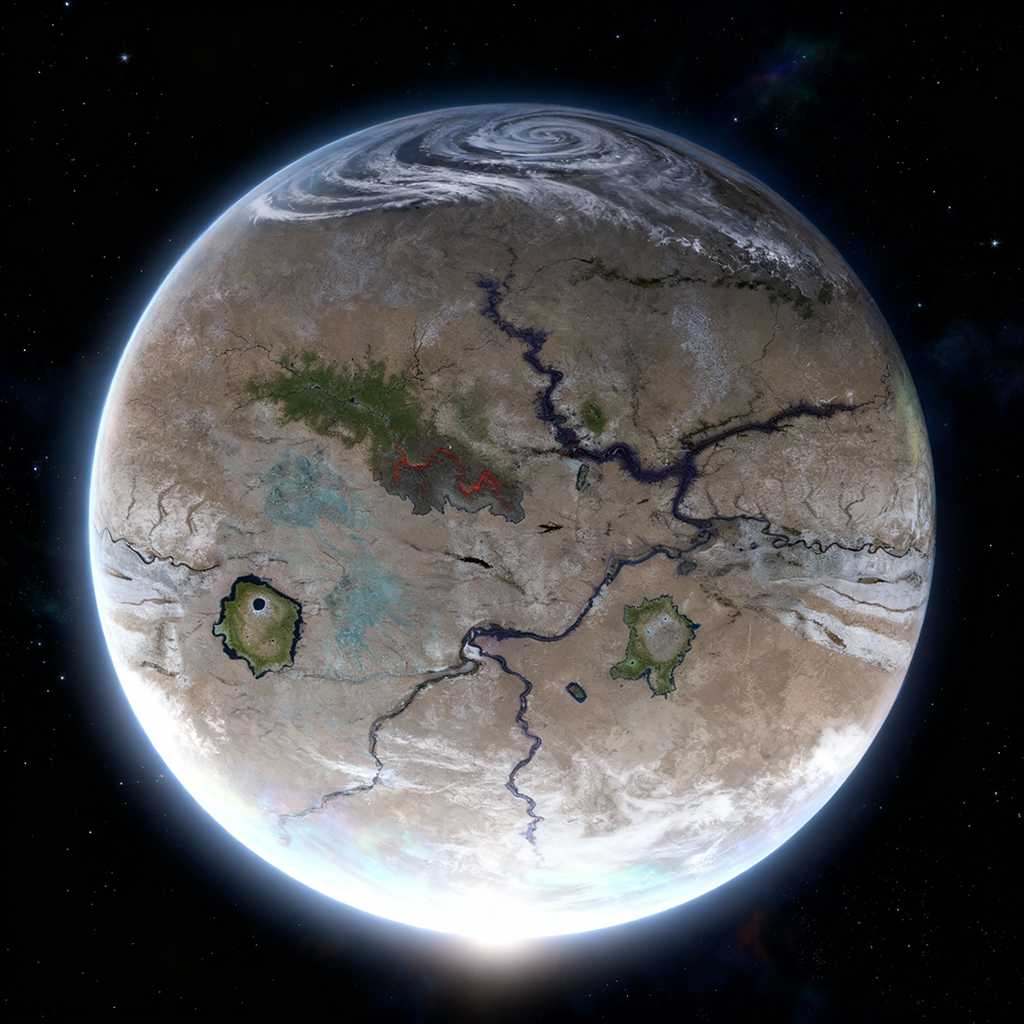
Water and Terrain: Despite its arid expanses, Inca possesses significant water resources, with a Water/Ice Index of 37.56. Water is concentrated in a network of vast lakes, meandering rivers, and occasional inland basins that are critical to both settlement and agriculture. These waterways create narrow belts of fertile land that contrast starkly with the surrounding arid plains and barren uplands. From orbit, green zones encircle the lakes and rivers, forming natural hubs of life and cultivation in an otherwise dry environment.
Colonial Development
Inca’s colonization was a strategic move by Keo Terra Interstellar, driven by the planet’s potential for agriculture and its proximity to the central world of Keo Terra. Early settlers established domed habitats, irrigation systems, and atmospheric regulators, laying the groundwork for the lush agrarian belts that now define the world. Over time, it evolved into one of KTI’s key economic contributors and cultural anchors.
Urban Centers
Ardas: The capital city of Inca, Ardas is both political hub and cultural heart. Its shimmering white towers are equipped with climate-regulated shells and vast cooling ducts that vent heat into upper atmosphere layers. The city hosts the planet’s central government, trade halls, and embassies, making it the most influential metropolis outside Keo Terra itself.
Jordas and Ghendi: These twin megacities dominate industrial and agricultural sectors, respectively. Jordas oversees mining and atmospheric engineering, while Ghendi’s sprawling hydroponic domes supply food across the KTI Core. Both cities are connected via orbital elevators and subterranean transport grids linking them to the planet’s ports.
Economy and Industry
Agriculture forms the foundation of Inca’s economy, supported by mineral extraction and tourism. Genetically enhanced crops and livestock are cultivated under extreme conditions, supplying food to KTI’s colonies. Mining operations in the highlands extract valuable silicates and ores. Tourism flourishes around the planet’s lakes and historical ruins, attracting visitors from Keo Terra seeking warmth and recreation.
Conclusion
Inca embodies adaptation through ingenuity — a planet of intense heat transformed into a vital artery of sustenance and culture. Its people’s endurance and creativity mirror the strength of KTI itself, ensuring Inca’s continued prominence among Terran colonies.