

Cestisus
Introduction
Cestisus is the Cetian homeworld and the heart of the Consortium — a fertile, temperate world whose balance of environment and civilization defines the Cetian ethos. Mirroring Terran physiology but guided by divergent philosophies, the Cetians built a civilization grounded in continuity, cooperation, and respect for ecological harmony. Its sprawling river cities, consensus-driven councils, and vast maritime trade networks make Cestisus both the political capital and spiritual hearth of the Cetian people.
Geographical and Environmental Overview
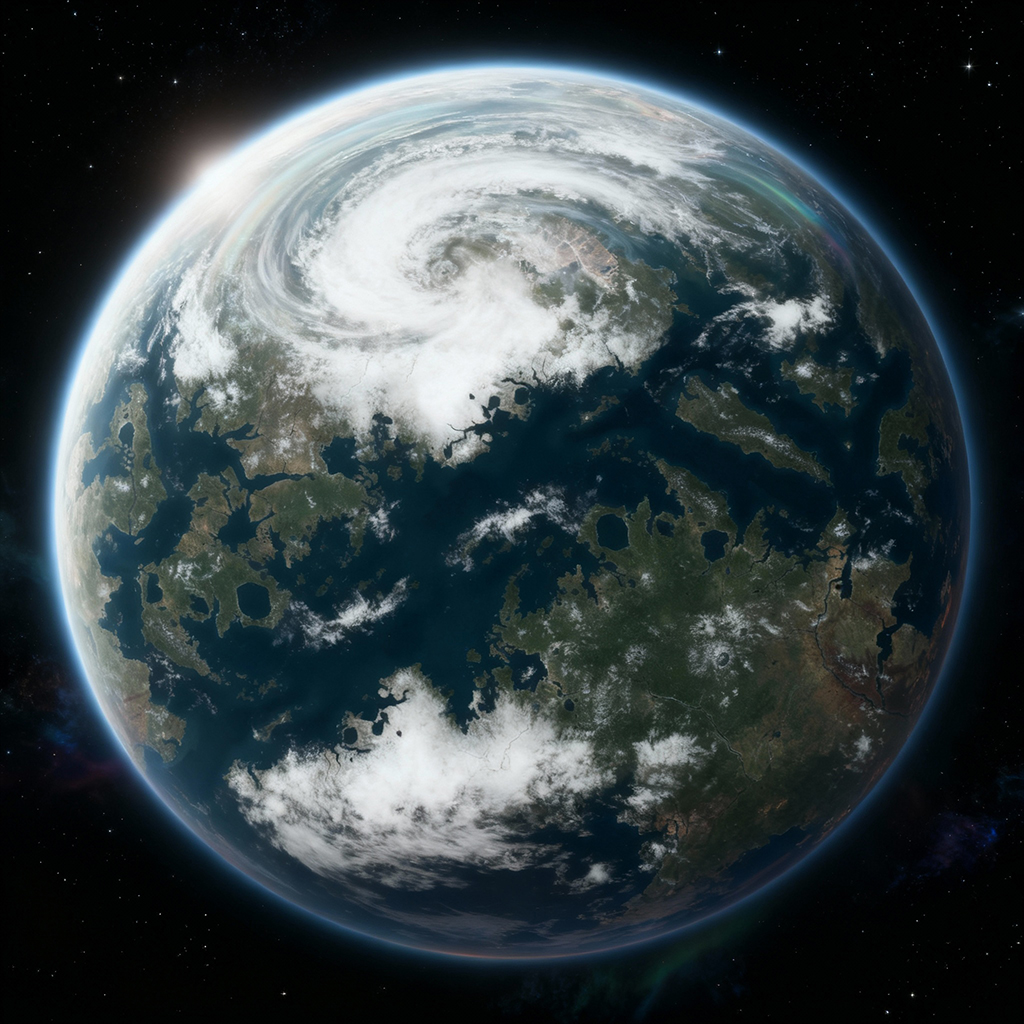
Cestisus is a world of rivers, archipelagos, and forests, its geography fractured by inland seas and lake systems that connect nearly every population center. The planet’s moderate gravity of 0.82G (radius 4,399 km) allows for tall, elegant architecture and expansive bridges linking its islands. Its 79-hour rotation produces long days and lingering nights, shaping both its agricultural rhythms and cultural calendars.
Climate averages 289K (16°C) with a breathable but thin atmosphere of 0.39 atm — clear, crisp air under endless horizons. The hydrosphere covers 49.1% of the surface, not as vast as Terran oceans but composed of intricate inland seas and wide river deltas. Its landscape resembles a world of endless coasts, creating a civilization where water is the unifying element of life and governance.
Biosphere and Ecology
Cestisus supports a complex but balanced biosphere. Its flora dominates the equatorial regions, forming continuous forest canopies over wetland plains. Native plant life evolved under low-atmosphere pressure, producing oxygen-rich spores and broadleaf growth that amplify air quality and visibility. The fauna, while less diverse than Earth’s, is highly specialized — light-boned, long-limbed, and well adapted to thin air and long daylight cycles.
The Cetians’ relationship with their environment is foundational. All urban and agricultural expansion is regulated by the Doctrine of Continuity, a planetary covenant mandating sustainable design, ecological restoration, and minimal displacement. Every city maintains “living reserves” — protected corridors of unbroken wilderness woven directly into its infrastructure.
Urbanization and Society
With a population of 1.34 billion, Cestisus is a mosaic of interconnected city-states rather than a centralized empire. The capital, Cestival, rises along the inner coast of a massive inland sea — a glittering metropolis of vertical gardens, skybridges, and fluid waterways that divide civic, academic, and residential sectors into concentric rings. Beyond it, over forty major cities form a global network linked by sea and maglev corridors.
Smaller communities populate the forested south and high northern tundra, each maintaining autonomy while adhering to shared ecological laws. Cetian society prizes communal governance: local councils deliberate until consensus is reached, and all citizens participate in environmental decision-making. Social cohesion is maintained through education and ritual, where cooperation and self-discipline are considered the highest civic virtues.
Orbital and Space Infrastructure
Cestisus maintains a robust orbital network. The natural planetoid Herias serves as a research and observation station, while the Tanmera Shipyards orbit the equator, assembling the vessels that sustain the Consortium’s exploration fleet. The planet’s delicate ring system — composed of ice and dust — remains a global symbol of beauty and unity, visible from every hemisphere.
Twelve orbital installations circle the planet, balancing civil, defense, and scientific functions. All adhere to Cetian principles of restraint — no installation emits waste or uncontrolled radiation. Energy is drawn from fusion arrays synchronized with Cestisus’s magnetic field, ensuring near-zero planetary interference.
Cultural and Social Life
Culture on Cestisus is rooted in rhythm and reflection. Art celebrates the harmony between human order and nature’s flow: translucent sculpture gardens, floating amphitheaters, and kinetic architecture that moves with the tide. Music follows the “River Cadence,” a traditional mode that mirrors water movement. Public festivals mark the turning of seasons, honoring cycles of birth, harvest, and renewal.
Education is universal and lifelong, emphasizing science, history, and philosophy. Every citizen is taught environmental ethics and practical skills — agriculture, engineering, and diplomacy — producing a population both pragmatic and idealistic. Cetian society measures success not in wealth or conquest, but in continuity — the preservation of balance between civilization and the living world.
Conclusion
Cestisus stands as the living heart of the Consortium — the world where harmony between progress and preservation was perfected. It embodies the Cetian conviction that civilization’s purpose is not domination, but stewardship. Through its rivers and cities, its councils and rituals, Cestisus continues to teach the galaxy that endurance lies not in strength, but in balance.